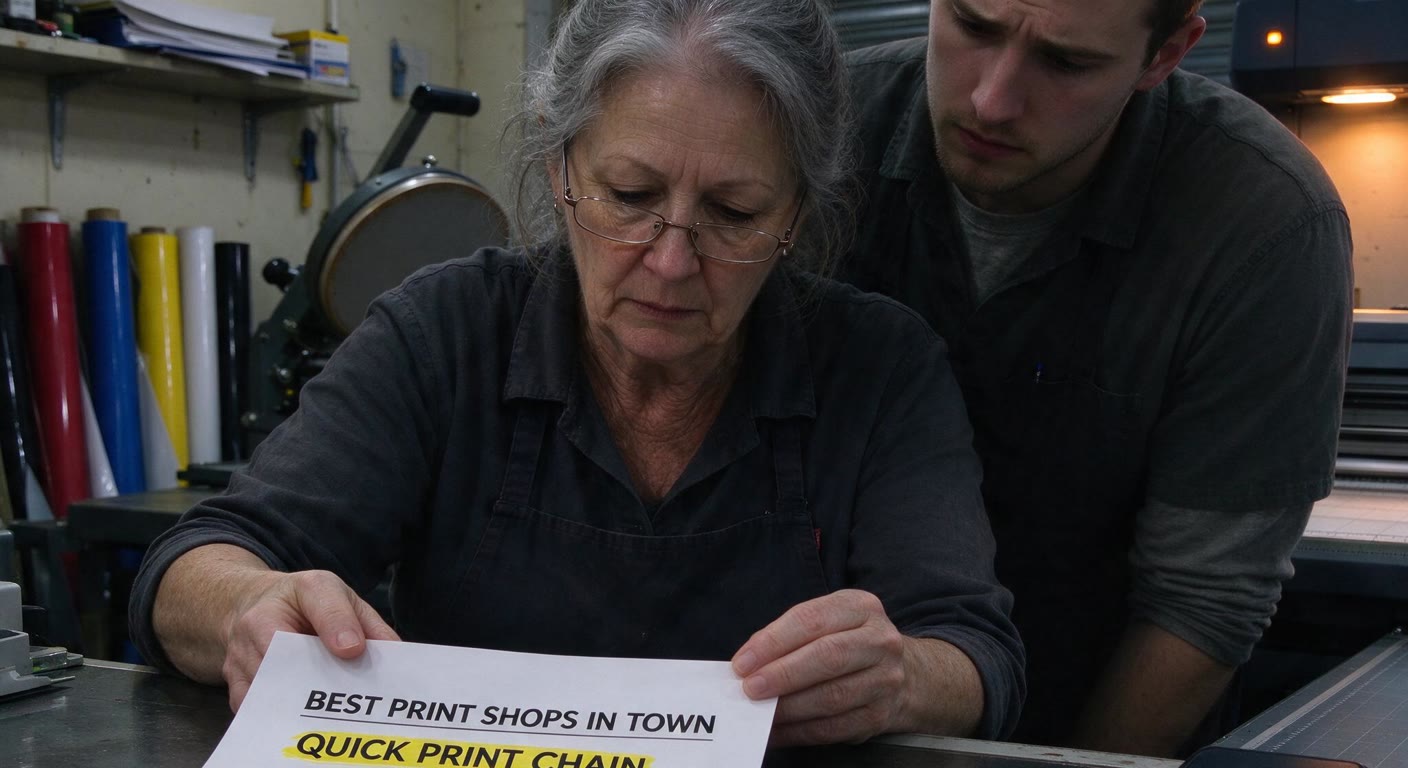
Ask ChatGPT to recommend a printer in your town and watch what comes back. You will get two or three names, confidently ranked, each with a sentence of justification. If you run a print shop, your name will probably not be one of them. It is tempting to read that as a content problem: the pages must be too thin, the service area too vague, the writing not optimised for the way models read. Three researchers tested exactly that reading, and it does not hold up.
Giorgio Monaco, Jacopo Lenti and Francesco Pierri, of Politecnico di Milano, published "The Popular Get More Popular: Auditing Brand Bias in Generative Search" on 6 November 2026. They ran two studies: one that measures what deployed assistants recommend, and one controlled experiment that changes a single page to see what makes it climb. The second one is the part that should change how you spend your marketing budget.
What the 2026 audit measured
The first study is an observational audit of three assistants: gpt-5.5, gemini-3.6-flash and perplexity/sonar, all reached through their APIs. The researchers took 20 real commercial questions per sector across four sectors — insurance, travel, fashion and beauty, and sport — and asked each one four ways: with no buyer profile, and with each of three buyer profiles that describe how someone shops and what they will pay. Each question was asked with the assistant's web search switched on and switched off, ten times, on all three engines. That is 19,200 answers in the sample, covering 1,176 brand names.
Two things about that design matter if you want to trust the numbers. Asking the same question ten times separates a stable preference from random wobble, and running each question with search off isolates what the model already believes from what it just read. The prompts were Italian, issued from Rome, and pinned to a single snapshot in time, so this is a picture of one market on one day rather than a law of nature. The authors say so themselves.
To rank the brands by fame the researchers used something you can check for your own business: how often the name gets searched on Google over twelve months, taken from a commercial keyword provider. A brand's popularity is that number on a log scale. It is not a measure of quality, and that is the point — they are testing whether the assistants are picking the best option or the most-searched one.
The second study is the controlled half. The team took 24 of those questions and built a small gallery around each: five real product pages from five real brands, shown to four models, which had to rank all five and say why. Then, for one of the five pages — the one sitting mid-table — they changed exactly one thing and re-ran the ranking, 38,400 times in total. Same five pages, same order of presentation, same question. Only the manipulated page differed.
How big the gap is, in numbers
Start with the observational half, because it establishes the size of the problem before anyone proposes a fix. Measured across the whole sample, the share of answers that mention a brand climbs steadily with how often that brand is searched for. In the least popular fifth of brands it sits below 1% of answers. In the most popular fifth it reaches between 1.2% and 5.3%, depending on which assistant you ask.
Put differently, a brand in the top fifth of fame is mentioned and cited between 1.4 and 2.8 times as often as the average brand in its engine and sector. And the pattern is not an artefact of one bad model or one unlucky sector: the link between fame and mentions is positive and holds in 23 of the 24 engine-and-condition combinations they tested, with the single exception being Perplexity on travel questions with search off.
Here is the finding that should make you sit up. If the bias were an artefact of stale training data, switching the live web search on should dilute it. It does not. A brand that gets searched ten times more often on Google turns up in 0.87 more answers out of every 100 when the assistant works from memory alone, and in 0.89 more when it reads the live web. The difference is two hundredths of an answer — statistically indistinguishable from zero.
There is a mechanism behind that. On the assistant that exposes its search steps, the team could see the query it writes before it reads anything. In travel, the share of mentioned brands whose name already appears in that very first query rises from 7% in the least famous fifth to 45% in the most famous fifth. The model looks for the names it knows and then finds pages about them.
| What the audit measured | Least-known brands | Best-known brands |
|---|---|---|
| Share of answers that mention the brand | under 1% | 1.2%–5.3% |
| Mentions and citations vs the average brand | below average | 1.4×–2.8× |
| Name already inside the assistant's first search query | 7% (travel) | 45% (travel) |
| Effect of switching live web search on | +0.02 answers per 100 (no measurable change) | |
None of this says the assistants are corrupt or that the big brands paid their way in. It says that in a market where an assistant answers with three names instead of ten links, the head start a known name already has gets amplified rather than levelled out. That is uncomfortable for anyone who assumed the new search would be more democratic than the old one.
Why rewriting your own pages barely moves you
This is the experiment worth reading twice. The team took the page sitting in the middle of the five, kept the brand that signed it, and rewrote the text three ways: one version that puts the decisive information first and uses headings and lists, and two that follow the "fluency" and "authoritative" methods from the best-known generative-search paper. A strong model did the rewriting, and a different model checked that no fact had been added or removed and that the length stayed within 15% of the original.
The result: a rewritten page moves by +0.02 positions on a scale of one to five. That is no improvement at all, and the confidence interval rules out anything above 0.05. Reordering your page for the machine buys you essentially nothing.
Change the name instead, with the text untouched, and the same page moves. Signed by its true brand rather than an invented one, it climbs 0.44 positions — from an average rank of 3.65 to 3.21 out of five. Keep the true brand but invent the product name and it drops 0.14. And this is the detail that should end the debate about what fame means here: a real but less familiar brand still lifts the page 0.19 positions above a completely invented one. It is not that the model is loyal to the market leader. It is that the model treats a name it has met before as safer than a name it has not. Switching the signature gains 0.42 positions more than rewriting the entire page.
Contrast that with the 2024 paper that launched the whole field. Aggarwal and colleagues reported that tactics like adding citations, quotations and statistics could raise a source's visibility by up to 40%, measured on their own benchmark and on Perplexity. The 2026 authors ran the same family of rewrites under one extra constraint — preserve every fact — and got a rounding error. Both can be true: their rewrites did not invent statistics or claims, and the gains in the earlier work came partly from adding evidence a page did not have.
Run the arithmetic on a real budget. A ten-person firm pays an agency 450 a month — 5,400 a year — for four "AI-optimised" pages a month. According to the experiment, that work moves the firm 0.02 places out of five. In an answer that names three companies, it does not enter the answer at all; it stays invisible while the invoice renews.
Send the same 5,400 at the variable that did move the page — being named by someone the model already trusts — and you buy something with a chance of working: five listings on existing "best in town" roundups and a couple of trade-press mentions. Neither is guaranteed. One is aimed at the lever, the other at decoration.
If you have been invoiced for "optimising your content for AI", that invoice was for a lever the evidence says is nearly weightless. The honest version of that service is a conversation about where your brand is named, or it is nothing.
Where the lever actually is: being named by someone else
The Milan team's own conclusion points the way. They write that fact-preserving rewrites yield marginal returns, and that a new provider may gain more from becoming known in the web sources that models learn from and retrieve. Two other studies make the same point from different angles.
A team at the University of Toronto compared how AI answers and Google pick their sources. AI answers, they found, lean systematically toward earned media — third-party publications, reviews and roundups — over a brand's own pages and over social posts, in a way Google does not. In their tests, major brands took 56.3% of the brand mentions across ChatGPT answers they examined and 67.9% across Perplexity's; niche brands took 12.3% and 5.8%. The assistants are not refusing small brands. They are reflecting who has been written about.
The third study explains why being written about is so decisive. Chu and Hou put well-known and unknown brands head to head with identical product specifications and found the known brand recommended in every one of 670 valid trials — total dominance. Then they gave a competitor a 0.075-star rating advantage, a rounding error of a quality difference, and the monopoly collapsed. Once any quality signal exists, the brand name explains only 1.2% of the ranking variance. The lesson is not that fame is unbeatable. It is that fame is what a model falls back on when nothing else separates you.
That also kills the tidy hope that everyone can win this game by optimising. When all nine fictional brands in that experiment adopted the same authoritative language, the individual payoff fell from +0.802 to +0.007. The advantage existed only while it was rare.
One more number, from the Milan audit: of the mentions they could check against the sources the assistant returned, 36.2% appeared only on third-party pages. Your business can be named in an AI answer without a single link pointing at your site. Getting named on other people's pages is not a second-order SEO tactic here. It is the main channel.
So what does that mean for the owner of a five-to-fifty-person business with no marketing team? A short sequence, in this order:
- Ask the assistant your buyers' questions, not your own. Open a fresh session, use the phrasing a customer would type, and run the same five questions on three different days. One answer is a sample of one, and these systems wobble.
- Write down the pages the assistant cited instead of you. Those are the pages that decide your category. They are almost always lists, comparisons and reviews, not your competitors' homepages.
- Work down that list and ask to be on it. Contact the author of each roundup with one line on what you do, who for, roughly what you charge and one verifiable result. If a page describes you wrongly, send the correction.
- Settle your identity. One canonical business name, one one-sentence description, the same address, phone and category on your site, your profile on the map apps, your trade directories and your review profiles. An assistant has to decide these all describe one business before it will name any of them.
- Get one independently written page that names you and a person who works there. A trade-press story, a local news item, a supplier's case study on their own domain. One of those is worth more than another four posts on yours.
Budget it honestly. Steps 1 and 2 are two afternoons. Step 3 is a standing monthly task, not a campaign: two hours a month spent pitching three roundups and following up beats a fortnight of rewriting. Step 4 is a one-off clean-up that most firms can finish in a week. Step 5 is slow, and that is the nature of it. Becoming a name the model has met is not a thing you publish; it is a thing that accumulates.
This is the part of the work we do with an agent whose whole job is finding the places your category is already being discussed, rather than the places you have already written about.
When this is not worth doing
There is a genuine exception in the data, and it is worth more than most of the advice above. When the researcher put a buyer profile in front of the question — someone with a stated budget, stage of life and attitude to price — the preference for famous names weakened. The slope of mentions against fame fell from 0.98 with a bare question to 0.80 with a price-focused profile, a change the authors say is real rather than noise. Their explanation is simple enough: a constrained question forces the assistant to match a business to a stated need instead of reciting the best-known names in a category.
So the shape of the question decides how much the incumbents own. If your buyers type "best accountant", the famous names take it. If they type "accountant for a two-person design studio that bills in euros and dollars", the assistant has to look for a fit, and a specialist can be that fit. That is an argument for making the constrained version of the question answerable on your own site — the price band, the service area, the kind of client you take — rather than for another round of rewriting.
Three cases where you should skip all of this deliberately:
If your customers never put a question to an assistant, none of this touches you yet. A machining shop whose order book runs on three long-standing buyers and a tender process does not lose work to ChatGPT, and spending a quarter on AI visibility there is money set on fire. Check before you invest: ask ten of your last customers how they found you.
If the plan is to publish a page for every phrasing of the question, stop. Google treats pages made mainly to manipulate its AI answers as scaled content abuse, and a hundred thin variants of the same page is the pattern the policy names. The measurements here do not support it either.
And if the shortcut you are considering is signing pages with a better-known brand's name, the researchers ran that experiment and said plainly what it is: impersonation, which they neither recommend nor tested in the wild. It works in a laboratory and is a legal problem in a market.
What these numbers do not prove
Read the findings as a mechanism, not as constants. The audit was run on Italian prompts issued from Rome, pinned to a single snapshot in time. The authors flag this themselves: model outputs drift with updates and with location, and a brand that is unfamiliar to a model trained mostly on English content is a different case from the one a reader in Milan faces. Treat the direction as the durable part and the exact multipliers as a reading from one afternoon.
The controlled experiment, the one that produced the +0.44 and the +0.02, ran with the models' live web search switched off. That was deliberate — it is the only way to change one variable cleanly — but it means the experiment isolates the model's stored preference rather than reproducing a consumer chat window, where retrieval and re-ranking also act. The models were queried through APIs, which can omit the extra system prompts the public apps add.
Two smaller cautions. The study counted mentions and citations, not sentiment, so it tells you nothing about whether being named is flattering or damaging. And when a separate model was handed the manipulated page with every name stripped out, it still guessed the original brand 38% of the time, which sets the ceiling on how clean the brand-swap test can be.
What survives all of that is the ordering of the levers. It is the name, not the prose. The person who signs a page and the people who write about it carry far more weight than how the paragraph is arranged. If you take one thing from a 19,200-answer audit, take that one.
Frequently asked questions
Does AI search only recommend big brands?
No, but it tilts hard toward them. In the Milan audit every engine and nearly every sector showed a positive link between how often a brand is searched for and how often it is named, and the best-known fifth of brands appeared between 1.4 and 2.8 times as often as the average. In the Toronto sample, niche brands still took 12.3% of brand mentions on ChatGPT and 5.8% on Perplexity. It is a strong bias, not a closed door, and it is strongest on the vague questions.
So is optimising my own pages for AI search a waste of money?
Pay for clarity once, then stop. A page has to state plainly what you do, where and for whom, or an assistant cannot match you to a question at all — that is the difference between being eligible and being invisible. What the experiment found weightless is paying, repeatedly, to restyle pages that already say the right things: rewrites that kept every fact moved the page 0.02 places out of five.
How do I check whether an assistant already knows my business?
Open a fresh chat, ask the questions a buyer would ask without naming yourself, and repeat on three different days. Write down who gets named and which pages are cited. A single run says almost nothing, because the answers vary between sessions, and a business that appears once may not appear the next time. The pattern over a month is the signal.
Do I have to pay to be listed on the pages assistants cite?
Rarely, and you should be cautious when you are asked to. The roundups that get cited are usually written by a publication or a trade site with an editorial owner, and the honest approach is to send that author accurate information and a reason you belong on the list. Paid placements dressed up as editorial are exactly the pattern Google's spam systems act against, and they tend not to survive the next refresh of the page.
How long before I get named in AI answers?
There is no schedule in the research, and anyone who gives you one is guessing. The studies show what the assistants weigh, not how fast a new name becomes familiar. The workable substitute for a promise is a routine: the same set of buyer questions every month, and the share of answers that name you, tracked over quarters rather than days.
Is your business a name the assistants have met?
We build sites and run AI agents for small firms, and one of them spends its time finding the places your category is already being discussed and getting you mentioned there. Send us the questions your customers ask and we will tell you where you stand today and what to fix first.
Ask us to check your AI visibility