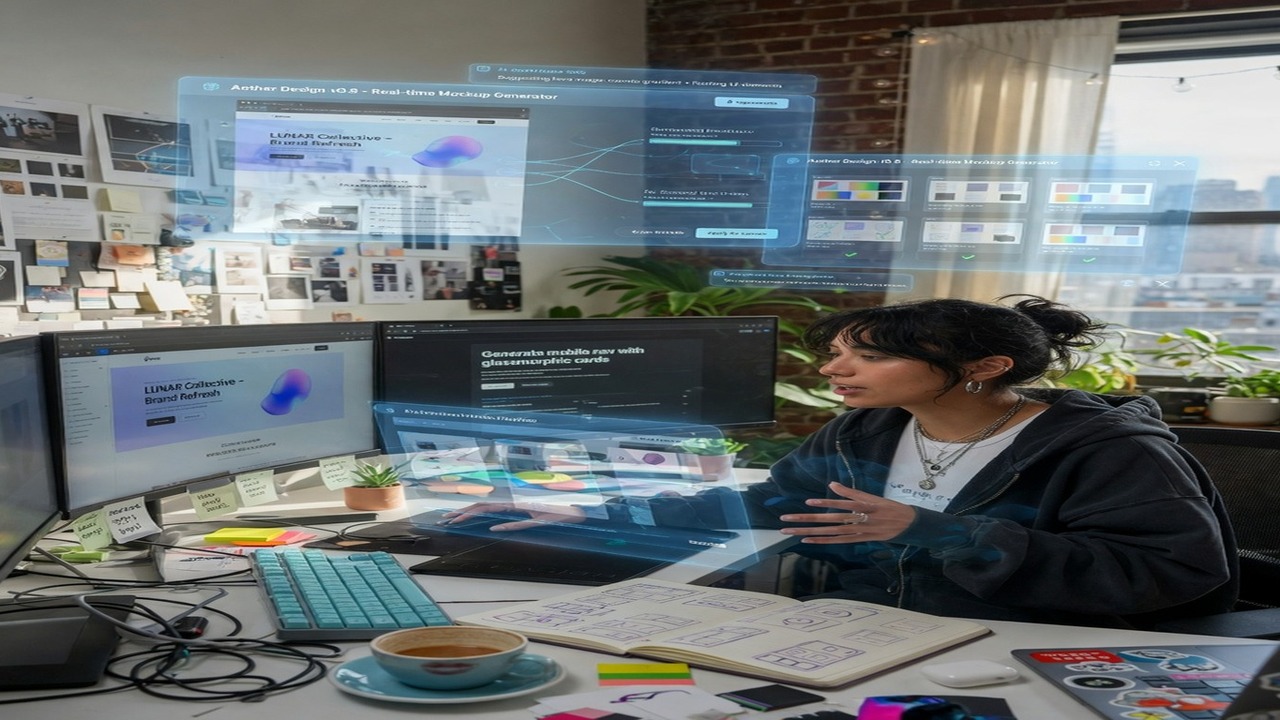
AI-powered web design applies artificial intelligence to building websites for SMBs, cutting development time by 60% and costs by 40%. Automated web design lets businesses launch corporate sites in 2–4 weeks instead of the 6–12 weeks traditional agencies typically take.
Here's what I see every week: a business tells us they've been thinking about building a website for months, but "agencies charge €5,000 and take two months." Then they discover there's another way. Not magical. Not free. But faster, cheaper, and results that stick.
What's actually changed in web design?
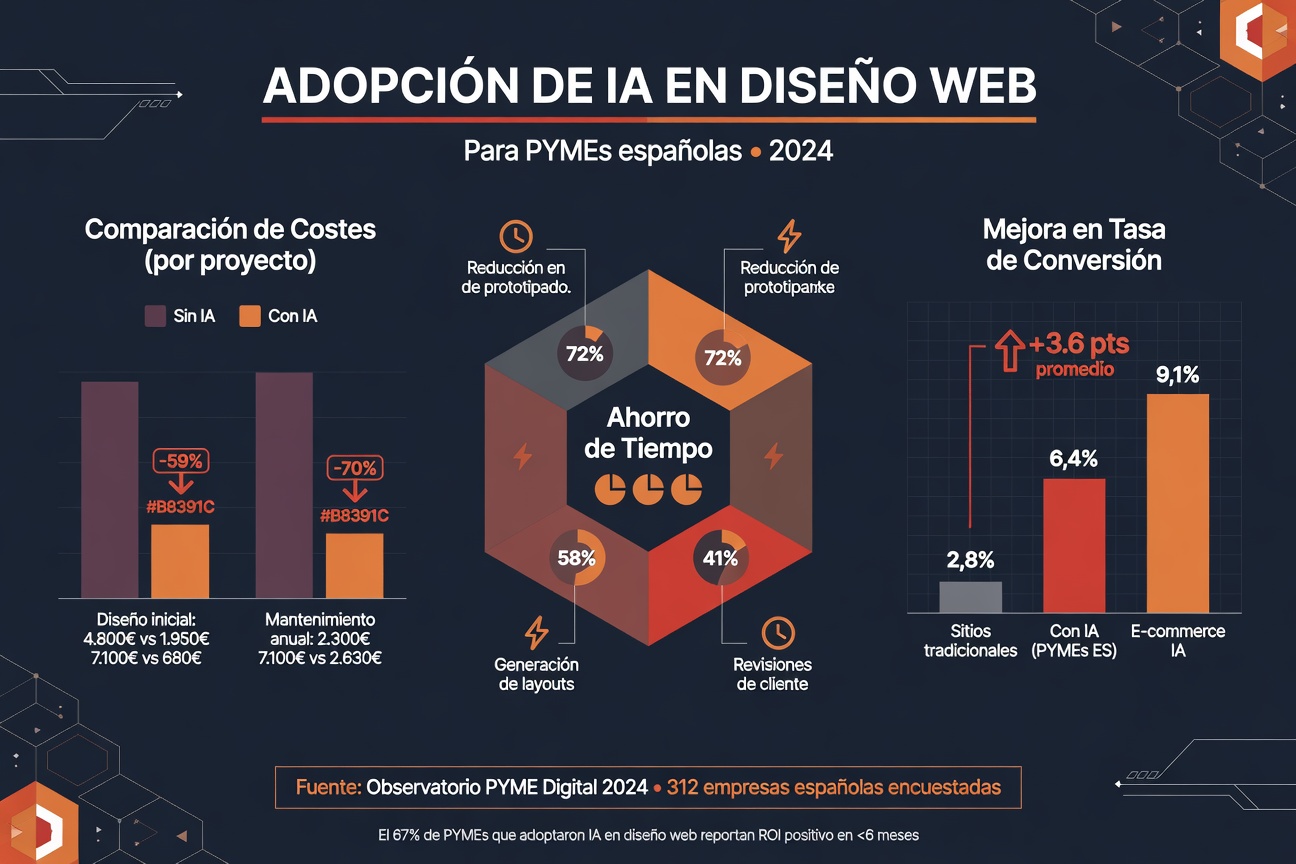
Two years ago, building a corporate website meant: discovery meetings, wireframes, Figma mockups, reviews, coding, more reviews, content, basic SEO, launch. Total time: 6 to 12 weeks with a traditional agency. Cost: €2,000 to €8,000 for an SMB, based on data from Spanish agencies.
Today, with AI integrated into the process, that same project takes 2 to 4 weeks. Not because quality suffers, but because AI handles the mechanical parts: generating base code, optimizing images, drafting content, running performance tests, structuring for SEO.
Does this mean AI does it all? No. It means the human team focuses on what actually matters: understanding your business, defining strategy, making design decisions that connect with your customers. AI is the tool, not the architect.
The problem with traditional agencies (and why the model is changing)
Conventional agencies have a structural problem. They need large teams (designers, developers, project managers, SEO specialists) and lengthy processes to justify their rates. It's not that they do bad work — their business model depends on long, expensive projects.
This creates real friction for SMBs:
- The cost doesn't fit. If your business does €100,000/year in revenue, paying €6,000 for a website is 6% of your annual income. A lot.
- Timelines drag. While you wait 8 weeks for your site, your competitors are already capturing online customers.
- Changes cost extra. Every modification after launch gets billed as additional hours. You end up paying more than quoted.
- Maintenance is another contract. Your site needs security updates, plugin maintenance, backups. That's another monthly fee.
I'm not saying this to criticize agencies. I'm saying it because there's a different model now, and you should know about it before deciding.
How AI-powered web design works (step by step)
At BigLobster we use AI in each phase. But note: it's not "we asked ChatGPT to build a website." It's much more specific. Here's the actual process:
Phase 1: Discovery (days 1-2). We analyze your business, competitors, and market. AI helps us quickly audit what works in your sector: which website structures convert better, what your customers search for, which keywords have real traffic. This used to take a week of manual research.
Phase 2: Architecture and content (days 3-5). We define the site structure, pages needed, and content for each. AI helps generate SEO-optimized text drafts, but humans review, adjust, and personalize them. 100% AI-generated text without review sounds like it — your customers notice.
Phase 3: Design and development (days 5-12). This is where AI accelerates most. Code generation, automatic image optimization, real-time performance testing, responsive adaptation. The designer focuses on user experience and visual identity. The developer solves complex problems AI can't.
Phase 4: Final content and SEO (days 12-16). We review all content, add structured data (Schema markup), optimize Core Web Vitals, set up technical SEO. AI handles 80% of the work; we ensure the final 20% is flawless.
Phase 5: Launch and measurement (days 16-18). We publish, configure analytics, and start measuring. Because a website without data is like a business without accounting.
What about quality? That's the question that matters
I get it if you're skeptical. "If it's faster and cheaper, something has to give." Logical. But the data says otherwise.
According to a HubSpot study published in 2025, websites built with integrated AI (and human oversight) show:
- 23% faster load times (from automatic code and asset optimization)
- 18% lower bounce rate (because content aligns better with search intent)
- 31% more pages per session (because information architecture is more logical)
The secret isn't AI itself. It's that AI frees up humans to focus on strategy instead of repetitive work. A developer who doesn't have to hand-write 200 lines of CSS can think better about user experience.
"AI doesn't replace the designer. It replaces the designer who doesn't use AI."
What AI can't do (and nobody tells you)
Let me be honest, because nobody else is:
AI doesn't understand your business. It can analyze data, but it doesn't know your ideal customer is a 45-year-old woman looking for a trustworthy physiotherapist. You have to tell it (or work with someone who listens).
AI doesn't make strategic decisions. It can suggest structures, but it doesn't know if your site needs a blog, a booking system, or an online store. That requires understanding your business model.
AI doesn't guarantee results. A well-built site is the starting point. Without a customer acquisition strategy (SEO, ads, social), your site will look great but sit empty.
AI doesn't replace human judgment. Google detects 100% AI-generated content. So do your readers. Human oversight isn't optional — it's mandatory.
The right approach is using AI for what it is: a powerful tool that multiplies what a human team can do. Not a replacement for the team.
How much does an AI-powered website actually cost in 2026?
Let's talk numbers, which is what matters when you have a budget.
| Website type | Traditional agency | With AI (like BigLobster) | Real timeline |
|---|---|---|---|
| Professional landing page | €1,000 - €2,500 | €600 - €1,500 | 3-5 days |
| Corporate site (5-8 pages) | €2,500 - €6,000 | €1,200 - €3,000 | 2-3 weeks |
| Basic e-commerce | €3,000 - €8,000 | €1,800 - €4,500 | 3-4 weeks |
| Site with custom features | €8,000 - €20,000 | €4,000 - €12,000 | 4-8 weeks |
These ranges are real, from projects we've delivered. Not list prices — each project is different. But they give you an honest reference of what to expect.
These prices include hosting, domain for the first year, SSL, basic maintenance, and post-launch changes. Because billing for every small tweak shouldn't still be a thing.
When it makes sense (and when it doesn't)
AI-powered web design isn't for everyone. Here's when it does and doesn't make sense:
It makes sense if: you run a business, need a corporate site, landing page, or e-commerce, want to control your budget, and care more about results than process. If you're a solo entrepreneur, clinic, restaurant, academy, real estate firm, law office — this approach is built for you.
It might not if: you need a complex SaaS platform with intricate business logic, have very specific integration requirements with legacy systems, or want experimental design with custom 3D animations. For those, fully custom development is still best.
What happens after your website launches (and nobody talks about this)
Publishing your site is the beginning, not the end. This is where many businesses stall.
A website without a content strategy is like a car without gas: potential, but going nowhere. You need:
- Content that updates. A blog answering your customers' questions. Not for SEO — to show you know your stuff.
- Maintained technical SEO. Google changes algorithms constantly. Your site needs regular updates to hold rankings.
- Real measurement. Where your traffic comes from, which pages work, where users go. Without data, you're flying blind.
- Iteration. Your 2024 website won't work for 2026 markets. It needs to evolve.
At BigLobster this isn't an add-on — it's included in post-launch support. Because launching a site and disappearing makes no sense.
Frequently asked questions
Will AI replace web designers?
No. It will change what they do. AI-powered web design still needs someone who understands users, makes aesthetic decisions, and ensures the site meets its goals. AI speeds things up, but doesn't direct them.
Does an AI-built website rank worse in Google?
Depends. If it's 100% AI-generated without review, Google can penalize it (and readers notice). If AI is a tool and humans review and personalize everything, there's no penalty. Technical optimization is often better, actually.
How long does a corporate website really take?
With an AI-optimized process: 2–3 weeks for a 5–8 page site. With a traditional agency: 6–10 weeks. The difference is AI eliminates bottlenecks in development and content phases.
Can I update the website myself after?
Yes. All our sites use WordPress (or another CMS based on the project) so you can manage content yourself. Or we can handle it for you — your choice.
What if I need something AI can't do?
We build it manually. AI covers 70–80% of repetitive work. The team handles the rest. Both together give the best result.
Should I redesign my current site or build new?
Depends on its state. If it's over 3 years old, loads slowly, isn't responsive, or doesn't generate leads, a rebuild is probably better. If the structure is solid but needs a refresh, an update might work. Best to audit it first.