
Exactly what this GEO thing is
Imagine a potential customer isn't searching on Google. They're on ChatGPT asking: "What's the best web design agency for SMBs in Madrid?" or on Perplexity asking "What company can do AI automation for me in less than 2 weeks?".
The AI gives an answer. And in that answer there are between 2 and 7 sources. No list of 10 blue results. No scrolling. Your brand is either in that answer or simply doesn't exist for that customer.
This is called GEO: Generative Engine Optimization. Researchers from Princeton and Georgia Tech coined the term in 2023 (arXiv:2311.09735) and it's become one of the most searched words in the sector. In Spanish, barely anyone explains it well for SMBs. Let's try.
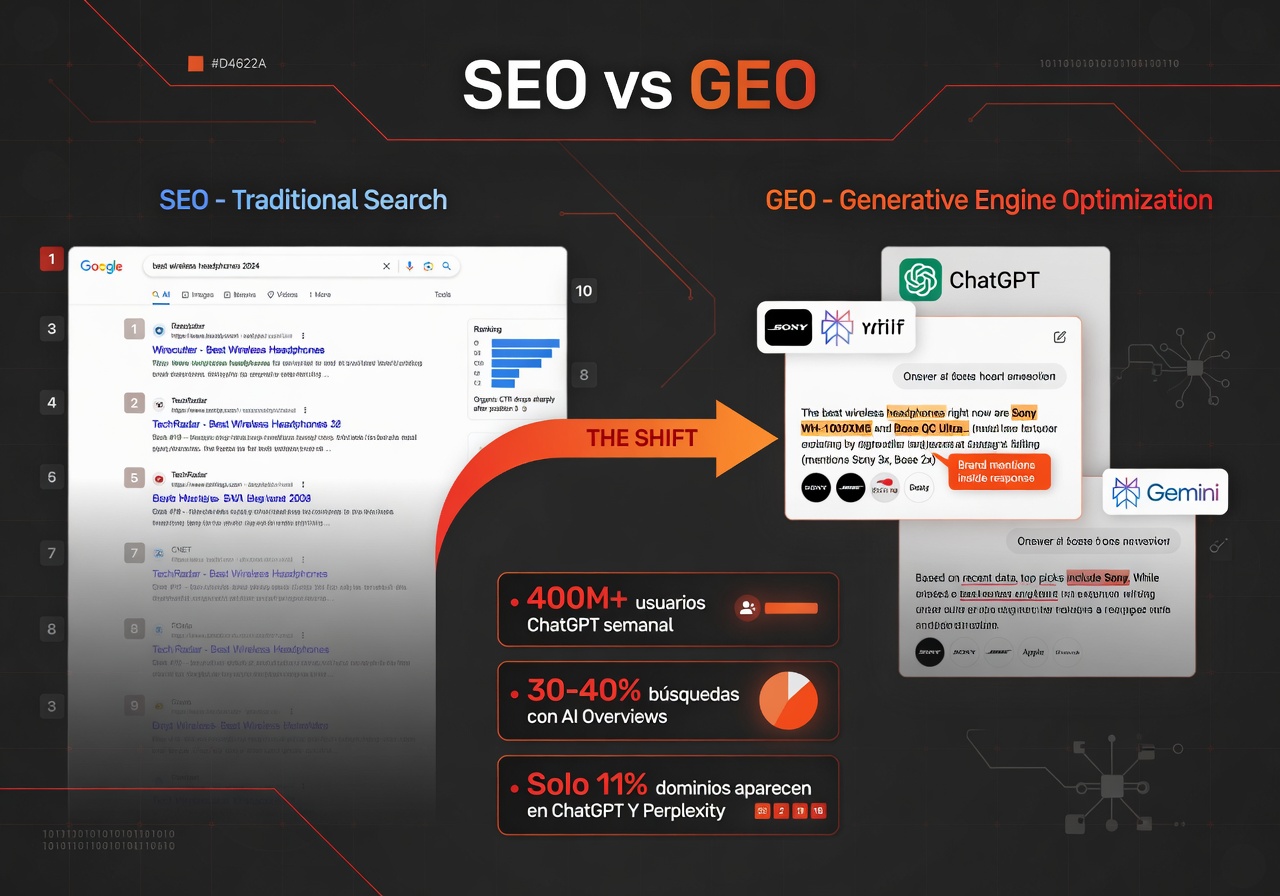
SEO vs GEO: the difference that changes everything
If you've been working on your website SEO, you have an advantage. But it's not enough. The logic is different.
| Traditional SEO | GEO (AI engines) | |
|---|---|---|
| Goal | Appear high in 10 results | Be cited within the AI's answer |
| User action | Scroll, compare, click | Read the answer and that's it |
| Your competition | 9 other results | 2-6 sources in the answer |
| Key metric | Ranking + CTR | Share of Voice in responses |
| Source | Google, Bing | ChatGPT, Perplexity, Gemini, Claude |
A finding from the Princeton study that changes everything: 44% of ChatGPT's citations come from the first 30% of the page's content. Not from the conclusion, not from the final summary. From the beginning. If your best points are at the end, the AI skips them.
ChatGPT, Perplexity, Gemini and Claude don't work the same
Each AI engine has its own search system and its own preferences. Optimizing for all four at once is impossible, but you can do things that work across several.
ChatGPT (Bing + GPTBot)
ChatGPT uses Bing as the underlying search engine. If you don't appear in Bing Webmaster Tools, you basically don't exist for ChatGPT. Its crawler is GPTBot, and it carries 27% of what Wikipedia cites. Wikipedia is the number-one source. Domains with strong E-E-A-T signals (authority, experience) have direct advantage.
Pages with First Contentful Paint under 0.4 seconds get 3 times more citations in ChatGPT. Speed matters more than you think. If your site takes over 2 seconds to load, you're losing visibility in both traditional searches and AI.
Perplexity (its own index, prioritizes freshness)
Perplexity is the fastest-growing engine (388% year-over-year) and works differently: it prioritizes recent content over domain authority. This is a huge opportunity for SMBs: 85% of URLs Perplexity cites have under 50 backlinks. You don't need 10 years of authority to appear.
Content updated in the last 7 days is 5 times more likely to be cited in competitive topics. Perplexity also loves "best X" content and comparisons.
Gemini (Google Knowledge Graph)
Gemini has direct access to Google's Knowledge Graph. If Google doesn't recognize you as an entity (with address, sector, coherent description), Gemini has less chance of mentioning you. Here, good traditional SEO gives you immediate advantage.
Claude (Brave Search)
Claude uses Brave as its search engine. It's the least known but usage tripled in the Spanish-speaking market. Its crawler is ClaudeBot, and it especially values technical and academic sources with verifiable citations.
The 7 patterns that increase your AI citations
These patterns come from analyzing over 2,200 real citations to Spanish domains studied between December 2025 and February 2026, combined with findings from the Princeton study (arXiv:2311.09735), the most cited in the sector. It's not theory: these are things that work measurably.
1. Direct answer at the start of each section (answer capsule)
After each H2, the first paragraph should answer the implicit question in the least amount of words possible, between 120-150 characters. Princeton calls this an "answer capsule" and it increases citation rate by 24%. Think of it as a featured snippet, but shorter and more direct.
2. Cite authoritative external sources (+40% per Princeton)
The number-one method from the Princeton study: you can increase your visibility in generative engines 40% by citing verifiable sources. If you claim "67% of Spanish SMBs plan to invest in automation," link to the Zulu Labs report. The AI reads your sources as a trust signal: if you cite well, you're a good source.
3. Numerical data and statistics (+35-40% per Princeton)
LLMs prefer content with concrete data over vague claims. Every section should include at least one quantified figure. Instead of "many companies automate," put "67% of Spanish SMBs plan to invest in automation in 2026 (Zulu Labs)." The difference in probability of being cited is 35-40%.
4. Keywords no, entities yes
Keyword stuffing, those practices of cramming keywords that Google penalized, reduces your visibility in generative engines by 10%. What does work: using named entities clearly and consistently (your company name as written, your sector, your location, your value proposition). Pages with 15+ recognized entities are selected 4.8 times more than those with few.
5. Properly implemented schema markup
LLMs read schema more literally than Google. Article, FAQPage, Person and Organization types are most relevant. Content with correct schema is 2.5 times more likely to appear in AI responses. Combine multiple types (Article + FAQPage + Organization) and citations increase 25-55%.
6. Permissive robots.txt for AI bots
If your robots.txt blocks AI crawlers, you don't exist for them. You need to explicitly allow: GPTBot (OpenAI) ClaudeBot (Anthropic) PerplexityBot (Perplexity) Google-Extended (Google AI Overviews) and CCBot (Common Crawl, feeds multiple LLMs). Every web design company we work with at BigLobster has this configured from day one.
7. Real E-E-A-T, not decorative
96% of AI Overviews citations come from sources with strong E-E-A-T signals. In 2026, authority stopped being a ranking factor and became an entry filter: without clear signals, your content simply isn't eligible. That means: visible author with real name, background and photo; "About us" page with concrete data (not a generic phrase); publication and update dates an LLM can parse; mentions in external media, LinkedIn, sector forums.
"The difference between what works in GEO (+40% citing sources) and what hurts (-10% with keyword stuffing) is 50 percentage points. GEO requires a radically different approach from SEO from 10 years ago."
Based on Princeton & Georgia Tech study (arXiv:2311.09735, updated with Ahrefs 2026 data)The technical stuff that matters: set this up today
Setting content aside (which is most important), there are three technical things you should review if you want AI engines to find you:
1. robots.txt with access for AI bots
In your robots.txt file, add these user-agents as allowed:
GPTBotOpenAI (ChatGPT)ChatGPT-UserChatGPT navigationClaudeBotAnthropic (Claude)PerplexityBotPerplexity AIGoogle-ExtendedAI Overviews and Gemini
2. Schema markup specific to AI
Implement Organization or ProfessionalService with full address, sector, service area. Add Article on each post with author, publication date and modification date. Add FAQPage on FAQ sections. Validate everything with Google Rich Results Test.
3. Loading speed (FCP under 0.4s)
Pages with First Contentful Paint under 0.4 seconds get 3 times more citations in ChatGPT. Optimize images, minimize JavaScript, use a CDN. If your site takes over 2 seconds to load, you're losing visibility to AI.
How to know if AI is already mentioning you (spoiler: it's not easy)
Unlike Google, there's no Search Console for generative engines. Yet. Professional tools like Profound, Otterly or AthenaHQ monitor mentions from plans starting €30-50/month. But for an SMB, you can do it manually:
Every first Monday of the month, open ChatGPT, Perplexity and Claude in a clean session (no history) and ask exactly as a potential customer in your sector would: "best [your service] in [your city]," "[your service] for SMBs in Spain." Note if you appear, in what position, what context it puts you in, and who else is in the response. It's a 20-minute exercise that gives you information your competition doesn't have.
You can also check Google Analytics 4 filtering by source=chatgpt.com source=perplexity.ai or source=claude.ai. If you're getting traffic from there, AI is already citing you with a link and people are finding you.
GEO for local SMBs: your biggest opportunity
Paradoxically, GEO favors local SMBs more than big global brands. Queries like "best employment lawyer in Seville" or "emergency electrician in Zaragoza" have very few possible answers. Appearing there is easier than ranking for "employment lawyer".
If you own an SMB in a Spanish city, a basic GEO strategy + Google Business Profile + 3-4 mentions in local directories can put you in 80% of relevant responses for your area in 6-9 months. 62% of AI Overviews citations come from pages NOT in the top 10 of Google. You can appear in AI even if your SEO is mediocre.
GEO doesn't replace SEO. And vice versa.
This is important: 82% of Gemini AI Overviews citations come from pages that already perform well in traditional SEO. GEO doesn't replace SEO, it expands it. The technical work that serves GEO—schema, structured data, well-organized content, domain authority, E-E-A-T signals—is exactly what makes good SEO.
The difference is in a few adjustments: content thought to be cited in short passages, robots.txt permissive with AI bots, direct answers at the start of each section, and concrete data with verifiable sources in each important paragraph. You're not starting from zero: you're fine-tuning what you already have.
June 2026 update: Since early this year, Google AI Overviews expanded to over 40% of commercial searches in Spanish, and Perplexity surpassed 150 million monthly queries globally. In Spain, B2B purchase-decision AI assistant use grew 62% year-over-year (source: Adigital Report 2026). SMBs that already implemented basic GEO strategies—clear definitions, FAQ schema, permissive robots.txt—report AI response appearances in 4-8 weeks. The opportunity window is still open, but each month passing without optimization, competition advances.
Frequently asked questions
Do I have to appear on all 4 engines (ChatGPT, Perplexity, Gemini, Claude) at once?
No, and practically nobody achieves it. Only 11% of domains appear on ChatGPT and Perplexity simultaneously. Start with whichever your audience uses. For B2B and professional services, ChatGPT and Perplexity are priorities. For local businesses, Gemini through AI Overviews is key.
How long does GEO take to show results?
Perplexity is fastest: it prioritizes recent content over domain authority, so with 2-4 weeks of updated content you can start appearing in long-tail queries. ChatGPT takes longer because it relies on Bing and values accumulated authority: 1-3 months. Gemini is slowest because it needs good prior SEO: 3-6 months. Your technical site (robots.txt, schema, speed) shows results in 4-8 weeks.
Is ranking in GEO expensive?
No. Unlike traditional SEO which requires month-by-month linkbuilding, much of GEO is solved with well-structured content, verifiable data, correct schema and loading speed. For an SMB, the real work is 15-25 hours spread over a month, then maintaining a reasonable update pace. You don't need expensive tools or specialized agencies: you need to understand how it works and apply it with judgment.
Does marketing language work or hurt in GEO?
The Princeton study found aggressive promotional language ("WE'RE THE BEST!") reduces citation probability. LLMs favor direct, factual tone with data. It's not about being boring, it's about being concrete: "we automate 80% of repetitive tasks in under 3 weeks" works better than "we're the leading company in digital transformation with excellence and dedication." Data over superlatives.
What if AI cites me but gives outdated information?
It happens. That's why visible update dates are critical. LLMs prioritize recent content. If your blog has a 2024 article still driving traffic, update it with 2026 data and add the date. That simple change can triple the probability Perplexity cites you. ChatGPT also favors freshness, though to a lesser extent.
Want your brand to appear when AI answers for your customers?
At BigLobster we work with AI in everything we do, including how we position your business in the engines that are replacing Google. Tell us your case and we'll tell you how we'd do it.
Let's talk about your AI visibility →