AI Cybersecurity for SMBs: Practical Guide 2026
94% of cyberattacks in Spain target an SMB. Not a multinational, not a bank: a business like yours. And the most alarming stat: 60% of those hit by a serious incident close within six months.
I'm not going to sell you smoke. Cybersecurity isn't installing antivirus and praying. But you don't need an army of engineers or a six-figure budget either. You need to understand the real 2026 threats, know what AI-powered tools you can activate today, and follow a concrete plan.
Let's do it.
1. The 5 threats already hitting Spanish SMBs
The threat landscape in 2026 looks nothing like two years ago. AI has changed the game on both sides: attackers use it to be faster and more convincing, and defenses use it to spot what used to slip past.
AI-personalized phishing
The old-school phishing—"your account has been locked"—doesn't work as well anymore. What does work, and works well, is AI-generated phishing that analyzes your company, your industry, and your employees to craft emails that look legit.
According to ISACA, 83% of phishing emails in 2025 were already generated by AI. The result: emails that mimic your trusted vendor's tone, mention real projects, or impersonate your boss with eerie accuracy.
Real case: A Valencia logistics firm got an email from the "CFO" requesting an urgent €47,000 transfer. Perfectly written, his usual tone, real project references. Only the domain had one letter swapped.
Voice deepfakes and CEO fraud
Attackers clone executive voices using public recordings: webinars, podcasts, YouTube videos, even recorded calls. Thirty seconds of audio is enough.
Average fraud cost in Spain exceeds €600,000. And it's not just big companies: any SMB with employees who can authorize payments is a target.
Autonomous ransomware
Next-gen ransomware doesn't just encrypt your files. It uses AI to identify which data is most valuable, when you're least vigilant, and how to spread across your network before demanding ransom.
INCIBE handled 392 ransomware attacks in 2025, up 116% from the year before. Key stat: only 57% of companies that pay ransom recover more than half their data. Paying guarantees nothing.
Business Email Compromise (BEC)
It's spoofing an executive or vendor's identity to request urgent wire transfers. According to the FBI, this fraud generated $2.9 billion in global losses in 2023.
SMBs are frequent victims because payment authorization processes are often lax. An email saying "need this payment today, I'm in a meeting" is enough.
Supply chain attacks
They don't attack you directly. They attack your software vendor, your accounting firm, or any third party with access to your systems. One weak link compromises the whole chain.
The NIS2 directive, taking effect in 2026, specifically requires managing this risk. But regulation is behind reality: attackers are already doing it.
2. Why SMBs are the main target
Simple: it's easier. Cybercriminals are pragmatic. Hitting a large company takes more time, resources, and risk. Hitting an SMB with basic defenses is quick and profitable.
The numbers tell it:
- 94% of cyberattacks in Spain target SMBs (Afianza, 2026)
- 60% of attacked SMBs close within 6 months
- Only 11% of SMBs use AI as a defense tool (Afianza, 2026)
- 85% of successful incidents start with human error
The attacker doesn't need sophistication. They need someone on your team to click a link, use the same password everywhere, or skip current backups.
3. AI defense tools you can use today
Good news: the same AI attackers use is available to defend you. And many solutions are accessible to SMBs.
AI-powered endpoint protection (EDR/XDR)
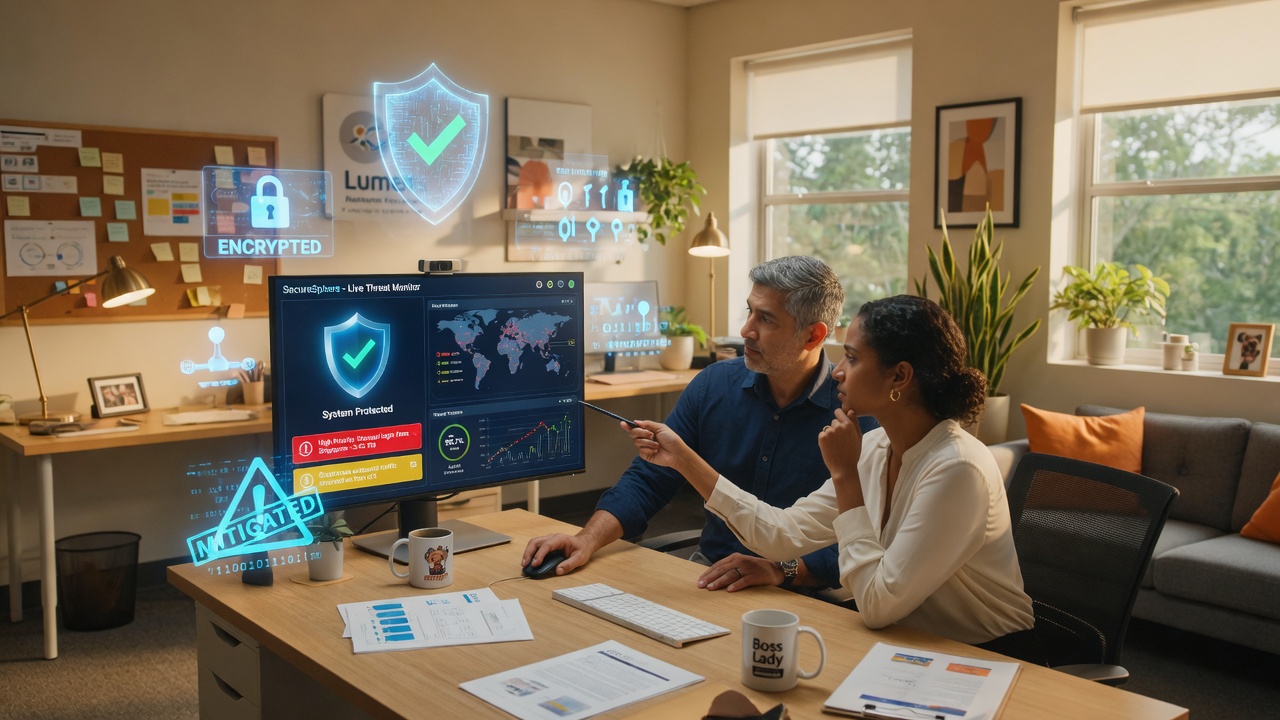
Traditional antivirus isn't enough. EDR (Endpoint Detection and Response) solutions with AI analyze each device's behavior in real time and detect threats with no known signature.
Accessible options for SMBs:
| Tool | Price from | Best for |
|---|---|---|
| Microsoft Defender for Business | Included in M365 Business Premium | SMBs already on Microsoft 365 |
| CrowdStrike Falcon Go | ~€8/endpoint/month | SMBs wanting enterprise protection |
| SentinelOne Singularity | ~€6/endpoint/month | SMBs with some tech team |
If you already pay for Microsoft 365 Business Premium (€26.40/user/month), you have EDR included. Activate it. It's the best ROI move you can make.
AI-powered phishing detection
Tools like Proofpoint, Mimecast, and even the built-in protections in Microsoft 365 and Google Workspace use AI to analyze every incoming email and detect phishing patterns a human would miss.
83% of phishing emails are already AI-generated. You need AI on the defense side.
AI-driven multi-factor authentication (MFA)
Basic MFA (SMS) isn't enough: attackers can intercept messages. Modern solutions use AI to detect anomalous access attempts even with correct credentials.
Microsoft Entra ID, Duo Security, or Google Passkeys offer adaptive MFA: if someone tries entering from an unusual device or location, it auto-requests extra verification.
Continuous monitoring (SOC)
A SOC (Security Operations Center) watches your systems 24/7. Building your own team doesn't make sense for an SMB, but managed SOC services start at a few hundred euros monthly.
More economical option: Microsoft Sentinel + Copilot for Security, which uses generative AI to summarize complex incidents and suggest response actions. Already in the Microsoft ecosystem? It's the natural path.
4. 5-step plan to protect your SMB this month
Here's a concrete plan. Not theory, not "you should." Actions you can complete in the next four weeks.
Step 1: Enable MFA everywhere critical (day 1)
Corporate email, online banking, management tools, cloud platforms. Everything. It's free and blocks most attacks that start from stolen credentials.
Use an authenticator app (Microsoft Authenticator, Google Authenticator) instead of SMS. If you can, go to passkeys (FIDO2), which resist phishing.
Step 2: Immutable backups (days 2-3)
Configure daily backups of critical data, stored outside your main environment. And verify they work: a backup you can't restore is useless.
The 3-2-1 rule: 3 copies, on 2 different media, 1 off-site. Tools like Veeam, Acronis, or even Google Workspace and Microsoft 365 built-in backup cover this.
Step 3: Train your team on phishing (week 1)
Human factor is entry point in 85% of incidents. A single "watch out for phishing" email isn't enough. You need real simulations.
INCIBE offers free cybersecurity training resources for SMBs at incibe.es: guides, phishing simulators, and phone advice. Simple, in Spanish, no tech knowledge needed.
Platforms like KnowBe4 or Proofpoint Security Awareness offer automated phishing simulations that send fake emails to your team and measure who falls. Now you know where the real risk is.
Step 4: Update and patch everything (week 2)
Sounds boring. It's the most effective. Most successful attacks exploit vulnerabilities that have had patches available for months.
Operating systems, apps, plugins, routers, everything. Enable auto-updates where possible. If you use WordPress, update WordPress, themes, and plugins. If you have a POS system, ensure it's on the latest security patches.
Step 5: Establish a payment verification protocol (week 2)
An email or phone call alone is never enough to authorize a payment. Period. Define a process: for any transfer above a threshold, require verification through a second channel (call a known number, not the one in the email).
This simple protocol would have prevented most BEC and voice deepfake fraud hitting Spanish SMBs.
5. NIS2 regulation: what affects you
The EU's NIS2 Directive, transposed in Spain in 2026, expands cybersecurity obligations to more sectors. If your SMB is in food, health, energy, transport, digital, or finance, it likely applies.
Main obligations:
- Notify serious incidents within 24 hours
- Designate a security officer
- Implement technical risk management measures
- Manage supply chain security
Non-compliance penalties can reach 2% of global revenue. This is serious.
Even if NIS2 doesn't apply directly, your big clients are obligated. They'll demand you meet certain security standards to keep working with you. If you handle customer personal data, our GDPR guide for SMBs helps align data protection with security obligations.
6. How much does SMB protection cost?
Depends on size and risk level, but for a 5-20 person SMB, a realistic budget is:
| Concept | Monthly cost | Includes |
|---|---|---|
| MFA + backups | €0-30 | If using M365 Business Premium, included |
| EDR/XDR | €30-160 | 5-20 protected endpoints |
| Phishing training | €0-100 | INCIBE free; platforms from ~€5/user/month |
| Managed SOC (optional) | €200-500 | Basic 24/7 monitoring |
Total: €30-790/month depending on what you need. Compared to average ransomware incident cost for an SMB (tens of thousands of euros plus downtime), the investment pays for itself.
And note: Kit Digital 2026 includes cybersecurity as a fundable category, with grants of €3,000 to €29,000 depending on company size. You can cover much of this investment with the subsidy.
7. AI in cybersecurity: what's coming 2026-2027
The field moves fast. These trends will mark the next months:
Autonomous security agents: Systems that don't just detect threats but respond automatically. Microsoft Security Copilot can already contain a compromised endpoint, isolate a user, and generate an incident report with zero human intervention.
Deepfake detection: Tools analyzing audio and video in real time to detect AI-generated content. Companies like Reality Defender or Sensity lead this space.
AI-driven Zero Trust: The "never trust, always verify" model with AI continuously evaluating risk on each access, each device, each connection.
Cybersecurity-as-a-service (SECaaS): More and more SMBs will outsource all security to specialists, just like accounting or payroll today.
Frequently asked questions
Is my SMB too small to be attacked?
No. 94% of cyberattacks in Spain target SMBs precisely because they're easier. Attackers automate: they don't pick, they sweep. If you have internet and corporate email, you're a potential target.
Isn't the antivirus I already have enough?
For 2015 threats, yes. For 2026, no. Modern ransomware, AI phishing, and supply chain attacks require behavior analysis, not just signatures. You need at least an EDR.
Can I use Microsoft 365 AI for cybersecurity?
Yes. Microsoft Defender for Business (included in Business Premium) offers AI-powered EDR. Microsoft Sentinel + Copilot for Security adds SIEM monitoring and AI-assisted response. If you pay for M365 Business Premium, you're more protected than you think: just enable the features.
Does Kit Digital cover cybersecurity?
Yes. Kit Digital 2026 includes cybersecurity as a fundable category with grants of €3,000-€29,000. Use it for security solutions, audits, and team training. Check if your company qualifies at acelerapyme.gob.es.
What if I've already been attacked?
First, don't pay ransom: no guarantee of recovery and marks you as a target. Second, contact INCIBE (free assistance). Third, notify the data authority if personal data was compromised (GDPR requires it). Fourth, document everything for insurance claim.
Get a free assessment
If you want to know your SMB's security level and what to improve first, request a free 30-minute assessment. Contact us here or message us on WhatsApp from the site.