What the 2026 Adecco report actually shows
The Adecco Group Institute, partnering with the CEU Chair of Innovation, published one of the most comprehensive snapshots of AI adoption in the Spanish business landscape in May 2026. They surveyed 611 owners, managers, and executives from companies with 1 to 249 employees. We're not talking about Fortune 500 companies here: we're talking about the 8-person plumbing firm, the 12-person dental clinic, the 40-person distributor.
And the numbers are striking. These aren't vague perceptions or wishful thinking: these are executives who already have AI running in their businesses and seeing real results. If you're thinking about taking the leap in your SMB, our AI implementation consulting helps you prioritize without breaking what's already working.
If you've been reading AI headlines for months thinking "this doesn't apply to me," these numbers should make you stop. This isn't the future—it's happening right now in businesses just like yours.
Where the improvement actually shows up
What I like about this report is it doesn't stop at "AI is wonderful." It digs into where those gains are actually happening. And the data gets specific.
The main impact, according to 50.1% of respondents, is work time optimization. AI doesn't work magic: it's that tasks taking two hours now take 40 minutes. 39.6% highlight gains in product or service quality, and 35.2% mention cost reduction.
But the most interesting piece is daily operational productivity:
- 48.9% see faster process execution
- 46% experience more efficient resource use
- 39.1% observe fewer errors
- 40.6% report better decision-making
That last number is key. It's not just about doing things faster: it's about doing them better. When you have AI-processed data, you stop guessing and start deciding on evidence. In an SMB where every euro counts, that makes a huge difference.
"40.6% of Spanish SMB leaders now make better decisions thanks to AI. It's not just automation: it's judgment amplified with data."
What's shifting for your team
This is where the report hits home. 88.4% of executives see changes in their teams' productivity. And we're not talking about mass layoffs or robots replacing people.
What's actually happening is more subtle—and in my view, more valuable:
- 45.8% say employees now have time for higher-value work
- 45.2% report automation of repetitive processes
Think about it. If you have someone spending three hours a day answering the same emails, filling the same Excel sheets, copying data from one system to another, and an AI tool gives them back two of those hours, what happens? That person can now spend time serving customers better, thinking about service improvements, doing work that actually moves the needle on revenue.
It's not replacing people. It's removing the boring work so they can do the work you actually hired them for.
Adoption levels: this is mainstream, not fringe
Another important number: this isn't a minority phenomenon. 51.4% of SMBs are at a medium level of AI adoption, and 20% have already reached high adoption levels. Only 7.7% say they haven't started.
To put it in perspective: more than 70% of Spanish SMBs are already doing something with artificial intelligence. And this is May 2026, not 2028.
The tech foundation was already there. 54.3% of SMBs have a medium level of digitalization and 35.7% have reached high levels. That means basic infrastructure (computers, internet, digital tools) was already in place. AI was the natural next step.
What tools are actually in use
And here's the part I find most revealing because it breaks a lot of myths. We're not talking about companies building machine learning departments or hiring data scientists at €80,000 a year.
The most common tools are the ones you already know: ChatGPT, Gemini, and Copilot, with 63.5% penetration. These are tools anyone can start using today—free or less than €25/month.
This matters because it demolishes the idea that AI is only for companies with massive budgets. The barrier to entry is gone. What's missing isn't money: it's someone who sits down, tries these tools, and finds where they drive value in your specific business.
How much they're planning to invest (and why)
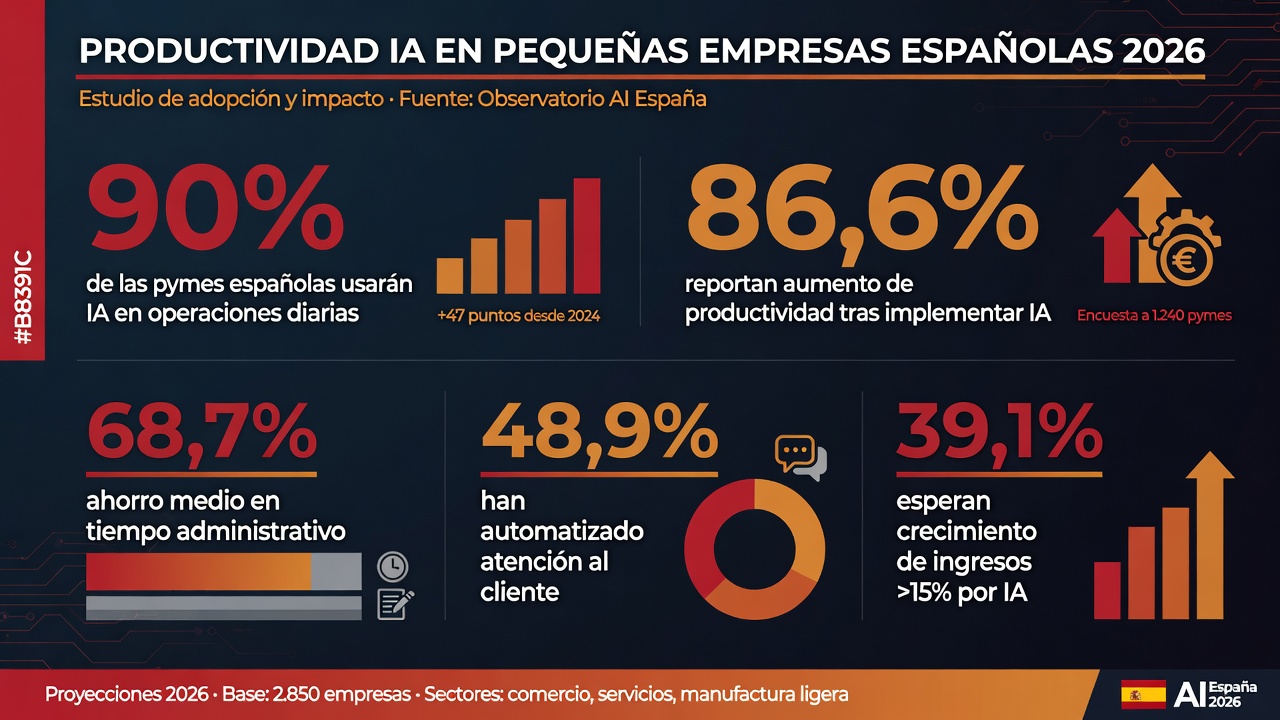
68.7% of executives say their company plans to increase AI investment. Not maintain it: increase it. That signals the companies already using AI are seeing returns and want to scale.
According to the IONOS/YouGov study, 35% of Spanish SMBs will invest in AI in 2026—placing Spain among European leaders in investment intent. And the most telling stat: AI investment (35%) is now almost on par with cybersecurity spending (37%), which has always been the number-one priority.
The main reasons for investing are clear:
- 47%: boost efficiency
- 39%: free employees from routine tasks
No one is investing in AI because it's trendy. They're investing because it saves time, cuts errors, and lets people focus on what actually matters.
What's still holding some back?
Not everything is smooth sailing. The report also identifies barriers, and I think it's honest to mention them.
According to Beedigital's research, the main obstacles for Spanish micro-SMBs are budget constraints (52%) and lack of technical knowledge (46%). More than half also cite ethical concerns and privacy worries.
And here's a striking finding: 47% of micro-SMB leaders already use AI in their personal lives, but only 1 in 3 has incorporated it in key business areas. There's a clear gap between personal use and business application.
Why? Because using ChatGPT to plan your vacation is worlds apart from integrating an AI agent into your customer service flow. The first is free and risk-free. The second takes a decision, time, and someone to guide you through it.
AI as a business accelerator
One overlooked data point: 84.8% of executives believe AI opens doors to new business opportunities. It's not just internal efficiency—it's growth.
How does this play out in practice?
- 52.5% see faster customer response times
- 45% report improved customer experience
- 35.4% say it lets them personalize their offer
Think about what it means to respond to a customer in minutes instead of hours. Response speed can be the difference between closing a deal and losing it to a competitor.
What this all means for your SMB
If you've made it this far, you're probably asking: "Okay, interesting data, but what do I actually do with this?"
Here's what I'd boil it down to:
1. It's not too early to start. 70% of your direct competitors are already doing something with AI. Waiting isn't prudent: it's falling behind. You don't need a big project. You need one real use case that delivers value from month one.
2. You don't need a huge budget. The most-used tools (ChatGPT, Gemini, Copilot) cost €0–25/month. An AI pilot project for a 10–50 person SMB can start at €2,000–5,000 setup plus €200–400/month operations, per industry benchmarks. Typical return is 3–8× your investment in 12 months if you pick the right use case.
3. The real risk isn't investing and missing—it's doing nothing. While you wait, your competition is answering faster, making fewer mistakes, and making smarter decisions. Every month that passes, the gap gets wider.
Where to start if you haven't made a move yet
I'm not going to tell you to build an AI department. I'll tell you what I tell any business owner who asks:
Question 1: What repetitive task eats the most time in your company? Not the most important: the most repetitive. The one someone on your team does daily that doesn't need creativity or human judgment.
Question 2: How many hours a day does that task take? Multiply by that person's hourly cost. That's the real cost of not automating it.
Question 3: Is there an AI tool that could handle 70% of that task? In most cases, yes. And if no off-the-shelf tool exists, you can build a custom agent for a fraction of what it would have cost two years ago.
Start there. One process. Measure the savings. If it works, move to the next one.
Frequently asked questions
Where does this AI and SMB productivity data come from?
The main data comes from "Artificial Intelligence Becomes the New Economic Engine for SMBs," published in May 2026 by The Adecco Group Institute in partnership with the CEU Chair of Innovation. It surveyed 611 executives from Spanish companies with 1 to 249 employees. Additional data comes from the IONOS/YouGov study on AI investment and Beedigital's research on the reality of Spanish micro-SMBs.
What kind of AI are Spanish SMBs actually using?
Per the report, the most common tools are ChatGPT, Gemini, and Copilot (63.5% adoption). They're mainly used to optimize work time, automate repetitive tasks, improve customer service, and support data-driven decision-making. We're not talking about complex machine learning projects: we're talking about accessible tools anyone can learn to use.
How much does it cost to implement AI in a Spanish SMB in 2026?
It depends on the project scope. For a freelancer or micro-SMB (1–5 employees): €2,500–5,000 setup plus €200–300/month. For a 5–30 person SMB: €4,000–8,000 setup plus €250–400/month. Typical return is 3–8× your investment in 12 months with the right use case. The cost variable that matters most isn't the AI tool itself—it's integration time with your existing systems.
Do I need technical skills to use AI in my business?
You don't need to be a programmer. The most-adopted tools (ChatGPT, Gemini, Copilot) work with natural language: you ask and they answer. For more advanced automation (like an AI agent managing customer inquiries), you do need someone to set it up, but you don't need a permanent technical staff. Many SMBs outsource the initial setup and then manage daily operations in-house.
Is it safe to use AI with customer data?
It's a legitimate concern—48% of Spanish SMBs require AI solutions to meet legal requirements. The key is choosing tools that comply with GDPR and the European AI Regulation (in force since August 2024). Avoid tools that train on your data without explicit consent. When working with sensitive data, always ask about the provider's privacy policy and make sure data stays on European servers.
Does Kit Digital cover AI projects?
Yes. Kit Digital (and Kit Consulting) covers up to €29,000 in digitalization for SMBs, and AI agents fall within funded categories. Regional programs in Catalonia, Madrid, and Andalusia also have dedicated AI lines. ENISA and CDTI offer soft loans for innovation projects that include AI.
Want to know where AI could help your business?
We talk 15 minutes, identify one concrete process, and tell you if AI can help. No strings, no jargon.
Schedule a free call →