The Real Cost of Not Automating Your Business (and How to Calculate It)
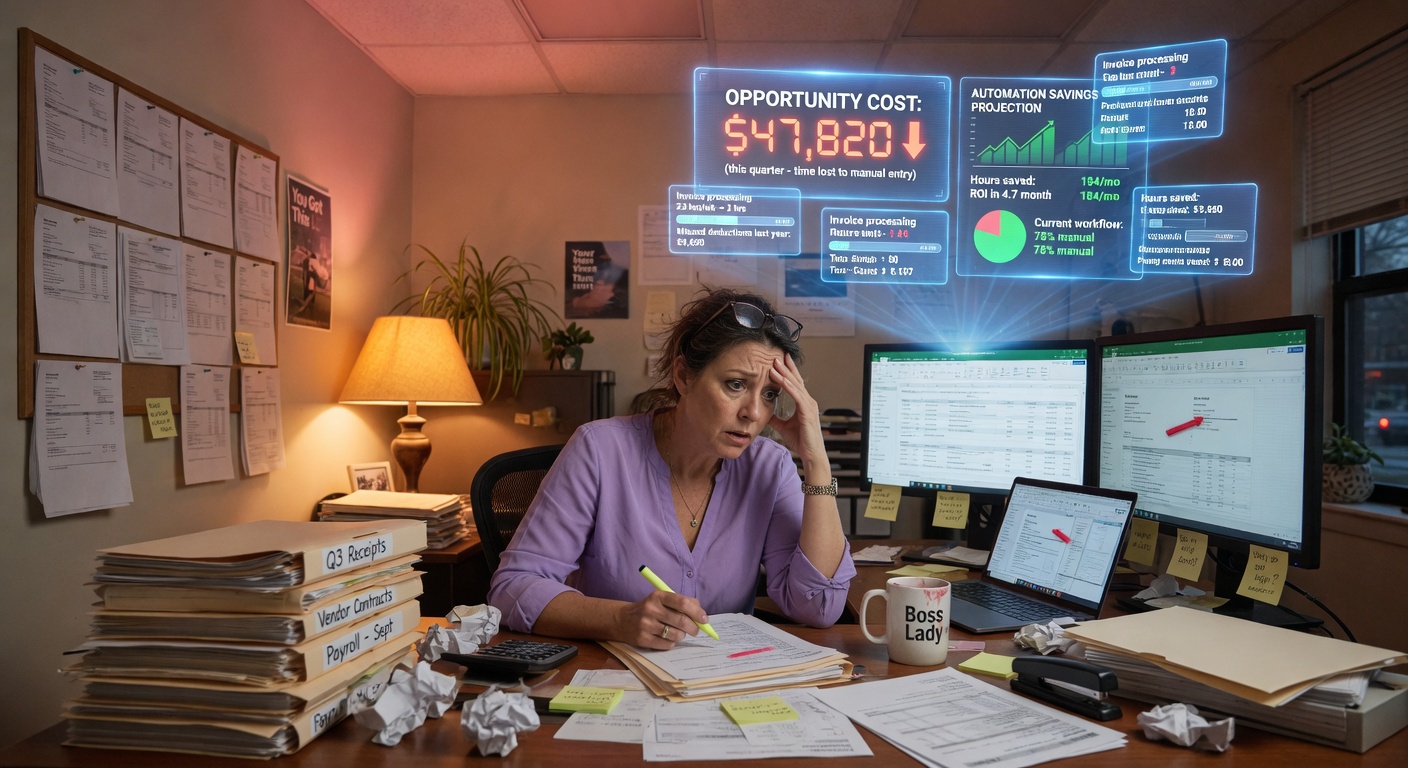
Time is money — yet most small businesses never calculate what they lose by keeping processes manual. Every email that gets no automatic reply, every order managed in a spreadsheet and every invoice raised by hand adds up to hours that could have gone into selling. Automating these processes isn't a luxury: in 2026 it's a competitive necessity.
📊 Infographic: how much NOT automating costs you
Discover the hidden-cost formula and the 3 solutions for your business.
View interactive infographicThe 3 tasks quietly costing you the most money
- Replying to routine emails. A customer-service agent spends 1 to 3 minutes per message. At 30 enquiries a day, that's 0.5 to 1.5 hours daily — roughly ≈ 7–10 hours a week of work you could automate with a chatbot.
- Order management. Entering every order into your system manually takes about 2 minutes. At 20 orders a day that adds up to ≈ 40 minutes a day, or ≈ 3.5 hours a week.
- Manual invoicing. Creating and sending invoices without a ready-made template costs about 5 minutes apiece. Invoice 15 times a month and that's ≈ 1.25 hours lost every month.
How to calculate the real cost
The formula is simple:
Cost = Hours lost × Worker hourly cost × Weeks per yearA practical example: an assistant earns €12/h. If they lose 10 h a month to repetitive tasks, the yearly calculation is:
- 10 h/month × €12/h = €120/month
- €120/month × 12 months = €1,440/year
That money could go into marketing, product development, or hiring — though keep in mind: the real cost of an employee goes well beyond the gross salary.
What you can automate today, without being technical
- Automated email replies. Use filters and pre-built responses in Gmail or Outlook, or connect Zapier to forward frequently asked questions to a bot.
- Order flow. Set up a "Zap" so that when a new order lands in your store (Shopify, WooCommerce), it automatically adds a row to Google Sheets and sends a notification to Slack.
- Invoice generation. Tools like Invoice Ninja or FacturaDirecta let you create templates that, once you fill in a form, generate the invoice and email it in seconds.
All of it comes together in a few clicks, with zero code. The goal is to free up time for the activities that actually generate revenue. For the concrete return on automation backed by real Spanish SMB data, we have a dedicated article.
June 2026 update: Automation for Spanish SMBs has moved fast. According to the Spanish Digital SMB Observatory (May 2026), 41% of Spanish small businesses already use some basic automation tool — chatbots, automated email marketing, or Zapier/Make workflows — up from 23% in 2024. The average cost of implementation has dropped 60% thanks to no-code tools. Businesses that automate at least 3 repetitive tasks report an average saving of 12 hours a week — the equivalent of €14,000–18,000 a year in avoided labour costs.
Want to see the exact calculation for your business? Book a call and find out how much you can gain by automating.
Frequently asked questions
How do I calculate the cost of a manual task?
Track the hours spent on the task, multiply them by the worker's hourly cost, and annualize the result. Include recurring rework and delays when they have a measurable impact.
Which process should a small business automate first?
Choose a repetitive, frequent task with clear inputs and outputs, such as routine email replies, order entry, or invoice generation. Start small and measure time saved before expanding.