
Why almost everyone calculates AI ROI wrong
35% of Spanish SMBs plan to invest in AI in 2026, according to YouGov research for IONOS. But here's the kicker: only 2.9% of those SMBs use AI effectively in their operations. Most get stuck in the "let's test it" phase.
One big reason is nobody knows how much they're actually gaining (or losing) from the investment. Not because the math is hard — it isn't — but because three mistakes torpedo the calculation from day one.
Mistake 1: Not measuring your baseline before you start. If you don't know how many hours you spend on a task today, how will you know how much you save when it's automated? Without a starting point, any ROI number is marketing spin, not real data.
Mistake 2: Calculating only on the license cost. A vendor tells you: "My tool costs €300/month and saves you €1,500/month. ROI: 400%." Sounds great until you discover implementation was €8,000, training another €2,000, and you're spending 10 hours a month babysitting the AI to stop it hallucinating. With the real cost, that 400% drops to 40–80%. Still a good project — but a very different number.
Mistake 3: Ignoring change-management costs. The first weeks after AI rolls out, your team produces less. Not because the tool is bad, but because they're learning. That temporary productivity dip is a real cost almost nobody includes in the math. To see what productivity gains Spanish SMB leaders report, read AI is already boosting productivity for Spanish SMBs.
The real formula (not from the sales brochure)
The classic ROI formula doesn't change just because you're using AI:
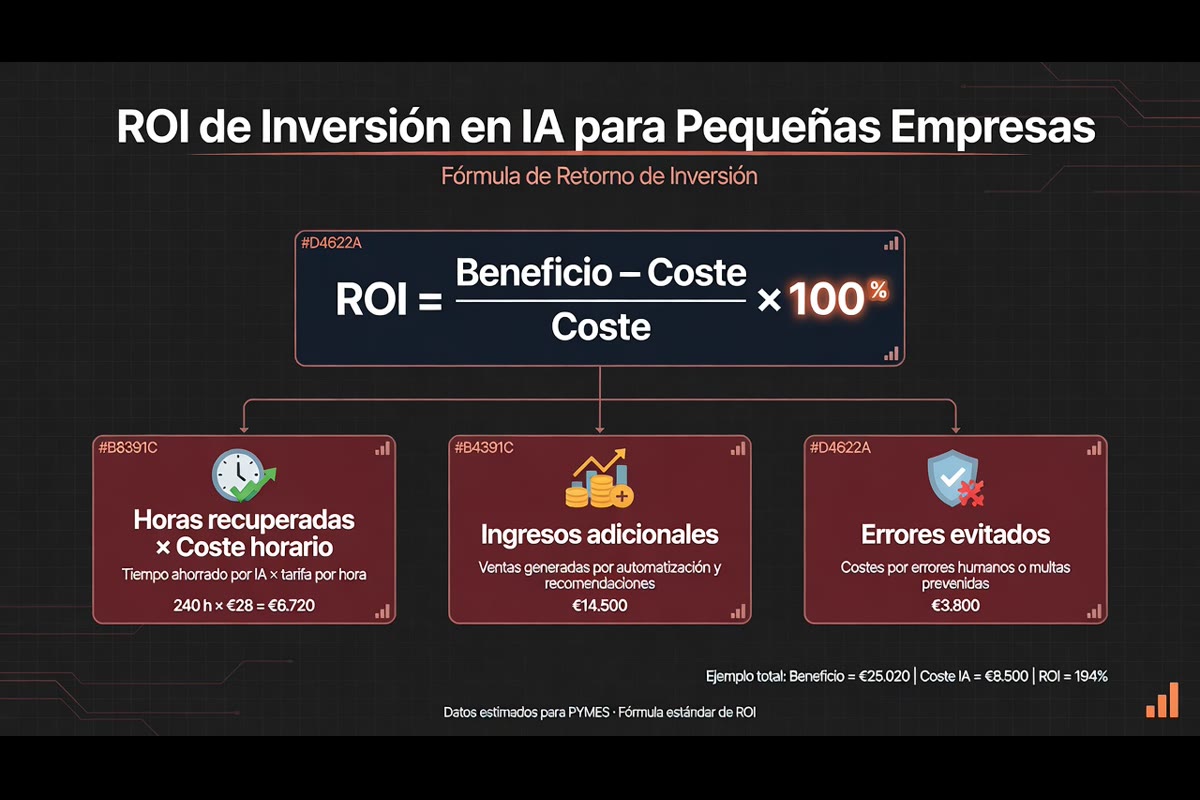
ROI = (Total benefit − Total investment cost) / Total investment cost × 100
What changes — and a lot — is what you put inside "total benefit" and "total investment cost." Let's break it down.
The benefit: three components you need to add
AI benefit isn't just "hours saved." It has at least three pillars:
1. Hours recovered. Easiest to measure. If your team spends 20 hours a week on repetitive work and AI cuts that to 8, you've recovered 12 hours. Multiply by your real loaded hourly cost (gross salary plus payroll taxes, divided by 160 hours a month). For an admin role in Spain, that's roughly €18–25/hour all-in.
2. Extra revenue. Harder to isolate but equally real. How many leads do you lose today because you don't respond fast enough? How many inactive customers could you reactivate with a system that flags them automatically? If your average deal is €500 and AI helps you close 2 extra deals a month, that's €1,000 in direct benefit.
3. Errors avoided. The most invisible one. Badly issued invoices, duplicate data, wrong shipping addresses, missed deadlines. Every error has a cost. If AI cuts your admin mistakes by 80% and you currently average 5 incidents a month at €150 each, that's €600/month you stop losing.
The cost: what vendors don't mention in the pitch
This is where AI vendors get creative with the accounting. Your total AI project cost in year 1 includes:
| Line item | What it is | Typical range (5–30 person SMB) |
|---|---|---|
| Setup / implementation | Configuring the tool, connecting to your systems, tuning for your process | €4,000 – 15,000 |
| Licenses / usage | Monthly AI service fee (or per-use cost) | €200 – 600/month |
| Team training | Hours your staff spend learning the tool | €500 – 3,000 |
| Internal management hours | Your team's time supervising, tweaking prompts, reviewing outputs | 2 – 5 h/week |
| Year 1 maintenance | Adjustments, degrading prompts, changing integrations | 10 – 20% of setup cost |
| Change cost | Temporary productivity hit in the first weeks | Hard to quantify but real |
According to industry data, setup and implementation is typically the largest line item — 40–60% of year-1 total cost. It's also what vendors most often bury when they show you a pretty ROI on just the license.
"If the number doesn't come from a measured baseline and doesn't include the complete process cost, it's not ROI—it's a sales pitch."
, Adapted from iaparaempresasb2b.comROI calculator step-by-step (with a real example)
Let's work through it with numbers. Say you have a 15-person professional services SMB (a consulting firm) implementing an AI agent to automate customer support and draft report generation.
Step 1: Measure your baseline (2 weeks before you touch anything)
- Hours per week answering repetitive inquiries: 25 h/week
- Hours per week drafting report templates: 15 h/week
- Average loaded hourly cost of team: €22/h
- Monthly incidents from documentation errors: 4 per month, ~€200 each
Step 2: Calculate total project cost (year 1)
- Setup and implementation: €8,000
- Licenses: €400/month × 12 = €4,800
- Training: €1,500
- Internal supervision hours: 3 h/week × €22 × 48 weeks = €3,168
- Maintenance: €1,200
- Total year 1: €18,668
Step 3: Calculate annual benefit
- Hours recovered: 30 h/week (from 40 to 10) × €22 × 48 weeks = €31,680
- Errors avoided: 4 incidents × 80% reduction × €200 × 12 months = €7,680 (3.2 prevented incidents × €200 × 12 = €7,680)
- Extra revenue from better support: estimated 2 extra clients/year × €1,500 = €3,000
- Total benefit year 1: €42,360
Step 4: Apply the formula
ROI year 1 = (€42,360 − €18,668) / €18,668 × 100 = 127%
127% return in year 1. Not bad. And from year 2 on, when setup is already amortized and cost drops to around €10,000 annually, ROI jumps to 320%.
Hidden costs AI vendors don't mention
I've watched a lot of AI projects get sold to SMBs, and there's a series of costs that rarely make it into the commercial proposal. Not because vendors are trying to deceive you, but because they complicate the sale. You need to know them anyway.
Data preparation
AI needs clean, accessible data. If your information lives in Excel, emails, PDFs and someone's head, there's work before AI can do anything useful. That prep work can run 10–20% of the project cost. Always ask: "What data do you need from me and in what format?"
Ongoing human supervision
AI doesn't work alone. Someone needs to review what it generates, fix errors and tune prompts when output quality drops. That supervision isn't optional—it's part of the operating cost. Typical projects need 2–5 hours a week of team oversight.
Model degradation
AI models change. What works today might produce different results in three months because the vendor updated something, your data format shifted or usage volume grew. Maintaining quality needs regular adjustments that aren't always included in the base fee.
Integration with existing systems
If your SMB already uses a CRM, ERP or other tools, connecting AI to them has a cost. Sometimes it's simple (standard API), sometimes it's a project unto itself. Ask about this before signing.
5 common AI ROI mistakes (and how to avoid them)
Mistake 1: Using vendor ROI without verification
If a salesperson says "our customers get 300% ROI," ask for data. 300% of what cost? Over what timeframe? With what baseline? ROI without context is meaningless.
Mistake 2: Mixing quick wins with structural projects
Automating common email replies has quick, easy-to-measure ROI. Building a predictive analytics platform is a 1–3 year investment. Blending both into one calculation gives you useless numbers. Calculate ROI per use case, not per "generic AI project."
Mistake 3: Forgetting the cost of doing nothing
AI ROI isn't measured only against what you spend today. It's measured against what you lose if you stand still. If competitors automate and you don't, your "cost of inaction" grows every month. That's part of the equation too.
Mistake 4: Measuring only the first month
Month one after AI launch usually has low or negative ROI. The team is learning, prompts need tuning, there's change resistance. Wait at least 8–12 weeks before drawing conclusions.
Mistake 5: Not reviewing quarterly
AI ROI isn't static. Models improve, processes evolve, teams gain experience. Something that delivered 50% ROI in Q1 might hit 200% in Q3. Review and adjust every 3 months.
When AI is NOT profitable (and that's OK)
Not everything needs artificial intelligence. Knowing when not to use it is as important as knowing when to.
If your company has fewer than 5 employees and processes are simple, AI probably won't pay for itself — not even the setup cost. Simple automation (Zapier, Make), smart forms and other no-AI tools will give you more for less, at least at first.
If your data isn't minimally structured, AI will cost you time and money. Before you even think about AI, make sure your information is accessible and organized.
If you can't spare 2 hours a week for oversight, AI will create more problems than it solves. These tools need a human in charge, especially at the start.
According to Automatizator.es data, in companies under 8–10 people, there's almost always 1–2 use cases that justify simple automation, but full AI usually waits until the business has more volume.
Roadmap: from idea to measurable ROI in 90 days
If after reading this you want to calculate AI ROI for your SMB, here's what I'd do:
Weeks 1–2: Baseline. Pick ONE process with clear ROI (repetitive text work: answering, qualifying, drafting, summarizing). Measure how many hours you spend, how many errors you make and what each error costs. Without data, don't move forward.
Weeks 3–4: Pilot. Launch an AI tool for that one process only. Start with 10–20% of the volume. Don't try to automate everything at once.
Weeks 5–8: Tune. Review results weekly. Adjust prompts, fix errors, train the team. This is where projects succeed or fail.
Weeks 9–12: Measure and decide. Compare to your baseline. Calculate ROI using the real formula (full cost included). If the number is positive, scale. If not, analyze why before investing more.
This 90-day approach is recommended by everyone from Upliora to AI publications: start small, measure rigorously, scale only when you have real data.
Frequently asked questions
How long until I can measure AI ROI?
Ideally measure 2–3 months after implementation. Month one lets the team adapt and ROI can be low or negative. By month two you should have solid data to compare against your baseline.
What if my AI project's ROI comes out negative?
Negative ROI doesn't always mean the AI isn't working. You might have picked the wrong use case, the team isn't using it well yet, or the benefits are hard to quantify (like better customer satisfaction). Review the use case, tune the prompts and give it at least 8 weeks before giving up.
Is AI ROI the same as automation ROI?
Not quite. Automation usually has faster, easier-to-measure ROI (hours saved on repetitive tasks). AI can generate softer benefits: better decisions, personalization, pattern recognition. Both use the same formula, but the benefit components differ.
What's a good ROI for an AI project in an SMB?
In year 1, 50–150% ROI is considered good for a Spanish SMB. From year 2 on, when setup is already paid for, it should exceed 200%. If a vendor promises 500% ROI in year 1, ask them to break down the full cost — something doesn't add up.
Want to know what your SMB could save with AI?
We help you find the highest-ROI use cases, calculate real numbers before you invest and execute without surprises. No BS, just data.
Request free assessment →