
Why you need to know the REAL cost before hiring
Here's the blunt truth: most small businesses delay hiring (or do it badly) because they can't do the math on what an employee actually costs. They see the gross salary and think "I can afford this." Then the first Social Security bill arrives and the bonus pay kicks in, and suddenly the picture changes.
The money isn't even the worst part. If you don't nail the numbers, you can watch your profit margin vanish into costs you never saw coming. For a 3–5 person SMB where every euro matters, that gap between budgeted and real labor cost can mean the difference between growth and shuttering the doors.
According to the European Central Bank, Spanish labor costs rose 4.2% in 2026 year-over-year—above the eurozone average. That means hiring today costs more than it did a year ago, and the trend isn't reversing anytime soon.
The real breakdown: what you pay for every euro of salary
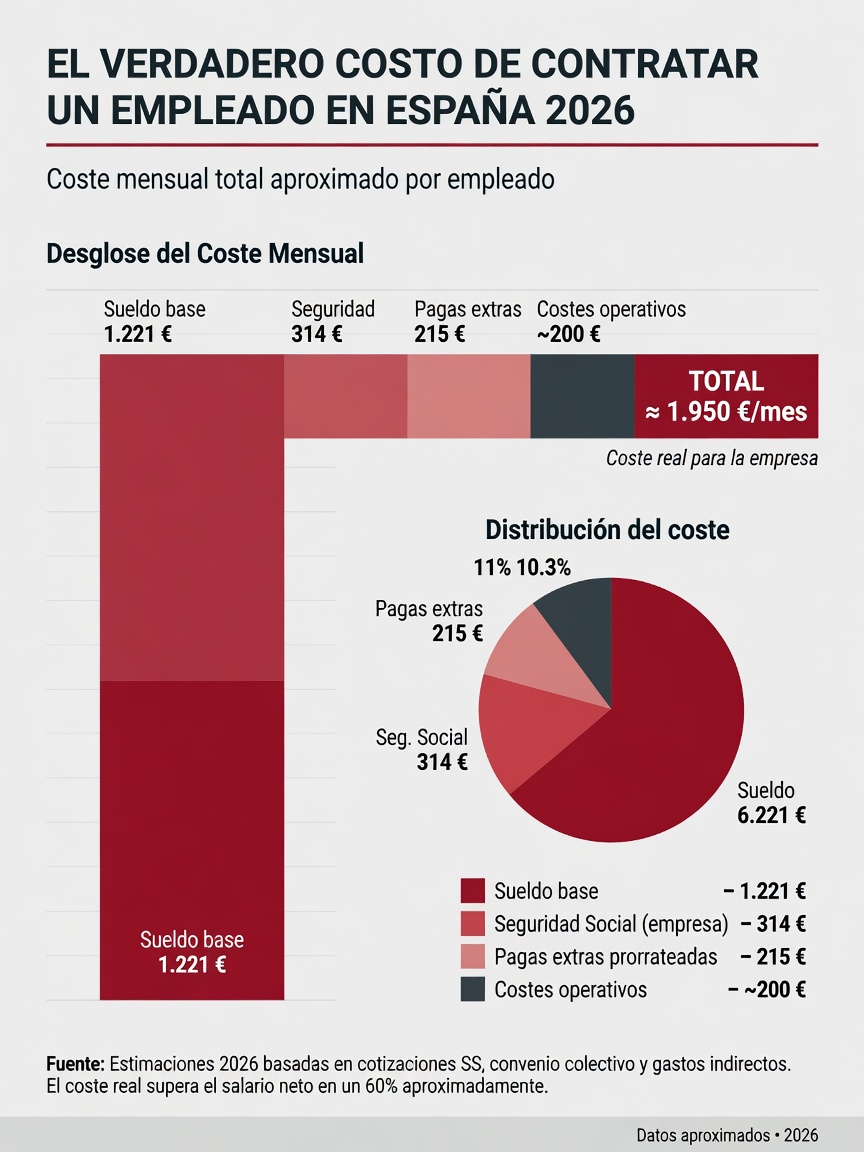
Let's put real numbers on this. Take a full-time contract at Spain's 2026 legal minimum wage.
| Item | Monthly amount | % of gross salary |
|---|---|---|
| Gross salary | €1,221 | 100% |
| Social Security (general contingencies) | €235.50 | 19.29% |
| Unemployment insurance | €66.70 | 5.46% |
| FOGASA (wage guarantee fund) | €2.40 | 0.20% |
| Vocational training | €7.90 | 0.65% |
| MEI (Intergenerational Equity Mechanism) | €1.50 | 0.12% |
| Total employer Social Security | €314 | ~25.7% |
| MONTHLY TOTAL COST | ~€1,535 | ~125.7% |
That's what you pay the tax office and Social Security each month. But Spain mandates 14 regular pay periods per year plus two extra bonuses (summer and Christmas). When you prorate the bonus pay, your true monthly cost climbs to roughly €1,750/month, or about €24,500 per year.
And note: this doesn't include the employee's personal income tax withholding (though under the 2026 Royal Decree 5/2026 reform, many minimum-wage workers are now exempt from withholding altogether).
The hidden costs nobody budgets for
Social Security is the obvious bill. But a series of indirect costs can blow your personnel budget far wider than expected.
Recruitment cost
Before the employee starts, you've already spent: job postings (LinkedIn, job boards, etc.), screening CVs, interviews, selection. If you hire a recruiter or headhunter, you're looking at 10–15% of annual gross salary. For a minimum-wage position, that's €1,700–2,500.
Training and onboarding
A new hire isn't productive on day one. Depending on the role, expect 1–3 months to reach full productivity. You're still paying full salary plus Social Security the entire time. Training costs (courses, colleagues' time spent coaching) can add another €500–2,000.
Tools and equipment
A laptop (€400–800), a decent chair (€150–300), software (Office 365, ~€12/month per user), phone if needed, internet access. For an office-based role, add workspace: commercial office space in a mid-sized Spanish city runs €8–15/month per square meter. First-year equipment and setup can total €2,000–3,000.
Admin and compliance
Social Security registration, monthly payroll, liability insurance, workplace safety compliance. If you outsource to an accounting firm, budget €80–150/month. If you handle it internally, that's your time (or someone else's) diverted from revenue-generating work to paperwork.
Termination cost
You don't want to think about this when you're hiring, but you should. An unfair dismissal of a permanent employee costs 20 days' wages per year worked (capped at 12 months' pay), plus severance for unused vacation and prorated bonuses. For a 2-year tenure, termination can cost over €4,000. This reality makes many SMBs think hard before committing to permanent contracts.
"Salary is just the tip of the iceberg. What sinks the ship is the cost you don't see coming: admin, equipment, training, and if it goes wrong, termination."
, Labour consulting firm for SMBsAlternatives to hiring: when each one makes sense
If the numbers scare you (they should, a little), you have options. Not all work for every situation, but it's worth knowing them.
Freelancer/contractor
For specific recurring tasks that aren't full-time, hiring a freelancer saves 30–40% compared to permanent hiring. You pay their invoice; you don't pay Social Security. The catch: if the relationship is ongoing and full-time, Spain's labor authority can reclassify them as a hidden employee and demand back contributions.
Part-time contract
If you don't need someone for 8 hours a day, a part-time contract proportionally cuts salary costs (though contributions don't scale exactly). It can be a low-risk entry point for both sides.
Apprenticeship/training contract
For people aged 16–25 (or up to 30 if they lack formal qualifications), apprenticeship contracts let you pay 60–70% of standard salary plus Social Security bonuses. Ideal if you can train someone from scratch in your sector.
Tax credits and subsidies
In 2026, Spain offers substantial tax credits for permanent hiring of young people under 30, women in non-traditional roles, workers over 52, and people at risk of social exclusion. Subsidies range €100–300/month for 12–24 months. If your hire fits the criteria, this significantly cuts real costs.
How to calculate your true total payroll cost (practical formula)
You don't need an MBA. Use this formula to calculate the real cost of any hire:
Annual total cost = (Gross salary × 14 pay periods) + (Gross salary × 0.297) + Operating costs + Admin costs
The 0.297 is the effective average employer contribution rate (general Social Security, unemployment, FOGASA, vocational training, and MEI). Add your operating costs (equipment, space, software) and admin costs (accounting, internal time).
Real example: You hire a sales rep at €1,800/month gross (14 pay periods).
- Annual salary: €1,800 × 14 = €25,200
- Employer Social Security: €25,200 × 0.297 = €7,484
- Equipment (laptop, software, phone): €1,200
- Accounting/admin: €1,200/year
- Total: ~€35,084/year (about €2,924/month)
That sales rep costs nearly €3,000/month, not €1,800. Is it worth it? That depends on what they generate. But now you know the real number before you sign.
How this hits a 3–5 person SMB
Say you run a small business with 4 employees. Your total payroll cost is €7,000–12,000/month depending on salaries. That means you need to generate €80,000–140,000 in annual revenue just to cover payroll alone.
Now add rent, utilities, insurance, marketing, tools, taxes—and suddenly you understand why profit margins for small businesses are razor-thin. It's not that you're not selling enough; it's that fixed costs are brutal. For the other side of the equation, see why an SMB can have revenue but no profit.
That's why more SMBs are adopting hybrid models: a lean core of 2–3 key permanent staff and outsource everything else through freelancers, agencies, or service platforms. It's not strategic cowardice—it's financial survival.
Can AI cut your payroll costs?
This is where things get interesting. It's not about replacing people; it's about making your team vastly more productive. And that hits your bottom line hard.
A 3-person team with solid AI tools can deliver what used to require 5–6 people. Automating lead management, basic customer support, report generation, repetitive accounting—all of that frees human hours for work that actually makes money.
At BigLobster, we see this daily: companies externalizing work to us that would have meant hiring someone new. Not because they don't want a team—because they'd rather scale with flexibility and skip the fixed-cost anchor they can't afford.
Frequently asked questions
What does it cost to hire someone at minimum wage in Spain 2026?
The 2026 legal minimum is €1,221/month across 14 pay periods. The total employer cost, including Social Security contributions and prorated bonuses, is roughly €1,750–1,950/month (€24,500–27,300/year). Add operating costs like equipment, training, and admin overhead on top.
What is the MEI and how does it affect me?
MEI (Mecanismo de Equidad Intergeneracional—Intergenerational Equity Mechanism) is an employer Social Security surcharge. In 2026 it's 0.12% of the contribution base—about €1.50/month per minimum-wage employee. Small now, but it's set to increase progressively to 0.53% by 2029.
Is hiring a freelancer cheaper than hiring an employee?
For part-time or specific tasks, yes: you skip the €300–400/month employer Social Security. But if they work regularly and full-time for you, Spain's labor authority can deem them a hidden employee and demand back contributions. The rule: the contractor must have genuine operational independence and not depend exclusively on you.
Are there subsidies for hiring in Spain 2026?
Yes. The main credits include: permanent hiring of people under 30 (up to €300/month for 12 months), women in male-dominated sectors, people at social risk (up to €250/month for 24 months), and apprenticeship contracts. Check with your accounting firm which applies to your situation.
What does it cost to terminate an employee in 2026?
An unfair dismissal of a permanent employee costs 20 days' wages per year worked (maximum 12 months' salary) plus severance for unused vacation and prorated bonuses. For a 2-year permanent employee earning minimum wage, total termination cost is roughly €4,000–4,500. Fair dismissal (objective cause) cuts the severance to 12 days per year.
Need help managing your team or outsourcing tasks?
BigLobster helps SMBs grow without taking on more fixed costs than they can handle. We automate workflows, manage leads, and free up your time for what actually matters: running your business.
Talk to BigLobster →