
Why this matters even if you have twelve employees
If you hire once a year, you might not need to read this. But if your small industrial firm in Galicia opens a line operator position, an admin role, and a sales slot in the same quarter, CV screening eats weeks out of your calendar.
And here's the kicker: slow hiring costs too. A machine sitting idle waiting for the new operator produces less. A sales rep who should start three months ago is revenue that never hits your account. Slow hiring isn't free — it's an invisible cost you never see on an invoice.
AI won't interview for you or bet on a hunch. What it does do is get rid of the part nobody misses: reading, sorting, and ranking. That's time you get back to spend talking to the people who actually matter.
What AI does in recruitment (and what it doesn't)
Let's be concrete, no fluff. An AI recruitment system typically does three things:
- Reads and extracts: it opens the PDF, Word doc, or CV pasted in email, and pulls out what matters: years of experience, forklift license, languages, location, availability.
- Scores against the job spec: it compares each candidate with what you're asking for and gives you an ordered list with a reason for each ranking.
- Books and coordinates: it sends interview time options, confirms, and sends reminders without you typing ten emails.
What it doesn't do — and shouldn't: take you out of the decision. A good tool proposes, explains, and lets you override any score. If the system says "hire this person and delete the rest" without telling you why, dump it. That's a black box, and as of this year, it's also a legal problem.
The stat that should wake you up: 50% are already using it
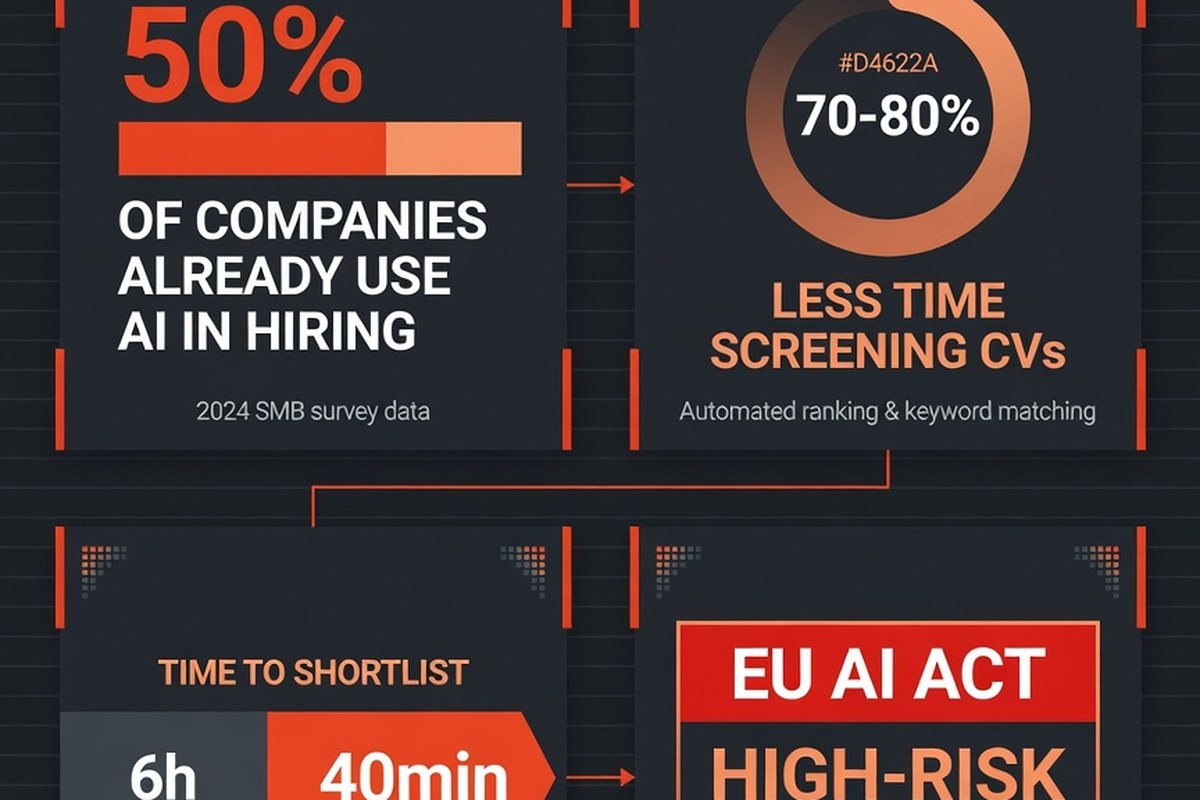
In 2023, only 16% of Spanish companies used AI in hiring. By 2025 that was 50%, per sector data compiled by Startup Ecosystem. It's not a fad of big consulting firms — these are SMBs getting 50 CVs per opening and have stopped reading them by hand.
I'm not telling you this to scare you. I'm telling you because if your competitor screens in minutes and you're still opening emails one by one, you lose speed and the good candidates go to them.
How much time and money an SMB stops losing
A real case published by Upliora (June 2026) spells it out: a search firm of about 18 people received around 2,000 CVs a month. Before setting up private AI, they spent 4 to 6 hours screening each opening. After: about 40 minutes.
The measurable result:
- The shortlist went from taking 4 days to less than 1.
- Each recruiter got back roughly 11 hours a week.
- Zero discrimination complaints, because the score is backed up by job requirements.
At your SMB you don't have a ten-person HR department. You, or your manager, read CVs between invoices. So that time savings matters twice as much: the time you recover is billable time, not time from a department that already exists.
The AI Act arrives in August 2026: what it requires
This is where people panic or get overconfident. The EU AI Regulation treats recruitment and personnel selection as a high-risk system (Annex III, section 4). The requirements become fully enforceable on August 2, 2026.
Before you start sweating: using AI to hire isn't banned. It's regulated. And the rules are sensible:
- Human oversight: the machine never hires or rejects alone. You decide and it's logged.
- Transparency: you must tell the candidate that AI is in the process.
- No discrimination: the tool can't use age, gender, origin, or anything that looks like it to score candidates.
- Record-keeping: automated decisions and human review are stored for at least 5 years.
- Bias testing: before you deploy it, you check whether the system discriminates and fix it.
GDPR and Spain's data protection law reinforce the same point: a candidate can demand human review of any decision affecting them. So the golden rule is simple: AI proposes, a person decides, always, and it's documented.
The three biases that can hurt you (and how to avoid them)
AI learns from what it sees. If you're not careful, it learns your prejudices. Three biases show up constantly in recruitment:
Historical bias
If you always hired men for the workshop, AI learns that "workshop = male" and discards women without you meaning it to. Fix it with balanced training data and regular audits.
Proxy bias
Sometimes you don't ask for gender, but you use postal code, university, or employment gaps as a shortcut. That ends up discriminating anyway. The fix is not putting those variables into the scoring.
Formulation bias
AI rewards the CV written in a particular style, not the best candidate. That's why it matters that it scores job-relevant skills, not how nice the prose sounds.
"An AI that rejects on its own isn't productivity — it's a fine waiting to happen. The good one gives you a ranked list with reasons and the final call stays yours."
BigLobster teamHow to start without spending €10,000
You don't need a custom build to test it. If you get fewer than 30 CVs per opening, an ATS with an AI module is plenty and costs pennies.
The sensible path for an SMB:
- Sharpen your job posts. Write a clear description with the actual requirements (not the nice-to-haves). AI only scores well if you give it good criteria.
- Pick an ATS with AI. Factorial, Bizneo, or Talent Clue work in Spain and cost a fraction of a custom build.
- Keep the decision human. The tool ranks; you interview the top 10 who came through, not the 200 who applied.
- Document it. Keep a note of why you hired or rejected someone, just in case anyone asks. Five minutes that save you from a lawsuit.
If your volume is high (more than 500 processes a year) or you want it wired into your ERP, then a custom system makes sense. Talk to a vendor who can explain AI Act compliance without buzzwords.
Tools that work in Spain in 2026
Depending on your budget, you have two paths:
| Option | For what | Typical price |
|---|---|---|
| Factorial (AI) | SMBs wanting HRIS + basic screening | From ~€6/employee/month |
| Bizneo / Talent Clue | ATS with screening and job portal | From ~€50–100/month |
| Custom system (private RAG) | High volume, ERP integration, proprietary data | €6,000–10,000 + €350–550/month |
SaaS gives you results in days. Custom takes weeks but if you manage thousands of candidates annually, it pays for itself in recruiter hours it frees up. You know which is your case.
And if you want to calculate how much each hire really costs you (and what you save by hiring faster), check out the true cost of hiring an employee in 2026. You'll see that slow hiring makes your hires more expensive than you thought.
Frequently asked questions
Is it legal to use AI to screen CVs in Spain?
Yes, as long as the tool doesn't decide by itself. The AI Act requires human oversight, transparency, bias testing, and logged decisions. The machine proposes; you or your team decide and document it. That's legal and, done well, protects you.
Can AI automatically reject candidates?
No. Recruitment is a high-risk AI Act system: no hiring or rejection decision can land solely with the algorithm. A final rejection needs human review, and candidates can ask for an explanation.
How much does AI-powered recruitment cost for an SMB?
Two paths. An ATS with AI like Factorial runs from about €6 per employee per month. A custom system with screening, matching, and chatbot runs €6,000–10,000 for setup plus €350–550/month. For low volume, start with SaaS.
What if a candidate asks me about the AI?
GDPR and the AI Act give them the right to know AI was used and to request human review of decisions affecting them. That's why AI must justify each score with objective job criteria, not a black box that no one can explain.
Want to set up AI recruitment without legal trouble?
We help you pick the tool that fits your volume and configure it to comply with the AI Act from day one. No long-term contracts, no hype, and the final call stays yours.
Talk to us →