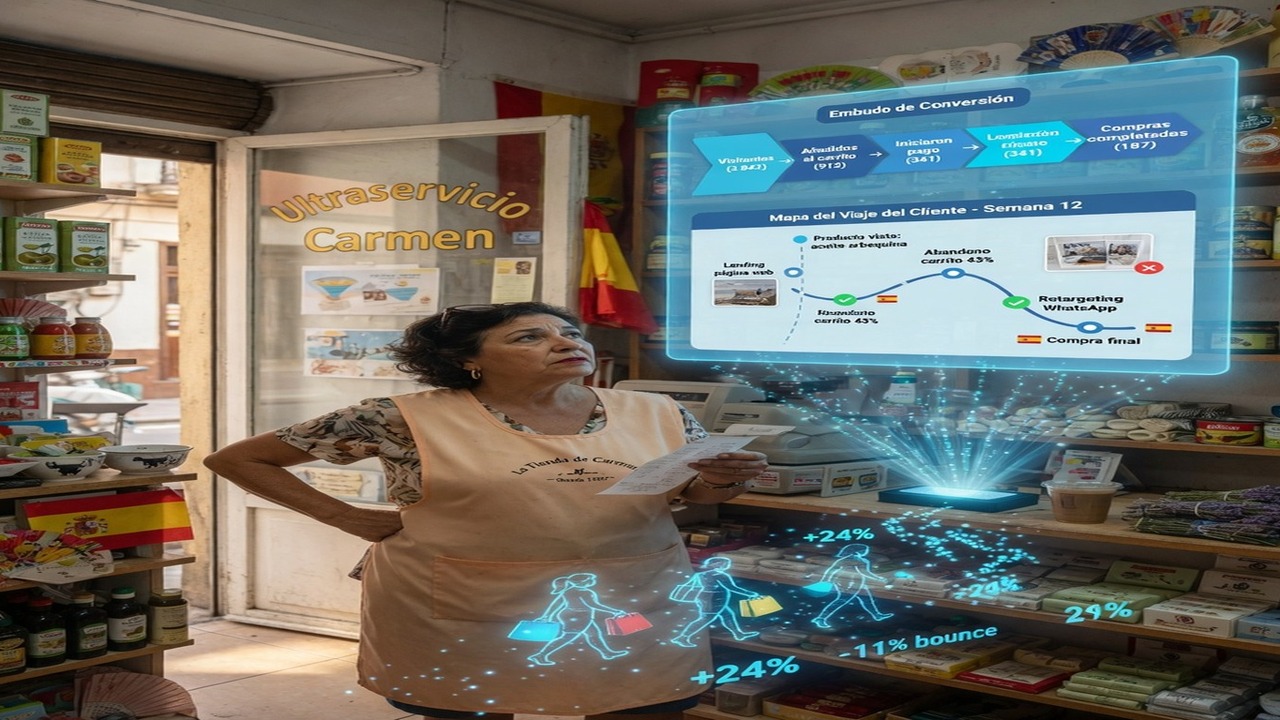
I hear this often from business owners who've invested in a beautiful website, Google Ads, social media. They have traffic. People are visiting. But orders don't come. The phone doesn't ring. And that's one of the most frustrating things there is, because you're putting money and effort into it, and something doesn't add up. What nobody tells you is that getting traffic is only half the battle. The other half is making those visitors do something.
In 2026, Spain's average conversion rate sits at 1.22%. This comes from Flat 101's tenth annual conversion study, analyzing over 1,000 Spanish digital businesses. Translation: out of every 100 people who land on your page, 1.22 do what you want them to do (buy, request a quote, subscribe). The other 98 leave.
And here's the thing: this isn't a traffic problem. If your website converts at 1% and you get 1,000 visits a month, you get 10 customers. If you improve conversion to 3%, with those same 1,000 visits, you get 30 customers. Without spending an extra euro on ads. That's what optimizing your conversion rate means.
The problem isn't your product. It's what happens before they buy
When someone lands on your website, they go through a mental process in seconds. And in those seconds, you decide whether they stay or go. User behavior studies confirm it: if a visitor doesn't understand in three seconds what you offer and why they should choose you, they leave. You won't get a second chance.
I've seen it a thousand times. Websites with beautiful designs that don't answer the only question that matters: "Does this solve my problem?" And because they don't, the user leaves for another page that does. Your competition is one click away.
I think many small businesses confuse "having a website" with "having a sales tool." They're not the same thing. A beautiful website without a conversion strategy is like a spectacular storefront on an empty street. It looks good, but it doesn't sell.
The three conversion killers (and how to spot them)
After working with dozens of businesses, I see that conversion problems almost always come down to three things. If you spot which one is yours, you've already solved half the problem.
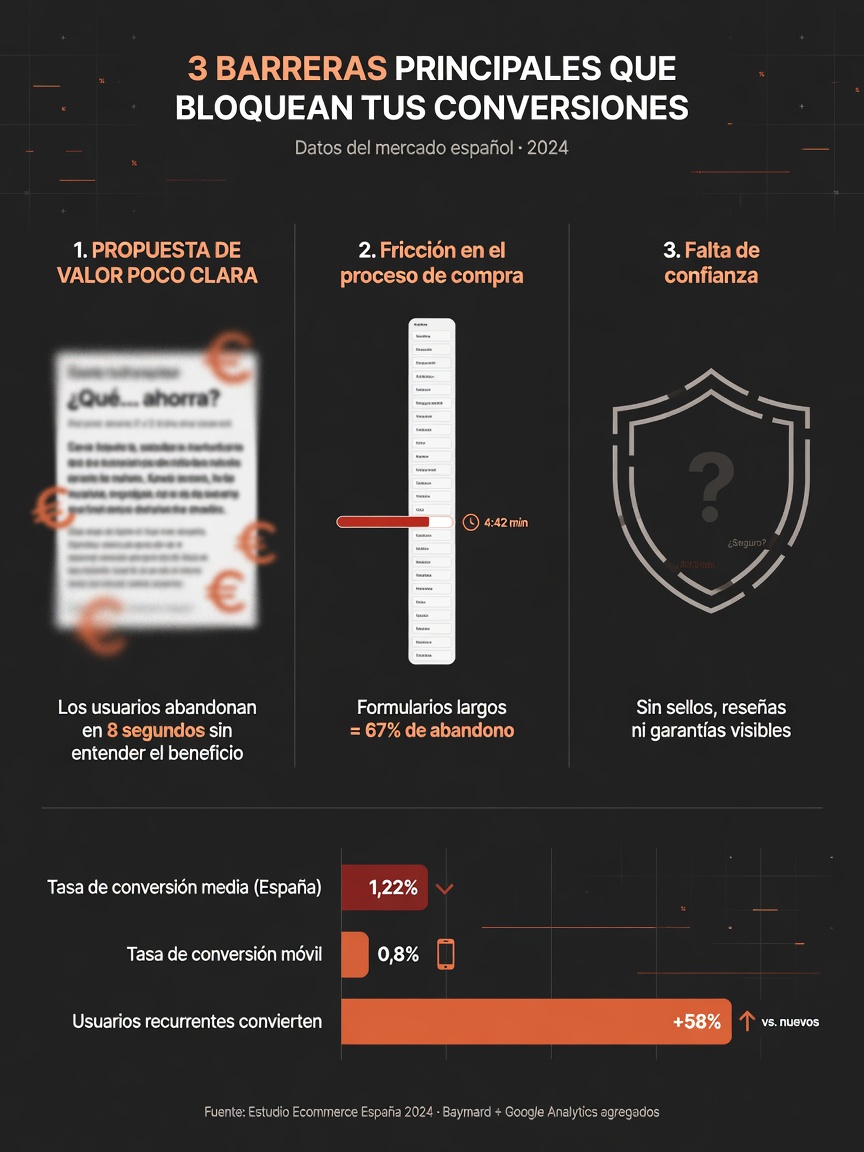
Killer 1: Nobody understands what you do. This is the most common. You land on the website and see a generic headline like "Leaders in integrated solutions." That doesn't help anyone. Your visitor needs to know in three seconds: what do you sell, who is it for, and why should they buy from you? If it's not clear, they leave. A dental clinic that says "Healthy smiles for the whole family" will convert better than one that says "Excellence in oral health with the best professionals." The first talks about the visitor (the customer), the second talks about itself.
Killer 2: It's too hard to take the next step. Long forms, checkout processes with a hundred steps, having to sign up just to request a quote. Every obstacle you put up is a conversion you lose. A real case I found: a consulting firm had a form with 12 fields. We cut it to 4 (name, email, phone, and a dropdown for the type of consulting they needed). Contact requests tripled. Not because more people came, but because the people who did come, filled out the form.
Killer 3: No reason to trust. If your website doesn't have real testimonials, case studies, visible reviews, or some kind of social proof, the user hesitates. And hesitation kills conversion. According to Spanish market data, businesses that include social proof on their product pages improve conversion by 15% to 30%. You don't need a hundred reviews. Three or four in the right place already build more trust than none at all.
Speed matters more than you think
This one hits close to home because I see small business websites that load in 4, 5, or even 7 seconds. In 2026, that's unforgivable.
Google has been clear for years: bounce rate increases 32% when load time goes from 1 to 3 seconds. On mobile—which accounts for 66% of Spain's web traffic—patience is even thinner.
I'm not saying your website needs to load in 0.5 seconds like Google's. But if it takes more than 2.5 seconds to load completely, you're losing customers without realizing it. Worse: you're paying for traffic (Google Ads, social media) that arrives on a website that never loads.
"Every second your website takes to load, you lose 7% of conversions. A slow website is a silent tax you pay every day."
What makes the difference: Spanish market insights
The Flat 101 study has some conclusions worth knowing before you do anything:
The channel that converts best isn't what you think. Direct traffic (people typing your URL or bookmarking you) converts at 1.80%. Email marketing converts at 1.74%. Social media ads convert at 0.39%. In other words: people who already know your brand convert much better than those arriving for the first time from an ad. This doesn't mean you shouldn't run ads. It means your strategy needs something for people who already know you, not just new ones.
Returning users are 58% more valuable. The conversion rate of someone who has bought before is 1.72%, versus 1.09% for new visitors. If you're not doing anything to get your customers to come back, you're leaving money on the table.
Mobile converts at half the rate of desktop. Average conversion on desktop is 2%. On mobile, 0.8%. With 66% of traffic coming from mobile, that's a serious problem. If your website isn't optimized to make it easy to buy or request a quote from a phone, you're losing at least half your potential conversions.
Things you can do starting tomorrow (without hiring anyone)
Okay, enough theory. Let's get practical. These are things you can review yourself this weekend and that usually have fast impact.
Check your headline. Go to your website and look at the first text a visitor sees. Does it answer "What do you do and who is it for?" If not, change it. It should say something like "We design websites for dental clinics that want more patients," not "Web design agency with 10+ years of experience."
Simplify your contact form. The more fields you have, the fewer people fill it out. Try cutting it down to 3 or 4 fields. The consulting firm example I mentioned isn't an isolated case: reducing fields usually doubles or triples conversions.
Put testimonials where people see them. Don't hide them on a separate page. Put them on the homepage near your contact buttons. A short testimonial from a real customer is worth more than anything you can write about yourself.
Measure your load speed. Use Google's PageSpeed Insights or GTmetrix. If your website takes more than 3 seconds, that's your number-one problem. Most of the time, compressing large images or switching hosts makes a real difference.
One goal per page. Make each page on your website have a single main action. If it's a service page, the CTA is "Request a quote." If it's a blog post, it can be "Subscribe." Don't put five different buttons. Visitors freeze when they have too many choices.
How much you can improve (spoiler: a lot)
Real conversion optimization numbers from Spain are encouraging. Documented cases show conversion rate improvements of 25% to 76% by making specific changes. Don't expect to multiply your sales overnight, but you can expect significant results in weeks.
| What to improve | Typical conversion impact | Time to see results |
|---|---|---|
| Load speed (5s to 2s) | +20% to +35% | Immediate |
| Simplify forms | +50% to +200% | 1-2 weeks |
| Add social proof | +15% to +30% | 2-4 weeks |
| Clear, single CTA per page | +10% to +25% | 1-2 weeks |
| Mobile optimization | +30% to +50% | 2-4 weeks |
Impact metrics are estimates based on real documented cases from the Spanish market (Flat 101, Satorisan/Viva! Conversion, sector-specific CRO studies). Your case may vary, but the direction is clear.
Order matters: where to start based on your situation
Not every website needs the same fix. It depends on where you are now:
If your website loads slow: start there. No point optimizing anything else if visitors leave before they see it. Compress images, review your hosting, minimize scripts. It's the most technical work and it has the most immediate impact.
If your website loads fine but doesn't convert: check your value proposition and your CTA. Often the problem is that visitors don't understand what they're supposed to do. Put a big, visible button with clear text. "Request a quote" and "See pricing" work better than "Learn more."
If you have traffic but few leads: simplify your form and add testimonials. People need to trust before they give you their data. Lower the friction and build trust, and leads go up.
If you have customers but they don't come back: set up basic email follow-up. One email at 7 days, another at 30 days. Email marketing converts at 1.74% on average—double social media. And it costs almost nothing.
The myth that more traffic fixes everything
This one worries me and I see it all the time. A business runs Google Ads, spends €500 a month, gets 300 new visits, but doesn't convert. What solution do they get offered? Spend more on ads. The vicious cycle repeats.
But think about it: if your website converts at 1% and you spend more on traffic, you'll have more visits but the same conversion percentage. Instead of 10 customers from 1,000 visits, you'll have 20 from 2,000. You've doubled your ad spend but haven't improved efficiency.
Meanwhile, if you improve conversion to 3%, with those same 1,000 visits you get 30 customers. Without spending an extra euro. Conversion optimization, done right, is the highest-return investment you can make.
Frequently asked questions
What's a normal conversion rate for a small business in Spain?
Between 1% and 1.5% for most sectors, according to Flat 101. But don't obsess over the average. Better question: Can I improve my current conversion rate? In almost all cases, the answer is yes.
How much does it cost to optimize website conversion?
Depends what needs doing. If it's just copy changes and form simplification, it can be nearly free (you do it). If it means redesigning pages, improving speed, or restructuring navigation, it usually costs €300 to €1,500 depending on complexity. Compared to what you're spending on ads, it pays for itself in weeks.
How long before you see results?
Load speed changes are instant. Form and CTA changes show in 1–2 weeks. Bigger structural changes (redesigns, restructuring) can take 4–8 weeks to show their real impact.
Is it worth optimizing conversion if I have little traffic?
Yes, but with caveats. With little traffic (under 500 visits a month), improvements will be small in absolute numbers. Still, setting up your website to convert well from the start is cheaper than redesigning it later when you have more traffic.
Are SEO and conversion at odds?
No, the opposite. A website that converts well usually has better user experience, and Google rewards that. Lower bounce rate, more time on page, better Core Web Vitals. Conversion optimization and SEO go hand in hand.
Can I do A/B tests myself?
Yes, tools like Google Optimize or VWO have free versions. But you need at least 1,000 visits a month for results to be reliable. With less, you can measure big changes (like simplifying a form) by comparing before and after without complex statistical tests.
Want your website to convert more?
We analyze your website, identify the conversion blockers, and suggest specific changes with measurable impact. No smoke, no jargon.
Request a conversion audit →