Why it matters to know real pricing before requesting a quote
If you're a freelancer or own a small business and are thinking about building a website (or redesigning the one you have), your first question is probably: how much is it going to cost?
The honest answer is: it depends. But "it depends" isn't useful when you need to make a decision. What is useful is knowing what price range the market handles for each project type, what's included in each bracket, and most importantly, what you're comparing when two quotes say very different things with similar numbers.
According to industry data, 73% of Spanish SMBs requesting website quotes receive offers with price differences over 200% for apparently similar projects. That doesn't mean one is a ripoff and the other a steal: it means they're not comparing the same things.
This article gives you the tools to know exactly what you're buying, what you should demand, and how to avoid overpaying (or underpaying, which is also a problem). And if you'd rather have it built, our web design and automation services deliver AI-built sites in days.
Website types and real prices in 2026
Let's get concrete. These are the price ranges the Spanish market handles in 2026, based on data from multiple industry sources and our own experience delivering projects weekly.
| Website type | Estimated price | Best for | Average time |
|---|---|---|---|
| Landing page | €400 – €1,500 | Freelancers, one-off campaigns, professionals | 3-7 days |
| Basic corporate site | €800 – €2,500 | Small businesses with multiple services, local businesses | 1-3 weeks |
| Advanced corporate site | €2,500 – €6,000 | Companies needing custom design, animations, integrations | 3-6 weeks |
| Basic online store | €1,800 – €4,000 | Businesses selling physical or digital products (up to 100 items) | 2-4 weeks |
| Advanced ecommerce | €4,000 – €15,000+ | Stores with large catalog, payment gateways, ERP integration | 4-12 weeks |
| Custom development | €6,000 – €20,000+ | Platforms with custom features: bookings, memberships, SaaS | 8-24 weeks |
Important note: These prices are for legitimate professionals and agencies. On platforms like Fiverr you can find offers for €50-300, but the quality, post-delivery support, and compliance with technical standards (accessibility, SEO, speed) are usually much lower. Below we explain why this can end up costing you far more.
What SHOULD ALWAYS be included in a website quote
Two €1,500 quotes can be radically different. One might include design, development, content, SEO, first-year hosting and support. The other might just be "I'll set up a template with your text." Here's what should be included in any serious professional quote:
The essentials (non-negotiable)
- Responsive design: adapted to mobile, tablet and desktop. In 2026, over 65% of web traffic is mobile.
- Technical SEO: clean URL structure, meta tags, sitemap.xml, robots.txt, optimized loading speed.
- SSL (HTTPS): security certificate. Without it, Google penalizes you and browsers show "Not secure".
- Functional contact form: with spam protection.
- Legal pages: legal notice, privacy policy and cookies (required by law in Spain).
The recommended (makes the difference)
- Conversion-focused copywriting: text that doesn't just inform, it sells.
- Speed optimization: Core Web Vitals above 90 on Google PageSpeed.
- Structured data (Schema.org): so Google shows rich snippets (stars, prices, FAQs).
- Google Analytics 4 and Search Console integration.
- WhatsApp Business connection: direct contact button.
The premium (for higher budgets)
- Custom UX design: wireframes, prototypes and usability tests before development.
- Animations and microinteractions: that improve experience without hurting speed.
- CRM or ERP integration.
- AI chatbot: automated customer support 24/7.
- Training: so your team can manage content without relying on the developer.
"The cheapest price is almost never the most economical. A poorly made website doesn't just fail to sell: it damages your brand and makes you invisible to Google."
Design Team, BigLobsterDetailed comparison: DIY vs freelance vs agency vs AI
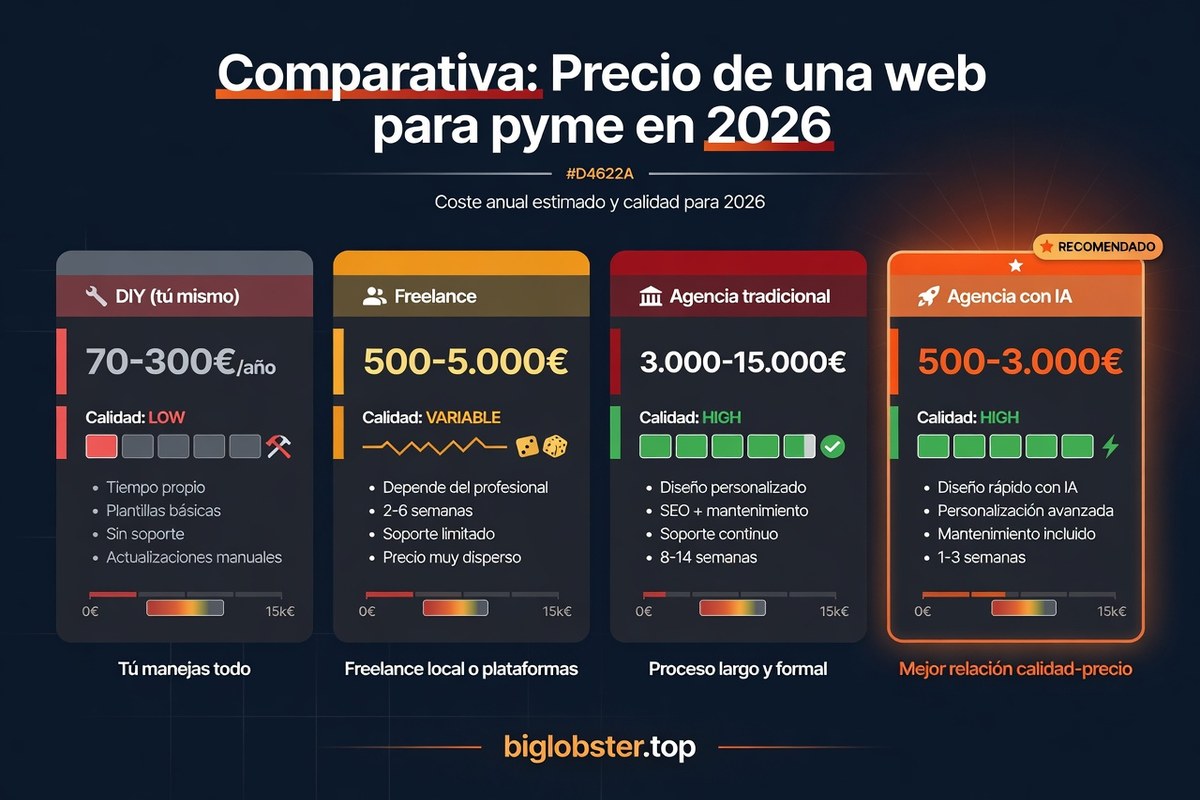
Not all providers are created equal. Here's an honest comparison of the four main options an SMB has in 2026:
| Criteria | DIY (yourself) | Freelance | Traditional agency | Agency with AI (like BigLobster) |
|---|---|---|---|---|
| Average price | €70-300/year (hosting + template) | €500-5,000 | €3,000-15,000 | €500-3,000 |
| Time to live site | 2-8 weeks (your time) | 1-4 weeks | 4-12 weeks | 3-10 days |
| Design quality | Low-medium (template) | Variable | High | High (custom) |
| SEO included | No | Sometimes | Yes | Yes, technical + content |
| Post-delivery support | No | Limited | Yes (with maintenance) | Yes (included) |
| Scalability | Low | Medium | High | High |
| Best for | Minimum budget, temporary sites | Simple projects with tight budget | Companies with high budget and flexible timeline | SMBs wanting quality quickly at fair price |
The key is the AI model: agencies like BigLobster use artificial intelligence in every phase of the process to give you more value for less money. We accelerate design, content writing, technical SEO, and code generation. This lets us offer agency-quality websites at freelance prices, with much faster delivery times. It's not magic: it's working smarter.
7 mistakes that inflate your website cost (and how to avoid them)
After hundreds of projects, here are the most common mistakes we see that unnecessarily spike the budget:
Mistake 1: Not defining the goal before requesting a quote
If you don't know whether your website needs to sell products, capture leads, or just provide information, any quote will be a shot in the dark. Solution: write in one sentence what your website should achieve and share it with the provider.
Mistake 2: Comparing prices without comparing scope
An €800 quote and a €3,000 quote aren't comparable if one includes SEO, content and support and the other doesn't. Solution: ask for a detailed breakdown of what each line item includes.
Mistake 3: Asking for "something like this website"
Copying a big company's website without their budget is the sure way to frustration. Solution: get inspired by websites from companies your size in your sector.
Mistake 4: Ignoring maintenance
A website isn't "install and forget." WordPress, plugins and servers need constant updates. Without maintenance, your site can become vulnerable in months. Solution: budget €50-150/month for maintenance.
Mistake 5: Not asking about code ownership
Some agencies use proprietary tools that lock you in. Solution: make sure the code is yours and that you can migrate to another provider.
Mistake 6: Wanting everything on day one
Trying to launch a perfect website with all features delays the launch and multiplies the cost. Solution: launch with essentials (MVP) and improve iteratively.
Mistake 7: Not measuring results
If you don't install Analytics from day 1, you won't know if your site works. Solution: demand GA4 and Search Console be included from launch.
How AI is driving down web development costs in 2026
This is the most important industry shift in the last two years, and most SMBs aren't taking advantage yet.
Until 2024, building a professional website required: a designer (weeks of work), a frontend developer (more weeks), a copywriter (days), an SEO specialist (days), and a project manager coordinating everyone. The hour cost was enormous — and each person on that team has a real cost that far exceeds their gross salary.
In 2026, AI has changed the equation:
- Design: tools like Figma with AI generate wireframes and prototypes in hours, not weeks.
- Development: code assistants like GitHub Copilot or no-code tools accelerate development by up to 60%.
- Content: AI generates draft texts optimized for SEO in minutes, then a human refines them with brand tone.
- Images: generation of customized stock images without relying on generic banks.
- Technical SEO: automated audits that spot issues in seconds.
- Testing: AI detects usability issues and suggests improvements before launch.
The result: projects that used to cost €5,000 and take 6 weeks are now delivered at €1,500-2,500 in 1-2 weeks, with the same (or better) quality. Not because we cut corners, but because we eliminate repetitive work.
At BigLobster, this is our model: we use AI in every phase to give you more value for less money. It's not the future: it's what we do every day. Here is what really changes with AI web design.
Pricing by sector: what each business type needs
Not all SMBs need the same thing. Here's a quick sector guide:
🔧 Auto repair shops
Main need: corporate site with appointment form, work gallery, and optimized Google Business profile.
Recommended budget: €800 – €2,000
Key feature: calendar integration for online bookings.
🏥 Veterinary clinics
Main need: website with service info, professional team, testimonials, and appointment system.
Recommended budget: €1,200 – €3,000
Key feature: chatbot for FAQ answers (Do you handle emergencies? What are your hours?).
🏭 Distributors
Main need: online catalog (not necessarily ecommerce), private B2B client area, and order management.
Recommended budget: €2,000 – €6,000
Key feature: ERP or order management system integration.
⚡ Installers and electricians
Main need: landing page or minimal website with visible phone, quote form, and clear service area.
Recommended budget: €500 – €1,500
Key feature: prominent WhatsApp button and embedded Google Maps.
🚚 Logistics and transport
Main need: corporate site with shipment tracking, rate request form, and visible fleet.
Recommended budget: €1,500 – €4,000
Key feature: rate calculator or smart form.
📚 Stationery shops and local retail
Main need: site with basic catalog, hours, location, and Google Business integration.
Recommended budget: €600 – €2,000
Key feature: local SEO to appear in "near me" searches.

Budget vs. investment: calculate your website's return
A website isn't an expense: it's an investment. But to be one, you need to know how to calculate the return. Simple formula:
Your website ROI = (Revenue generated by website − Total website cost) / Total website cost × 100
Real example: a veterinary clinic invests €2,000 in a website with online booking form. Thanks to the website, they attract 8 new clients a month who didn't find them before. Each client averages €60. That's €480/month = €5,760/year. In the first year: ROI = (€5,760 – €2,000) / €2,000 × 100 = 188%.
The question isn't "how much does my website cost?" but "how much does not having a working website cost me?"
According to INE, in 2026 over 78% of Spaniards search online before hiring a local service. If you don't appear, your competition does.
How to choose your provider well (practical checklist)
Before signing with any agency or freelancer, review this list:
- ✅ Verifiable portfolio: ask for real URLs of delivered projects and check them.
- ✅ Itemized quote: be skeptical of quotes that just give one total with no breakdown.
- ✅ Delivery timeline in writing: with clear milestones and deliverables for each phase.
- ✅ Code ownership: make sure everything is yours when finished.
- ✅ Post-delivery support: what it includes, for how long, and at what cost.
- ✅ SEO included: at least basic technical SEO from launch.
- ✅ Clear communication: one point of contact, no nonsense, no unnecessary jargon.
- ✅ No lock-in contracts: be skeptical of anyone tying you up with long contracts without justification.
- ✅ AI usage: ask if they use artificial intelligence to cut costs and speed up timelines. If the answer is no or they look confused, you're with the wrong provider in 2026.
Frequently asked questions
How much does a website cost for a freelancer in 2026?
For a freelancer needing a professional website (landing page or basic 3-5 page corporate site), the price in 2026 ranges from €500 to €2,000 with a serious professional. If it includes SEO, copywriting and support, the average is around €1,000-1,500. With AI tools, some agencies offer this full range for less.
Is WordPress better or visual builders like Wix or Squarespace?
WordPress remains the most flexible and scalable option, ideal if your site will grow. Builders like Wix or Squarespace are faster to start but lock you into their platform and limit customization. In 2026, with AI, WordPress is easier than ever to manage, so our recommendation is WordPress for any SMB serious about their digital presence.
How long does it take to build a professional website?
A landing page: 3-7 days. A corporate site: 1-3 weeks. An ecommerce store: 2-8 weeks. These timelines assume you deliver content (text, photos, logos) on time. The most common bottleneck isn't development: it's waiting for the client to send information.
What if I don't invest in SEO?
You can have the most beautiful website in the world, but if it's not optimized for Google, you'll be invisible. Technical SEO must be included from development. Content SEO (blog, keywords) is ongoing work you can do yourself or delegate. Without SEO, your website depends 100% on paid advertising for traffic. Once the visits arrive, here is how to turn them into customers.
Can I build my site myself and have someone improve it later?
Yes, but keep in mind it's often more expensive (and slower) to fix a website built with a visual builder than to build it right from the start. If your budget is very tight, you can start with a simple landing page and scale when you see results. What we don't recommend is spending months learning to do something a professional with AI can do in days.
How often should I refresh or update my website?
The design should refresh every 3-5 years. The technology (WordPress, plugins, PHP) needs weekly updates. The content should grow continuously (at least one blog post a month if you want to rank in Google). If your site hasn't changed in over 3 years, it's probably losing ground to more active competitors.
Want to know what YOUR website would cost?
Tell us what you need. We give you a no-obligation quote, with fixed price and real timelines. We use AI to deliver faster and cheaper.
Request free quote →