
What was impossible two years ago is routine today
Here's a real example. A canned-goods producer from Galicia with 4 employees. Three years ago they sold only in Spain, to shops and a bit online. In 2025 they entered Amazon Europe and now 30% of their revenue comes from Germany and France. They didn't hire anyone abroad. They didn't open offices. They just learned to use tools that already existed.
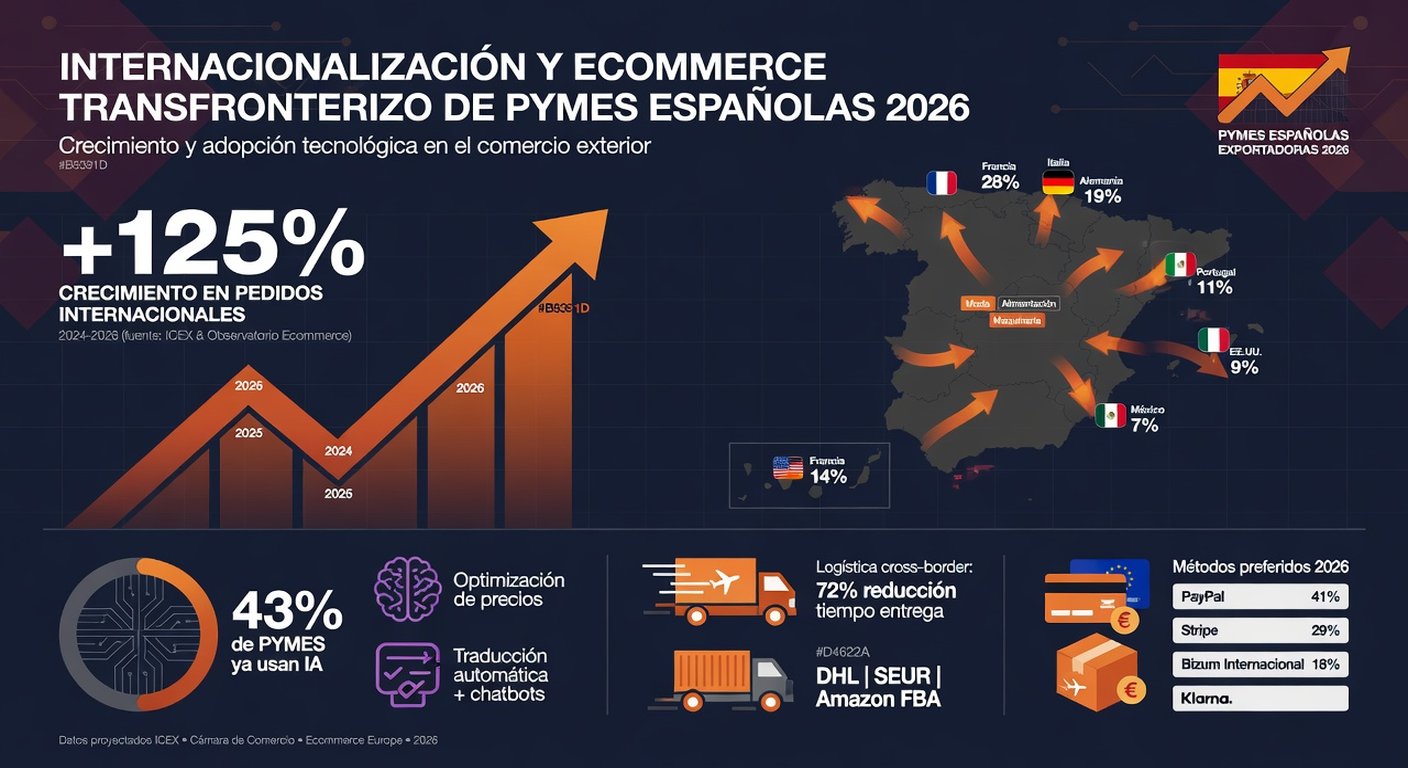
This isn't an exception. According to Flowwow and Admitad research for ICEX, international orders grew 125% in the first half of 2025 among Spanish SMBs selling online. The number of regular exporters (companies selling continuously abroad) is pushing 46,000, with 5% year-on-year growth.
What changed isn't the will to export—it's that barriers fell. You used to need an export department, a lawyer handling tariffs, an international logistics partner. Today you need a good website, smart marketplace choice and grasp of four basic concepts about shipping and payments.
Where to sell: it's not Amazon or nothing
When people say "sell abroad online," the first image is Amazon. Amazon is fine—it has traffic, logistics, consumer trust. But it's not the only option, or always the best to start.
Amazon: Ideal if you have your own product with enough margin (commissions around 15% plus FBA logistics costs). Advantage: you forget about shipping and customer service. Downside: fierce competition and total dependence on their rules.
Etsy: Perfect for handmade, artisanal or value-added products. Lower commissions than Amazon, more loyal community. Selling ceramics, natural cosmetics or fashion with story? This is your place.
AliExpress / Temu (seller side): For competitive-price, high-volume products. Tight margins but immediate global reach. Not recommended if your value is quality.
Your own website with international payment gateway: Most profitable long-term because you don't pay per-sale commissions and build your brand. But requires more traffic and SEO work. A well-built website makes the difference here.
B2B marketplaces: Platforms like Alibaba, Europages or IndustryStock for B2B sales. Less known but much higher average deal size.
My advice: start on a marketplace where your customer already is (Amazon or Etsy depending on your product) and build your own website in parallel. In a year, your website should be primary and the marketplace complementary.
The website you need for selling abroad (it's not your Spanish version)
This is where most fail. They take their Spanish website, run it through Google Translate and call it done. Mistake. Selling in another country means adapting several things beyond language.
Must-haves for your international website
- At least English plus Spanish: You don't need 10 languages. Spanish and English cover 80% of potential market. But translation must be professional, not automated. Customers seeing bad translations don't buy.
- International payment gateway: Stripe or PayPal minimum. Accept cards worldwide and if selling in Europe, SEPA. Many Spanish SMBs lose sales because they only have Redsys (doesn't work outside Spain).
- Transparent shipping costs: No "ask for quote." Post real costs by zone from day one. If you can't calculate them, use a shipping calculator at checkout.
- Clear customs info: For shipments outside the EU, customers need to know if extra tariffs or VAT apply. Be transparent: "This ships from Spain. Outside-EU destinations may have import tariffs charged to buyer."
- Multilingual customer support: You don't need 10 languages. A chatbot answering FAQs in English and Spanish covers 80% of inquiries. Rest gets email with 24h response.
Logistics without losing your mind
Logistics is the scary part. And rightfully so: a lost shipment, a package broken in customs or a customer receiving an order 6 weeks late can tank your international reputation.
Luckily, you now have options that didn't exist five years ago:
- Amazon FBA: Ship your stock to their European warehouses and they handle it all: storage, shipping, returns and customer service. You pay for it, but you forget logistics exists.
- Correos / SEUR / DHL eCommerce: All have SMB-specific solutions for cross-border shipping. DHL eCommerce is fastest (3–5 days to Europe), Correos cheapest for light parcels.
- Shipping platforms like Sendcloud or Outvio: Connect you with multiple carriers and automate labels and tracking. Ideal if you sell through your own site and want multiple shipping options.
What I don't recommend: overcomplicating at first. Start with one carrier for one market (say DHL to Europe) and expand when you have volume and understand real costs.
AI is changing this (a lot)
In June 2026 BBVA launched an AI-powered sales agent with Oftex for exporting SMBs. What does it do? Locates potential buyers abroad and automatically activates sales contacts, 24/7. BBVA customers get a free trial to contact 20 companies and make 100 sales calls.
That's just one example. AI is impacting internationalization several ways:
- Quality automated translation: Translating your product catalog to 5 languages takes hours, not weeks. Then a human reviews what matters.
- Market analysis: AI tools analyze which products have demand in each country, what competitors charge and where gaps exist.
- Automated customer support: Multilingual chatbots solving questions about shipping, sizes, warranty... in any language, anytime.
- Localized content generation: Create product descriptions for each market using local keywords, not literal translation.
The stat that sums it: 43% of Spanish companies already use AI moderately to intensively, per the European Central Bank. Spain ranks among Europe's highest for SMB AI adoption. It's not the future—it's happening now.
Real cases that work (and what you can learn)
Quickpay: from local to global
Quickpay started selling digital services locally. Today over 40% of revenue comes from outside Spain. Their strategy was clear: dominate the Spanish market first, then adapt the website to English, then enter marketplaces where their international customers were. They didn't try to be everywhere at once—they picked one market, mastered it, then expanded.
Galician canned goods (the earlier example)
This 4-person company found their canned goods had added value abroad that wasn't appreciated the same in Spain: gourmet, artisanal, with story. They created an English-language online store with pro photos, entered Amazon Europe and a French gourmet marketplace. Result: in 18 months they went from 0% to 30% international revenue.
What these cases share: they didn't wait for a perfect website or an export department. They started with what they had, adapted what was needed and iterated.
Mistakes that cost money
After watching hundreds of SMBs try selling abroad, these are the most common (and most expensive) errors:
Mistake 1: Don't research the market first
Your product might be great in Spain and have no demand in Germany. Or France might have 50 competitors doing the same. Spend two weeks researching: search Amazon in the target country, check prices, read reviews of similar products to see what customers complain about. Free and saves you thousands in mistakes.
Mistake 2: Don't adapt payment methods
Spain uses cards and Bizum. Germany prefers PayPal and bank transfer. Netherlands uses iDEAL. Brazil uses Pix. Only offering local Spanish methods? You're losing sales. Fix: implement Stripe (accepts cards worldwide) and PayPal minimum.
Mistake 3: Ignore taxes and tariffs
Within the EU it's easy: VAT handled via OSS (One Stop Shop). Outside the EU, each country has rules. You don't need to be a tax expert, but you do need to know which taxes apply and tell the customer before they buy.
Mistake 4: No international returns plan
Returning a product from Germany to Spain costs money. Many SMBs don't clarify this and find angry customers and bad reviews. Fix: be transparent about returns policy and, if the product allows, consider holding stock in a warehouse in the destination country (FBA, for example).
Mistake 5: Translate literally instead of adapting
"Canned premium bonito tuna belly in extra virgin olive oil" doesn't translate word-for-word. It adapts for local taste and sales language. Sales copywriting isn't translation—it's cultural adaptation. Here AI well-used saves you tons of time.
ICEX+Adigital webinars for 2026
If you've never sold abroad and don't know where to start, ICEX Spain Export and Investment and Adigital signed an agreement in April 2026 for a series of free webinars on international e-commerce. The agreement was published in the Official Gazette on 29 April 2026 and the series covers:
- Accessing and operating global marketplaces
- Managing international logistics: shipping, customs and delivery operations
- Online sales strategies in foreign markets
Free and specifically designed for SMBs and self-employed. No excuse not to get at least basics before you launch.
What an SMB should budget for digital internationalization
Depends on approach, but here are real numbers for reference:
| Item | Initial investment | Monthly cost |
|---|---|---|
| Multilingual website + international gateway | €1,500 – 4,000 | €50–150 (hosting + maintenance) |
| Marketplace (Amazon, Etsy) | €0 (commissions only) | 10–15% commission per sale |
| Professional product photography | €300 – 1,000 | €0 |
| Website translation + copywriting | €500 – 2,000 | €0–200 (additions) |
| International logistics (shipping) | €0 | Variable per order (€5–25 per shipment) |
| Marketplace advertising | €0 | €200–1,000 (by volume) |
Total to start: €2,300–7,000 initial investment, plus roughly €250–1,350/month operating costs. Far less than opening a foreign office, right?
"Internationalization is no longer a luxury for big companies. It's a necessity for any SMB wanting sustainable growth. And technology's made it more accessible than ever."
, Juan José Fuentes Saiz de Bustamante, BBVA Director of Foreign Trade for SMBsThe Spanish market is ready to make the leap
Spanish e-commerce grew 15% in gross sales and 8% in order count. Competition within our borders is intense and margins narrowing. To grow, the logical answer is geographic diversification.
Export data confirms this is happening: Spain hits record highs in destinations like UK, Morocco, Turkey and Mexico. Oceania exports grew 15%, Africa 6.4%, Asia 3.5%. Not just Europe—it's global.
What I find most interesting is the cultural shift. Five years ago an SMB said "why sell abroad?" Now they ask "how?" That mindset change is most important, and we're seeing it in more entrepreneurs every conversation.
Frequently asked questions
How much does it cost to start exporting online as an SMB?
Depends on channel. Selling on marketplaces like Amazon can start at €0 initial investment (commission-only), while building your own internationally-focused store might cost €1,500–6,000 with an agency. The free ICEX+Adigital webinars in 2026 are a good starting point.
Which marketplace is best for a starting Spanish SMB?
Amazon generates the most international traffic but is most competitive. For value-added Spanish products (food, fashion, crafts), platforms like Etsy or even AliExpress can be better entry points. Ideally combine your own marketplace with presence in one or two global ones.
Do I need an English website to sell abroad?
Not mandatory, but highly recommended. At least an English version of product pages and checkout. With AI, translating a professional website costs a fraction of two years ago. What matters is the purchasing process being clear to foreign customers.
What about tariffs selling outside the EU?
Depends on country and product. No tariffs within the EU thanks to the single market. Outside the EU, customers might pay import tariffs and VAT from their country. Best to be transparent on your site and check with your carrier on costs before launching in a new market.
Should I start selling in just one country?
Actually, yes. Pick a market where your product makes sense (say, if you sell gourmet Spanish products, France or the UK could be good first steps) and master it before expanding. Better to nail one than half-ass five.
Want your SMB selling outside Spain?
We help set up your international digital presence: multilingual website, global payment gateway, international SEO and marketplace strategy. No BS, no surprises.
Tell us about your project →