
Here's a picture I see too often: a business with great location, solid product, good customer service. But when someone searches "plumber in Manchester" or "dentist in Los Angeles," they don't show up. Not on the first page, not on the map, nowhere. Meanwhile a competitor with worse service but better online visibility takes the customers.
That's the local SEO problem in a nutshell. And the good news: it has a solution, it costs no money (the important part anyway), and results show up in weeks, not years.
What is local SEO and why should you care?
Local SEO is what makes your business appear when someone searches for a service near them. "Restaurants near me," "mechanic in Seattle," "family lawyer New York." Those searches with geographic intent.
It's significant: according to Google data, 76% of people doing a local search on mobile visit a related business within 24 hours. 28% of those searches end in a purchase. Not casual browsing. People with their wallets ready.
Local SEO differs from "regular" SEO in one fundamental way: you don't compete with your whole country, you compete in your city, your neighborhood. Competition is much smaller, and that's a massive advantage for SMBs.
Google Business Profile: your listing, your storefront, your best salesperson
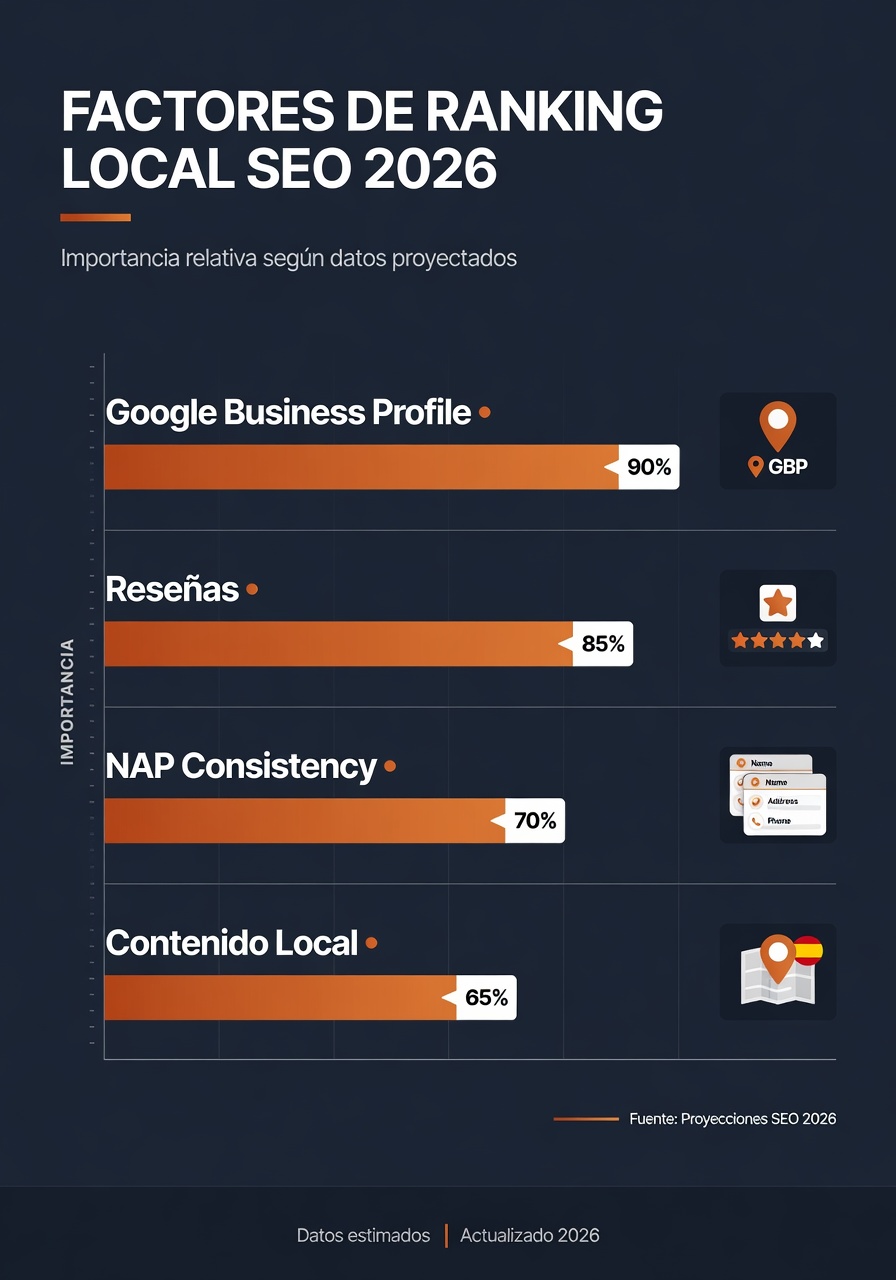
If you do one thing after reading this, do this: claim and optimize your Google Business Profile (GBP). It used to be called Google My Business. It's free and it's, by far, the biggest factor in local visibility.
Think of your GBP listing as a mini-website inside Google. It has your name, address, phone, hours, photos, reviews, services, products, and even a direct messaging system. A potential customer can learn everything about your business without leaving Google.
The problem: most SMBs created their listing years ago, verified it, and forgot about it. Empty description, three blurry photos from 2019, 12 reviews from three years ago. Google reads that as an inactive business. Inactive businesses don't rank.
The 7 fields you need at 100%
Google internally scores how complete your listing is. A 100% listing doesn't guarantee first place, but a 40% listing guarantees you won't show up. Here's what to check:
- Business name: The real one, no keyword stuffing. "Garcia Electric" is fine. "Garcia Electric Urgent 24h Repairs Cheap New York" violates Google rules and can get your listing suspended. Sounds crazy, but it still happens.
- Primary category: The most important factor. Pick the most specific option possible. Not "lawyer," but "family law attorney." Not "shop," but "electric vehicle repair shop" if that's you. You can add up to 9 secondary categories.
- Description (750 characters): Explain what you do, who it's for, where. Include your city naturally. Not a keyword list — text a human would read.
- Updated hours: Including holidays and vacations. Nothing generates 1-star reviews faster than a customer who travels and finds you closed when Google said you're open.
- Phone and website: That work, are staffed, and match exactly what's on your website and other directories. This is called NAP consistency (Name, Address, Phone) and Google checks it.
- Attributes: WiFi, parking, accessibility, outdoor seating, card payment, delivery. Many customers filter by these on Google Maps without you knowing.
- Services with pricing: Adding your service catalog with price ranges increases transparency. Transparency drives clicks.
Photos: the part everyone skips that makes the biggest impact
Fact that never sounds believable: businesses with over 100 photos on their GBP get 520% more calls than those with under 10. Not a typo. Five hundred and twenty percent.
Google prioritizes listings with recent, varied photos. So do users: a listing with no photos or generic stock photos signals neglect. Would you enter a restaurant with zero photos of the place?
What photos to upload and how often:
- Exterior of the building (so people recognize you from the street)
- Interior (showing atmosphere, showing people)
- Your team working (humanizes the business)
- Real work or products (proof you exist and do good work)
- Before/after if applicable (physiotherapy, renovations, clinics...)
Minimum: 20 photos starting out, 4-5 new ones every month. You don't need a professional photographer — a current smartphone with good light is enough. The key is consistency.
Reviews: your reputation, your ranking, your business
Reviews are the second biggest local SEO factor after your primary category. And they're the only element of your listing you don't directly control. That's why they carry so much weight — Google knows they're hard to fake.
But it's not just how many. Google measures: frequency (a listing with 20 recent reviews ranks better than one with 200 from three years ago), sentiment (the specific words people use), business response (if you reply, how, how fast), and diversity (all 5 stars that are identical raises red flags).
The strategy that works best: an automated request system. After each service, send a WhatsApp or email with a direct link to leave a review. No friction. No searching for your listing. This method doubles the response rate of verbal requests.
Negative reviews? Always respond within 24 hours. Don't get defensive or argue publicly. Thank them for feedback, acknowledge the issue, offer a solution or direct contact. I've seen a professional response to a 1-star review convince more prospects than ten 5-star reviews with no response. It shows someone cares.
What your website needs to do (besides exist)
There's a myth: having a great GBP listing is enough. It's not. Your website still matters, and Google cross-checks your listing info with your site. Inconsistencies lose you ranking.
The minimum your website needs for local SEO:
First, LocalBusiness Schema. A JSON-LD code block on your site that tells Google, in structured format, who you are, what you do, where, and your hours. Don't use generic "LocalBusiness" — use the right subtype (Dentist, Restaurant, Plumber, LegalService...). There are dozens at schema.org. Choosing the right one measurably impacts the rich results Google shows.
Second, real local content. Include your city name in your homepage title, H1s, and service descriptions. If you operate in multiple locations, create a page per location with unique content. Don't copy-paste changing only the city name — Google detects duplicated content and penalizes it.
Third, speed and mobile. Over 70% of local searches happen on mobile. If your site takes over 3 seconds to load, users leave. Before your site helps your local SEO, it has to work technically.
Fourth, NAP consistency. Your name, address, and phone must be identical on your website, GBP, Yellow Pages, Facebook, Yelp, everywhere you appear. Google verifies this. Discrepancies drop your ranking. Spend an afternoon auditing and unifying this data. It's tedious but it works.
Posts and Q&A: the features 90% of local businesses ignore
GBP lets you publish updates directly on your listing: offers, news, events, answers to FAQs. 90% of local businesses never post anything. That means if you post once a week, you're already ahead of almost all your competition.
What posts work best: limited-time offers (create urgency), answering a frequent question in your sector (add value), or highlighting recent work with photos (social proof).
And the Q&A section: don't wait to be asked. You can (and should) create your own FAQs from your owner profile. Questions like "Do you accept mobile payment?", "Is there parking?", "How much is an initial consultation?" answered directly on the listing. It removes friction and might be what sets you apart from the competitor next door.
"Your Google listing is the first touchpoint most potential customers have with your business. And unlike your website, it's there without them having to search for you."
Your action plan: what to do this month
All of that might sound like a lot. It's not. The key is starting at the beginning and being consistent. Your 30-day plan:
Week 1: Foundation. Claim or verify your GBP. Complete every field at 100%. Define your primary category (most specific possible) and add all relevant secondary ones. Do a photo session of your business and upload at least 20.
Week 2: Consistency and website. Check that your NAP is identical across your website, Google, Facebook, and every directory you appear in. Implement or fix LocalBusiness Schema. Include your city in titles and service page text.
Week 3: Reviews. Define your request system (an automated message after each service with the direct link). Start asking for reviews today. Respond to all existing ones, especially negative ones.
Week 4: Maintenance. Publish your first GBP post. Check your listing stats (discovery searches, calls, direction requests). Set up monthly reminders to review metrics, upload new photos, and post at least once.
What doesn't work (and they're selling you)
Before we finish, I want to be honest about some tactics you'll see recommended:
Buying fake reviews. Google detects it better every time. Consequences range from removing suspicious reviews to suspending your listing. Not worth it.
Stuffing your business name with keywords. "Emergency Locksmith 24h Fast Cheap Los Angeles" isn't your business name. It violates Google rules and eventually gets penalized.
Ignoring your website and focusing only on Google. Your listing is the center, but your website reinforces it. Both work together.
Thinking local SEO is "set it and forget it". The opposite is true. Google rewards active businesses: new photos, recent posts, frequent reviews, current hours. Consistency is your best tool.
First results show in 1–3 months. Not instant, but much faster than general SEO. And once you're in the Local Pack (the top three results with map), quality traffic is steady. Without paying per click, without depending on campaigns that stop when budget runs out.
Frequently asked questions
How much does local SEO cost?
The core part — optimizing your GBP, getting reviews, and keeping your website current — you can do yourself for free. If you want professional management, local SEO services for SMBs typically run €200–€600 per month, depending on your industry and local competition.
Do I need a website for local SEO?
Technically no. You can rank with just your GBP. But an optimized website multiplies results: more content for Google to understand your business, service-specific pages per location, and somewhere to direct the traffic coming from your listing. Highly recommended.
How many reviews do I need to rank?
No magic number. What matters is frequency (steady flow beats a burst), diversity (not all identical), and how you respond. With 30-50 recent reviews and above 4.0 average, you're competitive in most local sectors.
How long for local SEO results?
First changes usually show in 4–8 weeks. Six months of consistent work usually gives solid, stable results. Faster than general SEO because local competition is smaller, but it takes patience.
Can I show up in Google Maps without a physical address?
Yes, if you're a service business that goes to customers (plumber, electrician, mobile services). You can set a "service area" instead of showing an address. Important: define real coverage zones, not your whole country if you work in one city.
Do smartphone photos work or do I need a photographer?
Smartphone photos work if they have good light and look professional. You don't need a photographer to start. What matters: they're real (not stock), varied, and you update them regularly. A current phone with natural light gives great results.
What if a competitor leaves me fake negative reviews?
Report them directly from your GBP. Google reviews them and removes them if detected as fake. Having a steady flow of real reviews quickly dilutes the impact of one or two fake ones. Don't obsess — keep your strategy and let the volume of authentic reviews speak.
Want your business to show up on Google Maps?
We optimize your local presence: from GBP to local website content with Schema. No lock-in contracts, no smoke.
Request local SEO audit →