The numbers that sting: how many you miss
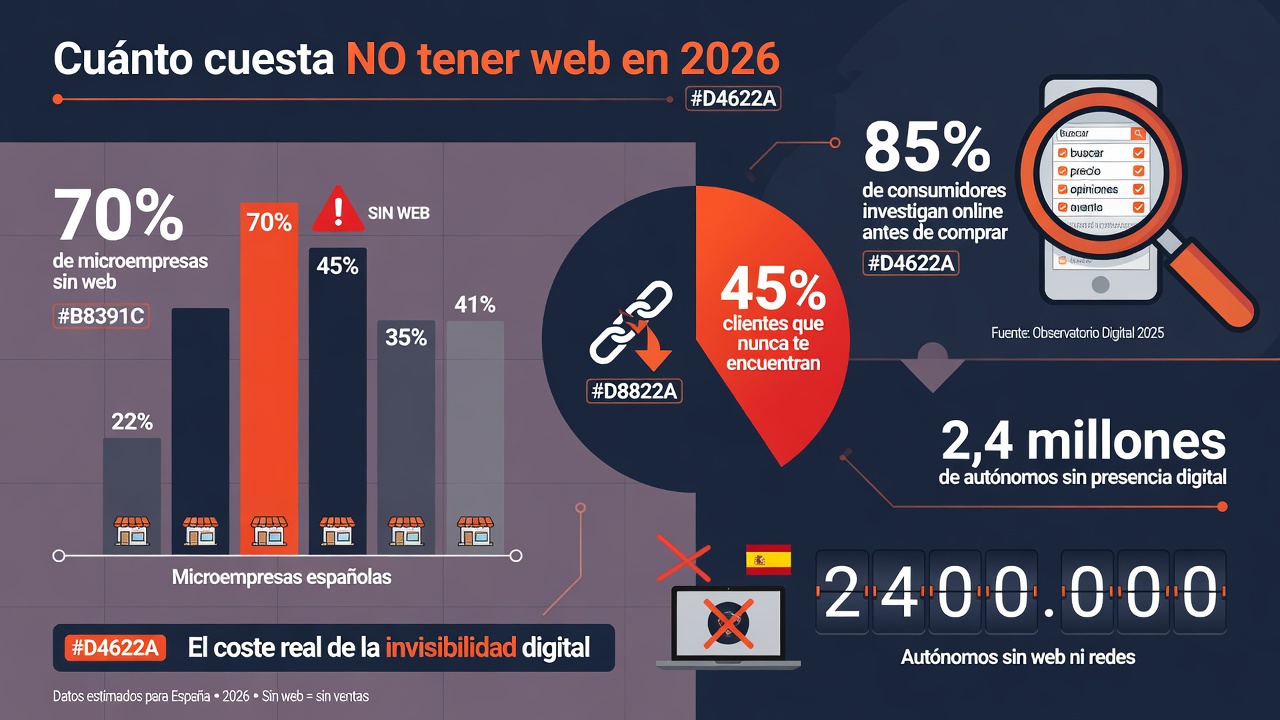
Let's put hard numbers on what many business owners suspect but don't want to face. According to Spain's National Statistics Institute (INE) ICT survey (Q1 2025, published in 2026), 70% of Spanish businesses with fewer than 10 employees have no website. That's roughly 2.4 million businesses and freelancers.
Know what that means? Of every ten businesses like yours, seven are competing with one hand tied behind their back. Not because they have worse products or service — but because when someone searches for what they offer on Google, they don't exist.
A Beedigital study on Spanish micro-business reality is even sharper: 82% of small businesses don't appear on the first page of Google. And the first page isn't a vanity issue — 92% of users never click past the first page. If you're not there, you don't exist.
What you lose every month (and aren't counting)
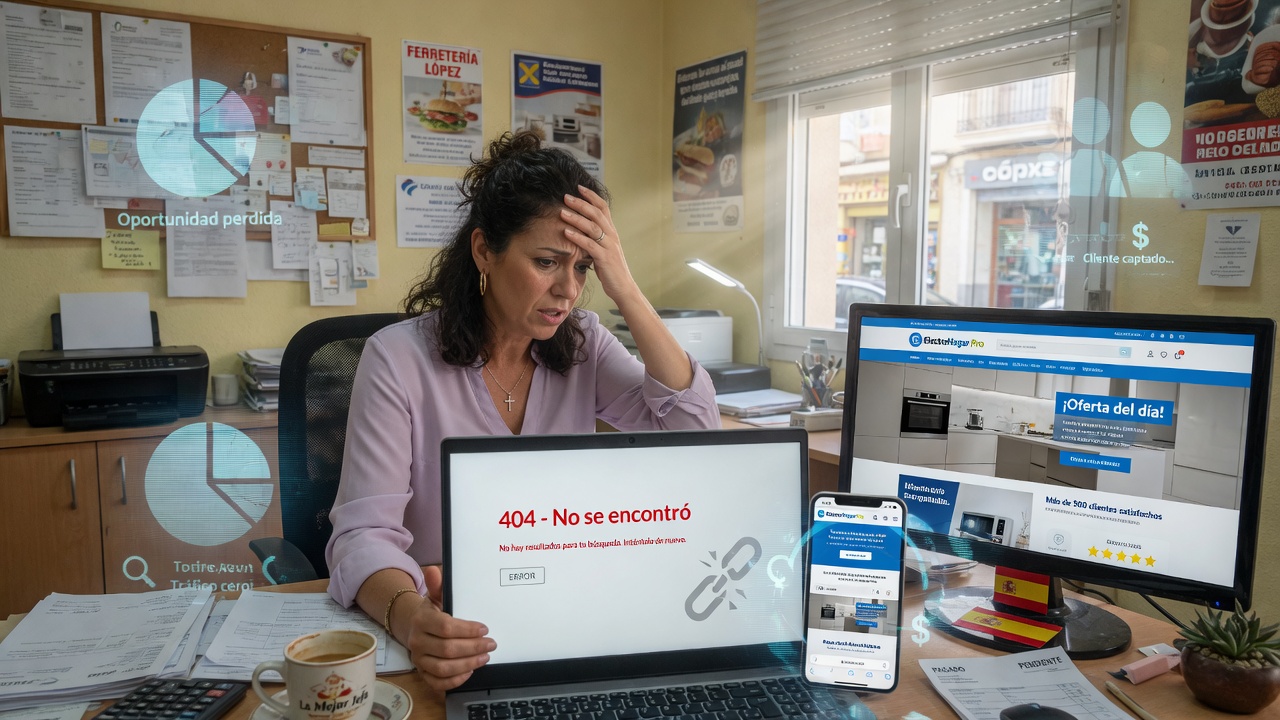
When a potential customer needs your product or service, they search Google first. If your competitor shows up with a professional website, photos, testimonials and a clear contact form, and you don't... who do you think they'll call? It's not that you're worse at what you do. It's that you're not in the game.
Three types of losses never show up in your books but they're real:
Direct loss of customers
A restaurant in Ourense with no online menu or photos. When someone searches "Spanish restaurant in Ourense" and sees three competitors with professional websites, that restaurant simply drops out of the consideration set. The customer doesn't decide not to go. They don't know it exists.
According to AECOC, 67% of Spanish buyers use digital channels (search engines, social media, AI assistants) before making a purchase decision. If you're not on those channels professionally, you lose those customers.
Loss of credibility
Think about your own behavior. When you need to hire a service — a lawyer, a plumber, an accountant — do you trust the one with a professional website and verified reviews, or the one with only a Facebook profile full of blurry photos? Exactly. Your customer thinks the same way.
70% of Spanish users distrust a brand that only operates through WhatsApp or social media, according to consumer surveys. Not because social media is bad, but a proper website signals permanence, solidity and professionalism.
Loss of operational efficiency
Without a website, you're probably answering the same questions on WhatsApp five times a day. "What's your price?" "How long does it take?" How much time do you burn sending quotes by email when a web form could automate it? Without a digital presence, your team works harder to achieve less.
How to calculate what not having a website costs you
This formula is simple but eye-opening. Get a pen or spreadsheet:
Monthly cost of no website = (Potential customers searching for what you offer × % who go to competitors) × Average customer value
Here's a concrete example. A physiotherapy clinic in Vigo:
- About 200 people search "physiotherapist in Vigo" on Google each month
- If the clinic doesn't appear, at least 70% (140 people) go to competitors
- Of those 140, even if only 5% become actual clients, that's 7 lost customers a month
- Average customer value: €150 (full treatment package)
- Monthly cost: 7 × €150 = €1,050
- Annual cost: €12,600
That's for a small operation. For an online store that could sell 24/7, the numbers multiply. For a law firm getting qualified inquiries from the web, they do too.
Now compare that to what a professional website costs: €800–2,500 for a corporate website. The investment pays for itself in weeks, not years.
The excuses costing you money
I've talked to hundreds of freelancers and business owners who tell me the same thing: "I don't need a website because my clients come by word-of-mouth." I believe them. But I also ask: what about customers from outside your town? What about the people who search for you on Google and find your competitor instead? What about prospects who compare you to competitors and choose them because they look more professional?
The most common excuses — and what they actually cost:
"I don't have time"
Building a professional website with AI today takes less time than you think. About 30 minutes to brief it, and you have something live in a week. How much time do you lose a month answering the same WhatsApp messages? Probably more than you'd need to put a website live. How that process works: AI web design and what changes for your business.
"It's too expensive"
A basic website built with modern tools costs less than you spend on coffee a month if you work with an AI-powered professional. And if you can't even do that, a simple landing page on Carrd or similar costs €15 a year. Less than a dinner.
"My industry doesn't need a website"
If your potential customer has a smartphone (and they do), they need to find you. A plumber, a farmer selling direct, a corner store — all have customers who search Google. Your industry doesn't determine if you need a website. Your customers do.
Verifactu: the final push
July 1, 2026 is the deadline for freelancers and small businesses to adapt their billing systems to the Verifactu regulation. If you're still fuzzy on what it is and how it affects you, read our complete guide here.
What does Verifactu have to do with having a website? More than you'd think. Businesses with an established digital presence (website, CRM, online payments) find the jump to electronic invoicing much easier. Businesses still running on paper, Excel and manual invoices face two transitions at once: going digital for their image and going digital for their billing.
I won't lie: you can adapt to Verifactu without a digital foundation, but it's painful and expensive. If you already have a website with payment integration and customer management, the path is much smoother.
What to do (and what to skip) to fix this
I'm not going to tell you to launch a 500-product online store tomorrow. That would be unrealistic. What I'll suggest is a three-step plan that works:
Step 1: Land
Create a simple page with your name, what you do, where you're located and how to reach you. Can be a single-page landing page. Cost: €0 (DIY with a free tool) to €500 (a pro using AI). Time: a weekend.
Step 2: Position
Add basic SEO: optimized title, clear description, local keywords. Connect with Google Business Profile to show up in local maps. Cost: €0 if you do it, €300–800 if you outsource.
Step 3: Convert
Add a contact form, WhatsApp button, real customer testimonials and photos of your work or business. This is what turns visitors into clients. Cost: included in step 1 if you do it right. If you already get visits but few enquiries, see why your website gets traffic but no sales.
In three weeks you can go from invisible to having a working digital presence. No need to do more. Later, as time allows, add a blog, online store, automation. But first things first: exist.
Frequently asked questions
How many Spanish small businesses don't have a website in 2026?
According to 2025 INE data, 70% of Spanish micro-businesses (fewer than 10 employees) have no proper website. That's about 2.4 million businesses and freelancers who rely only on social media, third-party platforms or in-person presence.
How much money does a small business lose without a website?
Depends on sector and size, but industry studies show a business without a website loses 30–45% of potential customers. For an operation billing €5,000/month, that's €1,500–2,250 in revenue going straight to competitors with a digital presence.
What if I only have Instagram or Facebook but no proper website?
Social media is a good addition, not a replacement for a website. Algorithms change, accounts get suspended and you don't own the content or the contacts. A website is your own space online: nobody can take it away and you control the user experience, contact data and Google ranking.
Do I need a website right now or can I wait?
Every day without a website is another day a potential customer searches for you, finds a competitor and hires them instead. Plus, regulations like Verifactu (deadline July 1, 2026) mean digitalization is no longer optional — it's now a compliance requirement.
Can I build my own website or do I need to hire someone?
Depends on your time and tech comfort. If you have a weekend and patience, you can build a working landing page with Carrd, WordPress or similar. If you want it done fast and done right, hiring an AI-powered professional might cost €500–1,500. What we don't recommend: putting it off indefinitely.
Ready to stop being invisible?
We help you launch a professional website in days, not months. With AI, fixed pricing and no surprises. Tell us about your business and we'll tell you exactly what you need.
Get started now →