
SL or stay self-employed? The first question you need to answer
Be honest: incorporating a company isn't free, isn't fast, and isn't always necessary. But there are situations where staying self-employed is costing you money. Real money. If you want to compare exact costs for your case, read our 2026 labour cost guide to see what makes sense.
The most obvious reason is taxes. A self-employed person earning €80,000 net pays 35–45% in personal income tax depending on region and deductions. An LLC with the same profit pays 25% corporate tax. If you reinvest that money and don't take it as a dividend, the difference is brutal over time.
But taxes aren't everything. If you have business partners, if your work carries lawsuit risk (construction, technical services, distribution), or if you work with government bodies that require financial proof, an LLC gives you something self-employment doesn't: liability limited to capital you invested.
I won't sugarcoat it: an LLC's fixed costs are higher than self-employment. Annual accounting, filing statements in the commercial registry, corporate tax filing... all adds up to €1,200–3,000 a year in recurring costs that don't exist as self-employed. The real question is whether the tax savings and asset protection justify that overhead.
The 7 costs of setting up an LLC (with 2026 prices)
Let's get to what matters. I won't give you a final number and walk away. I'm breaking down each line item so you know exactly where your money goes and what you can adjust.
Company name certificate
First, ensure the name you want isn't taken. You apply to the Central Commercial Registry (rmc.es). You propose up to 5 names in order of preference. It costs about €16 and takes 1–3 business days. Without this, you can't proceed.
Capital contribution and bank deposit
Minimum capital is €1. Yes, one euro. Since the 2022 reforms you no longer need the old €3,000 minimum. But here's what they don't tell you: most serious companies deposit €3,000–10,000. Not because the law requires it, but because to a large client or government agency, an LLC with €1 capital looks shaky. You'll need a bank certificate of deposit for the notary.
Notary fees
The notary drafts the incorporation deed: partners, capital, corporate purpose, management structure. Fees range from €150–400 depending on bylaw complexity and number of partners. Standard PAE bylaws cost less. Custom clauses (share transfer restrictions, withdrawal rights, partnership agreements) cost more.
Property Transfer Tax (ITP)
Good news: LLC incorporation is exempt from property transfer tax since 2010. You don't pay this. Many people don't know this and panic when they see it in an outdated guide.
Commercial Registry filing
The incorporation deed must be filed in your province's commercial registry. Cost: €100–200. Until it's filed, the company doesn't legally exist even though you've signed before the notary. The registry has 15 business days legally, but in practice it can be faster without backlogs.
Tax ID and tax registration (Hacienda)
With the deed signed (filed or not), you request a provisional tax ID and register for business activities. This costs €0–50 if you do it yourself with digital certificate. Professional activities are tax-exempt here, so if you're in services, you skip this.
Self-employed quota as administrator
This isn't an incorporation cost, but it's what hits first. As an LLC administrator-partner, you must register in the self-employed scheme. The 2026 quota is around €370/month without special rates. With new self-employed rate, it's €80/month for 12 months.
Accounting firm (optional but common)
If you delegate everything to an accounting firm, full incorporation usually costs €200–500 (not including items above, which you pay separately). Online firms like Finutive and Declarando offer packages from €200. Standard PAE with in-person can run €400–600.
"I've seen entrepreneurs pay twice: once for an LLC set up with too narrow a corporate purpose, then again to modify bylaws a year later when the business pivoted."
, Madrid accounting firm, 2026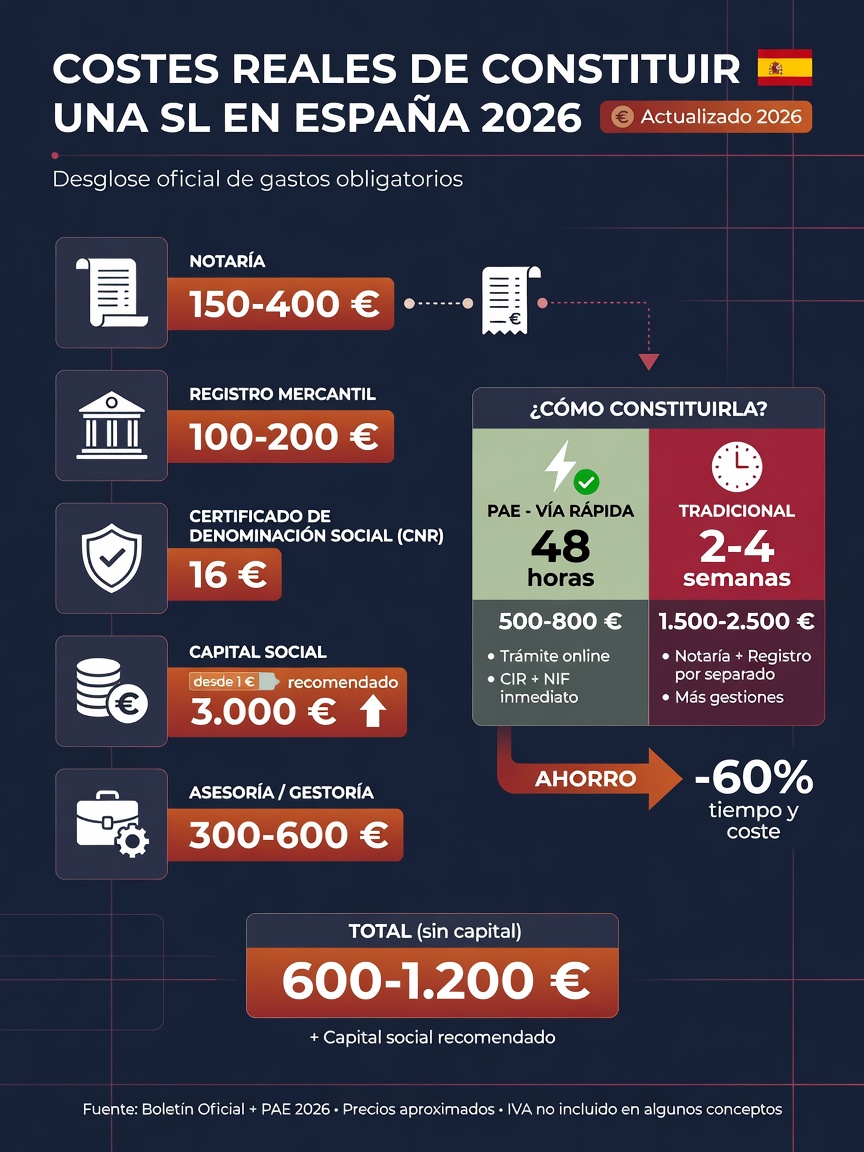
The PAE route: how to set up an LLC in 48 hours
PAE (Entrepreneur Support Point) is my recommended option for most cases where you don't need heavily customized bylaws. It works through CIRCE and lets you incorporate using standard Ministry-approved bylaws.
The process:
- Get your company name certificate (1–3 days)
- Fill out the PAE form (DUE - Single Electronic Document) with company, partner and administrator details
- It generates the incorporation deed with standard bylaws
- Sign before a notary (in-person or certified video)
- The notary files everything with the registry and applies for your tax ID
- In 24–48 hours your company is operational
When NOT to use PAE: if you need specific shareholder protections, special share-transfer restrictions, or complex governance (board of directors with committees). Then you need custom bylaws and the cost doubles.
5 hidden costs that don't appear in guides but you'll find
This is where most "how much to set up an LLC" articles fall short.
1. Digital certificate
You need it for everything: signing the deed, filing with tax authorities, registry submissions, contacting social security. The FNMT certificate for individuals is free and lasts 4 years (only video identification carries a €2.99 + tax fee). If you also need a legal-representative certificate to act on behalf of the company, that one costs €14 + VAT and lasts 2 years.
2. Commercial Registry gazette publication
When you file the company, the registry publishes an extract in the official Commercial Registry Gazette. It's mandatory, but publication of the filing is exempt from fees (art. 5, Royal Decree-Law 13/2010), so it adds nothing on top of the filing itself.
3. Required company books
An LLC must maintain: Minutes Book, Shareholder Register, Inventory and Annual Accounts Book, and General Ledger. Digital books are cheaper (accounting software from €20/month). Paper books with binding and legalization add up to €50–100.
4. Liability insurance
Not mandatory for all activities, but if you work with clients, do construction, or provide technical services, you almost always need it. Basic liability coverage for an LLC costs €300–800/year. Not an incorporation cost, but what comes right after.
5. Annual accounts filing
Each year after closing accounts, you must prepare annual statements, approve them in a shareholders meeting and file them in the registry. This costs €100–300 with an accounting firm. Not optional: failure to file means fines. And if you don't know it exists, you don't file it.
Real comparison: self-employed vs LLC (3-year view)
Numbers for comparison. Say you run a tech services company billing €90,000/year with €20,000 in deductible expenses:
| Item | Self-employed (3 years) | LLC (3 years) |
|---|---|---|
| Incorporation costs | €0 | €600 – €1,500 |
| Social security contributions | ~€3,000/year | ~€4,440/year (administrator) |
| Income tax / Corporate tax | ~€52,000 | ~€17,500 |
| Accounting | ~€300/year | ~€1,500/year |
| Total 3 years | ~€61,000 | ~€32,000 |
What you should do BEFORE signing the deed
Don't rush into incorporation without thinking. Three decisions have consequences for years:
Define your corporate purpose carefully
Your corporate purpose defines what the company can do. If you make it too narrow ("educational software development") and later want to do something else, you'll need to amend bylaws (new deed, new filing, ~€800–1,500). My advice: make it broad but professional. Something like "technology consulting, software development, digital transformation services and related activities."
Think about management structure
You can be sole administrator (simplest), joint administrators (each can sign alone), or solidary administrators (both must sign together). With a partner, joint usually works better day-to-day. But watch out: administrator compensation has legal and tax limits worth knowing before you start.
Open a business bank account from day one
Don't mix personal and business finances. It's one of the easiest ways to lose your liability protection (legally called "piercing the corporate veil"). Fee-free business accounts exist: Qonto, Revolut Business, Openbank Business. Open one before you invoice anyone.
Mistakes I've seen (that cost real money)
Mistake 1: Incorporate with €1 capital and ask for financing
Banks and investors see €1 capital and run away. If you need funding or work with big clients, put in at least €3,000. It's your money, you don't lose it—it stays in the company account.
Mistake 2: Don't agree on exit terms with your partner
60% of two-partner LLCs end in conflict. If you don't define in the bylaws what happens if one wants to sell, or how shares are valued, you'll be stuck. Costs €200 more at the notary to get it right up front. Saves thousands later.
Mistake 3: Forget corporate tax filing in year one
An LLC must file corporate tax returns even if it hasn't invoiced a single euro. Filing is mandatory. Non-compliance means fines. And if you don't know it exists, you won't file.
Mistake 4: Don't register your trademark before launching
Incorporating doesn't protect your business name. If you don't register it at OEPM (Spanish Patent and Trademark Office), someone else can later register it and you'll need a new name. First-class trademark registration costs about €150.
Frequently asked questions
How much does it cost to set up an LLC in Spain in 2026?
Incorporation costs range from €500–2,500 not including capital. PAE route with standard bylaws is cheapest (€500–800) and fastest (48h). With a lawyer and custom bylaws, costs rise to €1,500–2,500 and take 2–4 weeks. Minimum capital is €1, but €3,000+ is recommended.
Is an LLC or self-employment better?
Depends on billing and risk. Above €70,000/year revenue, LLC is usually more tax-efficient (25% vs up to 47% personal tax). With lawsuit risk, an LLC protects personal assets. Below €40,000/year with no partners, self-employment probably suffices. Remember an LLC has €1,200–3,000/year accounting costs that self-employed doesn't.
How long to set up an LLC?
PAE route: 24–48 hours if everything goes smoothly and the registry isn't swamped. Traditional route with lawyer and custom bylaws: 2–4 weeks. In high-demand provinces (Madrid, Barcelona) registry can add another 3 weeks during busy periods.
Can I set up an LLC with just €1 capital?
Yes, since the 2022 "Create and Grow" Law, minimum capital is €1. Legally it's perfectly valid. In practice, putting just €1 can look unprofessional to big clients or government. Standard is €3,000–10,000. With €1, remember you're liable with that capital if insolvency hits.
Can I incorporate myself without a lawyer or accountant?
Yes, absolutely. PAE is designed for anyone to self-incorporate without outside help. Just need a digital certificate, fill out the DUE form and sign before a notary. Saves €200–500 on accounting fees. But with partners or custom terms, legal advice is worth it.
What if I don't file annual accounts?
The Commercial Registry can impose fines (from €1,200) and, in extremes, can proceed to dissolution. Plus not filing blocks any future registry actions (address changes, capital increases, etc.). It's a €100–300/year cost that isn't optional.
Thinking about setting up an LLC or digitalizing your business?
BigLobster helps companies and self-employed workers across Galicia and Spain incorporate, digitalize operations and grow with a solid online strategy. Tell us your case and we'll point you in the right direction.
Free consultation →