Why you need to read this even if you think it doesn't apply
I'll tell you something that surprised me a few months ago. A textile company in Valencia with 85 employees and €12 million in annual revenue—a family business that had been supplying fabric to a major German outdoor clothing brand for 15 years—got an email that nearly cost them the contract. The brand, subject to CSRD, needed carbon footprint data, water consumption, and labor policy information from all suppliers before renewal.
They had nothing. Nothing measured, nothing documented. They spent three months in a mad dash to calculate emissions they should have been tracking for years. They kept the contract in the end, but the scramble cost them €8,000 in emergency consulting that could have been avoided with basic planning.
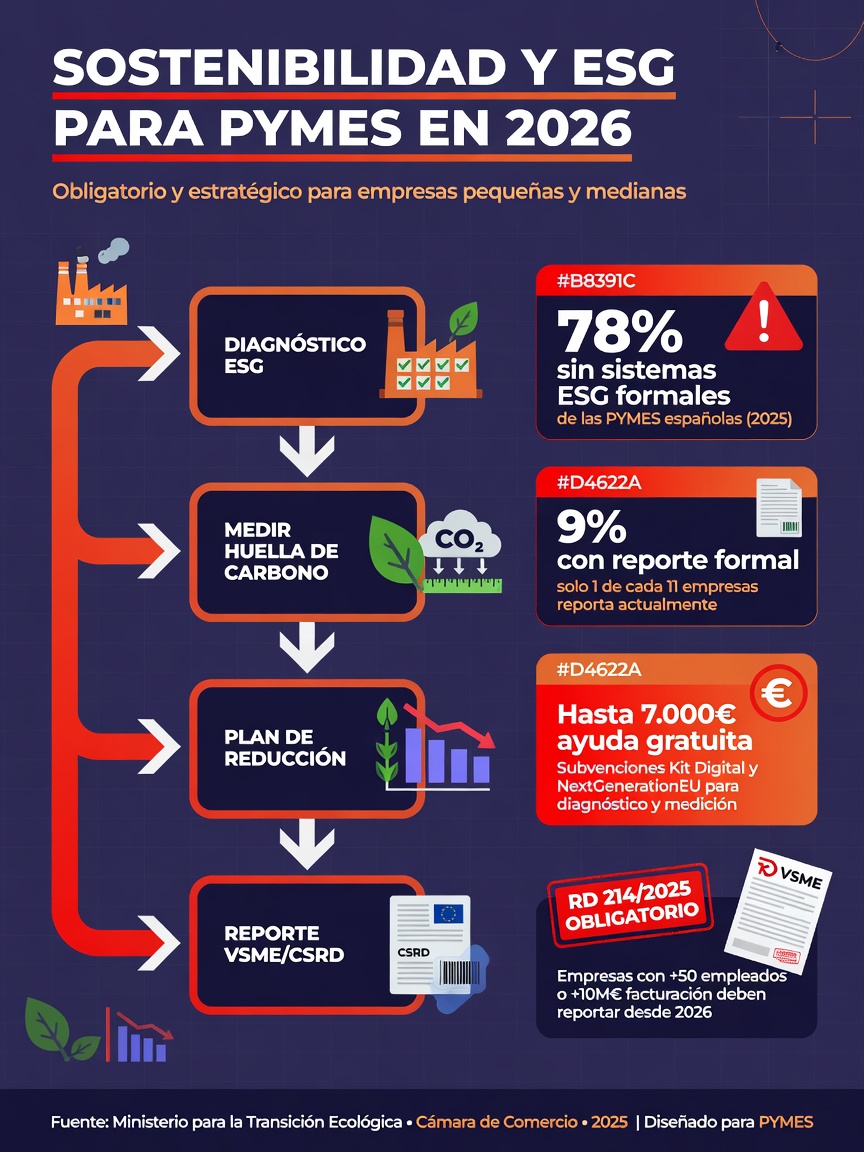
This isn't a rare case. According to the "State of Sustainability in Spanish SMBs" report from Spain's Chamber of Commerce (2025), 78% of SMBs lack formal systems for collecting ESG data. And only 9% have a structured reporting system.
While SMBs look the other way, their corporate clients are already required to report. And they need data from their entire supply chain. If your SMB supplies a mid-sized or large company in Spain, sooner or later they'll ask for numbers you don't have today.
CSRD: The directive that affects you even if you've never heard of it
CSRD (Corporate Sustainability Reporting Directive) is an EU directive requiring large companies and listed mid-caps to publish detailed sustainability reports. In Spain it transposes through modifications to Commercial Code and Audit Law. The first companies are already reporting 2024 data, and the obligation expands to more sectors in 2026.
So what does this have to do with your SMB? A lot. Large companies must report on their entire value chain (called "Scope 3" in technical terms). That means they need data from their suppliers: emissions, energy use, labor practices, waste management.
If your SMB supplies a company covered by CSRD, they will eventually ask for information. If you can't provide it, there's a risk they'll replace you with a supplier who can.
"It's not about being eco-conscious. It's about not getting locked out of the market because you can't provide data your clients already demand."
, Spain's Business Sustainability Observatory, 2026Royal Decree 214/2025: What's already mandatory
While CSRD mainly affects large companies (and their suppliers), Royal Decree 214/2025 is more direct. It creates a carbon footprint registry, compensation, and CO₂ absorption projects, and establishes the obligation to calculate and register carbon footprint for:
- Companies with more than 250 employees or revenue above €40 million
- Companies in specific sectors expanding the obligation progressively
- Companies seeking to bid on public contracts (where environmental certification scores points)
- Companies seeking green financing or sustainable credit lines
In 2026 the obligation expands to more sectors. And even if your SMB formally falls outside the threshold, there's a practical reality: if you want to win contracts from public administration or large corporations, you'll increasingly need that registry.
VSME: The standard worth adopting (and it's easier than you think)
EFRAG (the European financial reporting body) developed a voluntary standard specifically for unlisted SMBs: the VSME (Voluntary Standard for non-listed SMEs). It's a simplified framework for reporting ESG data without the full complexity of CSRD.
Why is it worth it? Three reasons:
- It prepares you for what's coming. If you report under VSME today, when they ask for CSRD data, you already have it organized.
- You access preferential financing. Financial institutions are starting to offer credit lines with reduced rates (50–75 basis points lower) to companies with audited carbon footprint and reduction plans.
- You score higher in public bids. Green public procurement in Spain already integrates ESG criteria as a scoring advantage.
VSME isn't mandatory, but major financial institutions and green public procurement are adopting it as a scoring standard. By end of 2026, it's expected to be the standard language for ESG data exchange between companies.
How to calculate your carbon footprint without spending €10,000
This is the part that sounds scariest, and it's actually the simplest. Let's break it down.
What is a SMB's carbon footprint?
It's the volume of greenhouse gases (measured in tonnes of CO₂ equivalent) your operations generate. It breaks into three scopes:
- Scope 1: Direct emissions. Boiler combustion, company vehicle fleet.
- Scope 2: Indirect emissions from energy. Electricity you purchase.
- Scope 3: Other indirect emissions. Employee travel, suppliers, logistics, waste.
For a small SMB, Scopes 1 and 2 cover the essentials. Scope 3 is more complex and usually comes later.
Free tools to get started
You don't need to hire an expensive consultant for the initial calculation. Your options:
- MITECO tool: Official free calculator for companies.
- Chamber of Commerce calculator: Available on their sustainability portal.
- ENISA: Offers free ESG self-diagnostic tools.
- Sustainable SMB Program 2026: Free assisted diagnostic + up to €7,000 grant to implement improvements.
Basic process: gather last year's electricity bills, fuel invoices, and travel data. Input the data into the tool. In 2–3 hours you'll have a reliable estimate. Then, if you need precision (for reporting or bidding), hire a formal audit that typically costs €1,500–4,000 for an SMB.
Grants you're not using (and they're free)
This is what bothers me about this issue. Real, accessible grants exist, and most SMBs don't even know they're there. The main ones in 2026:
Sustainable SMB Program 2026
From Spain's Chambers of Commerce, co-funded by the EU (FEDER). Offers free sustainability diagnostic and grants up to €7,000 to implement improvements: carbon footprint, energy efficiency, circular economy. No excessive fine print.
Kit Digital - Sustainability Category
The Kit Digital grant covers sustainability management tools, ESG process digitalization, and energy consumption reduction. Up to €6,000 depending on company size.
Green ICO credit lines
The ICO has financing lines with reduced rates for energy efficiency, renewable energy, and emissions reduction investments. Up to €1.5 million for SMBs.
Tax deductions
Energy efficiency and renewable energy investments have specific deductions in Corporate Income Tax. Check with your advisor, but they can reach 25–40% of the investment depending on demonstrated improvement.
Where to start this week (4-step plan)
No stress. No big investments. Here's what I'd do if I had a 5–30 person SMB and wanted to start now:
Step 1: Quick diagnostic (1–2 hours, cost €0)
Use the free Chamber of Commerce or ENISA tool. Gather last year's electricity and fuel bills. Get a rough figure for tonnes of CO₂.
Step 2: Identify quick wins (1 day, cost €0–500)
Measures that cut emissions and save money: switch to LED, optimize HVAC schedules, reduce printing, negotiate a green tariff with your supplier. Savings usually pay for the investment in under 6 months.
Step 3: Formalize the commitment (1–2 weeks, cost €0–1,500)
Draft a basic environmental policy (one page), register your footprint with MITECO if applicable, and document actions taken. This already positions you well with corporate clients.
Step 4: Communicate and access grants (1 month, cost €0)
Apply for the Sustainable SMB Program for the assisted diagnostic. Use the data to bid on public contracts or request green financing. Include your carbon footprint in your annual report or website.
Real case: how a 15-person SMB won a contract with ESG data
A logistics company in Zaragoza with 15 employees and €2.5 million in revenue bid on a food distribution chain contract. The specification scored environmental certification. They had no formal certification, but they had calculated their carbon footprint, documented a reduction plan, and presented optimized fleet consumption data.
Result: they won against three larger competitors. The buyer's purchasing manager said afterward that the difference was "data transparency." They weren't perfect. They could just demonstrate what they did.
This is what's changing. It's not about having the greenest company in the world. It's about proving what you do and having data to back your decisions.
Mistakes I see SMBs make when starting with ESG
After watching dozens of companies tackle this, these are the most common errors:
Mistake 1: Thinking it's only for big companies
CSRD directly affects large firms, but the cascade reaches all their suppliers. If you sell B2B, they will eventually ask for data.
Mistake 2: Wanting perfection from day one
You don't need to offset 100% of emissions or reach zero waste. You need to measure, have a plan, and show continuous improvement. Perfection is the enemy of action.
Mistake 3: Not involving your team
Sustainability isn't a director's project. If you don't connect it to daily work (energy savings, cutting unnecessary travel, waste management), the plan dies in a drawer.
Mistake 4: Not communicating what you do
If you reduce your carbon footprint and don't mention it, it's like you didn't. Include the data on your website, in sales pitches, in bids.
Mistake 5: Waiting until it's mandatory
By the time it's mandatory for your sector, you'll be late to prepare well. Companies starting now have an edge: they know their data, have systems running, and can show improvement history.
Frequently asked questions
Is my SMB required to comply with CSRD?
CSRD directly requires large companies and listed mid-caps. If your SMB doesn't trade publicly and has under 250 employees, you're not directly required. But if you supply a company that is required, they'll ask for your value chain data (Scope 3). In practice, the obligation reaches you through your client, not the law.
How much does it cost to calculate a SMB's carbon footprint?
You can do the initial calculation yourself with free tools (MITECO, Chamber of Commerce) in 2–4 hours. If you need a formal audit for reporting or bidding, expect €1,500–4,000 for an SMB under 50 employees.
What is VSME and do I have to adopt it?
VSME is a voluntary simplified standard for reporting ESG data. It's not mandatory, but more corporate clients, financial institutions, and public bids are valuing it. Adopting it prepares you for future requirements and gives you competitive advantage today.
What sustainability grants are available for SMBs in 2026?
The Sustainable SMB Program 2026 (Chambers of Commerce) offers free diagnostic and up to €7,000 in grants. Kit Digital covers up to €6,000 in sustainability tools. The ICO has green lines with reduced rates. And there are tax deductions for energy efficiency investments.
How long does it take to implement a basic ESG plan?
A working plan (diagnostic + carbon footprint calculation + basic measures + documentation) can be ready in 4–8 weeks working a few hours weekly. It doesn't need a dedicated team or big investment. It needs the decision to start.
Can I use AI to manage my ESG data?
Yes. AI tools can automate consumption data collection, generate sustainability reports, identify improvement patterns, and reduce carbon footprint calculation time. It's one of the most practical AI applications for SMBs today. Spain's AI Law also sets transparency and literacy requirements that affect these tools.
Want to know how CSRD affects your SMB?
We can help with an initial sustainability diagnostic, calculate your carbon footprint, and prepare documentation your corporate clients are starting to request. No obligation.
Request free diagnostic →