
What exactly changes in 2026 (and what stays)
If you run a company in Spain, corporate tax is that financial topic you can't ignore but nobody explains without putting you to sleep. Let's try a different approach.
The government approved a reform in late 2024 that's rolling out in stages until 2029. 2026 is year two of that transition, and there are concrete changes that directly affect what you'll pay.
First: the standard rate is still 25%. If your company does over €10 million in revenue, this doesn't affect you. But if you're a micro-SMB or SMB, keep reading—there are updates.
Micro-SMBs: 19% and 21% based on profit
If your company does under €1 million a year, you're classified as a micro-SMB for tax purposes. And this is where the good news is.
In 2026, your first €50,000 of profit is taxed at 19%. Everything above that, at 21%. To make it clear with numbers:
- €30,000 profit: you pay €5,700 (effective rate: 19%)
- €50,000 profit: you pay €9,500 (effective rate: 19%)
- €60,000 profit: you pay €9,500 + €2,100 = €11,600 (effective rate: 19.3%)
- €100,000 profit: you pay €9,500 + €10,500 = €20,000 (effective rate: 20%)
Compared to 2025? That same €60,000 profit taxed at 21% across the board would cost €12,600. So your real savings is about €1,000 at this profit level. Not a fortune, but money that stays in your account.
And it gets better: in 2027, the first €50,000 drops to 17%. The plan is for micro-SMBs to hit 17%/20% by 2029.
SMBs: 23% settles in
If your revenue is between €1 million and €10 million, your 2026 rate is 23% on all taxable income. No progressive tiers like micro-SMBs: a flat rate.
That's two points below the standard 25% rate. For an SMB with €2 million in profit, the difference is €40,000 less in tax. That's noticeable.
The trajectory is downward: 22% in 2027, 21% in 2028, 20% in 2029. The stated goal is to align Spanish SMB taxation with the European average.
15% Global Minimum Tax: what it is and who it affects
This is the big one for large players. For the first time in 2026, multinationals with over €750 million in annual global revenue must pay Spain a minimum tax of 15% on accounting profit.
This comes from an international agreement (OECD Pillar 2) that Spain has transposed. The logic is simple: if a multinational pays less than 15% in Spain because it uses tax optimization structures, the state collects the difference.
Does it affect you directly? Only if you're part of a multinational group that size. For 99% of Spanish companies, no. But it's worth knowing because it changes the global tax landscape and can affect your suppliers and major clients.
The first payment will be made between July 1–20, 2026.
Capitalization Reserve: now it's more worthwhile
This is less known but very useful for growing SMBs. The capitalization reserve lets you reduce your taxable income if you increase your own funds (i.e., if you reinvest profits instead of distributing them).
In 2026, the reduction is 20% (it was 15% before). And if you also boost your headcount by more than 10% and maintain it for three years, it jumps to 30%.
Example: your SMB has €200,000 in profit. If you allocate €50,000 to capitalization reserve, you reduce your taxable income by €10,000 (20% of €50,000). At 23%, that's €2,300 less in tax. If you've also hired, the reduction is €15,000 (30% of €50,000), saving €3,450.
It's not automatic: you must formally establish the reserve in equity and maintain it five years. But if you're in growth mode, this is a tax tool worth considering.
Loss Carryforward Limits: another year
Royal Decree-Law 16/2025 (published December 24, nearly at the last minute) extends loss carryforward limits for one more year.
In practice: large companies (revenue over €20 million) can only offset 50% of their taxable income with prior losses (before it was 70%). For companies with revenue between €10–20 million, the limit is 25%.
If your company had losses in prior years and has profit this year, this limits how much you can deduct. Plan this with your tax advisor, or talk to our team.
Other measures from December's Royal Decree-Law worth knowing
That December decree had more than just corporate tax changes. Some affect freelancers and SMBs:
Estimated income extended: limits for simplified tax method (estimated income) in personal income tax and simplified VAT regime remain. The deadline to opt out or revoke was January 31, 2026.
Green deductions extended: deductions for electric vehicle purchase (up to €3,000), charging infrastructure (up to €600/year), and energy efficiency home upgrades stay valid through December 31, 2026. If you want to see how these fit into a broader sustainability and ESG strategy for your SMB, we cover that in detail.
Free depreciation for renewables: you can freely depreciate investments in solar self-consumption and renewable energy coming online in 2025 and 2026.
Verifactu pushed back: the requirement to use tax-certified invoicing systems pushes to January 1, 2027 (for SMBs) and July 1, 2027 (for freelancers). You have one more year to prepare.
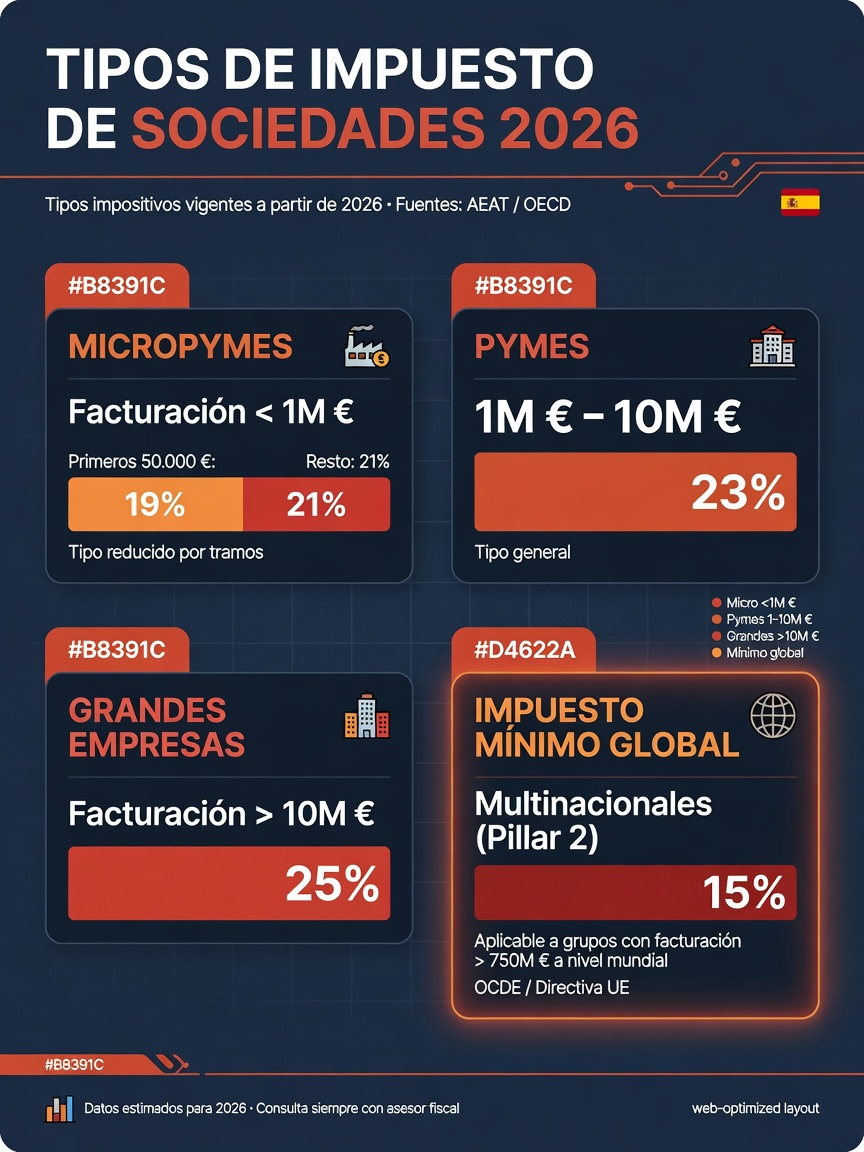
Summary table: Corporate tax rates 2026
| Company Type | Revenue | 2026 Rate | 2029 Forecast |
|---|---|---|---|
| Micro-SMB | Under €1M | 19% (first €50k) / 21% (rest) | 17% / 20% |
| SMB | €1M – €10M | 23% (flat) | 20% |
| Large company | Over €10M | 25% | 25% |
| Multinational | Over €750M global | Minimum 15% (global minimum tax) | 15% |
| Startup | Any size | 15% (first two profitable years) | 15% |
How to prepare: 5 things you should do now
Knowing the rates is useful, but what matters is what you do with this information. Here are five concrete actions:
1. Model your tax with the new tiers
Don't wait for the October filing deadline. Sit down with your tax advisor and calculate how much you'll pay this year under the new rates. If you're a micro-SMB, the savings could be significant. If you're an SMB, confirm you're applying the 23% correctly.
2. Evaluate capitalization reserves
If your company is profitable and you're thinking about reinvesting (expand facilities, buy equipment, hire), the 20% or 30% capitalization reserve can save you thousands. But it requires planning: the reserve must be formally established and maintained five years.
3. Check your installment payments
Quarterly payments in April, October, and December are calculated on the year's rate. If you've been paying 25% but your actual rate is 23% or lower, you're advancing money to the tax office needlessly. Recalculate.
4. Plan green deductions before they expire
Deductions for electric vehicles, charging infrastructure, and energy efficiency expire December 31, 2026. If you've been considering any of these investments, do it this year.
5. Prepare for Verifactu with time to spare
Just because it's delayed to 2027 doesn't mean you should wait. Verifactu-compatible invoicing systems already exist. Migrating now, calmly, beats doing it in a rush next year. And if you need help digitizing your processes, that's exactly what we do at BigLobster.
"The most common mistake we see in SMBs isn't overpaying: it's not planning. Knowing tax rates in time lets you make investment, hiring, and cash-flow decisions that save far more than any last-minute trick."
, Tax team, BigLobsterCommon corporate tax mistakes
After years working with industrial and distribution SMBs, these are the errors we see over and over:
Confusing revenue with profit
Corporate tax tiers apply to profit (taxable income), not revenue. A micro-SMB doing €900,000 in sales but with €40,000 profit pays 19% on those €40,000. Not on the €900,000.
Missing deductions
R&D deductions, job creation credits, investment deductions... many SMBs leave money on the table because they don't identify the deductions they qualify for. A good tax advisor pays for themselves on this alone.
Overlooking accounting adjustments
Accounting profit isn't taxable income. You need adjustments: depreciation exceeding limits, non-deductible provisions, expenses the tax office won't accept. If you don't track these, you're either overpaying or in for an audit surprise.
Ignoring year-to-year planning
If you expect high profit one year and less the next, maybe accelerate investments or provisions. If you have accumulated losses, plan how to offset them within legal limits. This all requires looking beyond the current year.
Frequently asked questions
How much corporate tax does a micro-SMB pay in 2026?
First €50,000 of profit is taxed at 19%, excess at 21%. A micro-SMB with €60,000 profit pays €9,500 + €2,100 = €11,600 (effective rate 19.3%).
What's the corporate tax rate for SMBs in 2026?
SMBs (revenue between €1 million and €10 million) pay 23% in 2026. It's a flat rate with no progressive tiers. The reduction continues toward 20% by 2029.
What is the 15% global minimum tax?
It's a tax on multinationals with over €750 million in global revenue. It requires them to pay at least 15% corporate tax in each country where they operate. In Spain, the first payment is July 2026. It doesn't affect SMBs or micro-SMBs.
How much can I save with capitalization reserves?
The reduction is 20% of the reserve amount (if you maintain the reserve five years). If you also increase headcount by over 10%, it rises to 30%. For a 23% SMB, each €10,000 reduction in taxable income saves €2,300 in tax.
Can I offset prior losses without limits?
No. Limits remain in effect for 2026: companies with revenue over €20 million can offset only 70% of taxable income with prior losses (and only 50% in some cases). Smaller SMBs have more generous limits.
When do I file the 2025 corporate tax return?
The 2025 return is filed between July 1–25, 2026 (for companies with December 31 year-end). 2026's quarterly payments (for current year) are due in April, October, and December.
Need help with your company's taxes?
BigLobster helps industrial and distribution SMBs digitalize their processes and optimize operations. If you're thinking about how technology can improve your business (including the tax side), let's talk.
Talk to an expert →