On March 31, 2026, Royal Decree 238/2026 was published in the Spanish Official Gazette. If you run a business or work as a freelancer in Spain and invoice other businesses, this directly affects you. It's not a recommendation or a trend: it's a legal obligation with specific deadlines.
The problem is most SMBs and freelancers don't yet know what they need to do, when they need to do it, or how to prepare without spending a fortune on consulting. Let's fix that.
What mandatory B2B electronic invoicing actually is
We're not talking about emailing a PDF. Mandatory electronic invoicing under Royal Decree 238/2026 is a structured electronic message conforming to European standard EN16931, issued in one of the accepted syntaxes (UBL, CII, EDIFACT, or Facturae). A format that can be read and processed automatically by IT systems, with no human touch needed.
In practical terms: your invoicing software generates structured data, not a visual document. A PDF can accompany the invoice during a transition period, but doesn't replace it.
Why is the government doing this? The stated goal of the Law 18/2022 (Crea y Crece Law) is to fight business payment default. Spain has one of Europe's worst B2B payment times: the average exceeds 60 days, well above the 60-day legal maximum. With a system where each invoice and each status (accepted, rejected, paid) is logged and traceable, the government wants real data to act against late payers.
Who it affects
Every business operator or professional who issues invoices to other businesses or professionals (B2B transactions) when the recipient has their place of activity, permanent establishment, or usual residence in Spain.
It does not affect invoices issued to end consumers (B2C). Those can continue to be issued on paper, PDF, or simplified invoice as before.
This means if you're a freelancer and your client is another business or professional, you're in. If you're a 3-person SMB invoicing a mid-size company, you're in. If you're a distributor selling to retail shops, you're in.
Implementation timeline: when your turn comes
Royal Decree 238/2026 came into effect 20 days after publication (late April 2026), but actual enforcement depends on the Ministerial Order that will detail the public e-invoicing solution. According to the draft order currently in process, the planned timeline is:
| Invoice volume (prior year) | Compliance date | Time from now (June 2026) |
|---|---|---|
| Over €8 million | October 1, 2027 | ~16 months |
| Under €8 million | October 1, 2028 | ~28 months |
Note: these dates are from the draft order. The final timeline will be confirmed when the Ministerial Order is published. But don't assume you have plenty of time. Large companies (>€8M) go first, and if you sell to them, they'll demand e-invoicing from you in October 2027 even if your own compliance deadline isn't until 2028.
Also, during the first 12 months each phase is in effect, obligated companies must accompany the structured electronic invoice with a PDF to ensure readability, unless the recipient expressly accepts receiving only the original format.
How the system works: private and public platforms
Spain's e-invoicing system has two routes:
Private platforms: These are invoicing software providers that meet Royal Decree 238/2026 requirements (interoperability, interconnection, advanced electronic signature). They issue and receive invoices among their users. If you use Holded, Billin, A3, Contaplus, or another program, you'll need to verify your provider is adapted.
Public E-Invoicing Solution (SPFE): Managed by the Spanish tax authority, it's free and acts as the universal repository. All invoices issued by private platforms must be sent simultaneously to the SPFE in UBL syntax. The SPFE also lets you issue and receive invoices directly and manages statuses (acceptance, rejection, payment).
You can use a private platform, the public solution, or both. But in all cases, invoice data and statuses end up with the tax authority.
Invoice statuses: what really changes
This is where it gets serious. Simply issuing an invoice isn't enough. The recipient has a legal obligation to report statuses within a maximum of 4 business days (excluding Saturdays, Sundays, and national holidays):
- Acceptance: The invoice is valid and accurate.
- Rejection: There's an issue (incorrect data, service dispute, etc.).
- Payment: Payment has been made (in full or partial).
This is a huge cultural shift. Until now, many SMBs and freelancers had no formal process for accepting received invoices. Now it's mandatory. And the issuer has the right to know their invoice's status.
For sole proprietor freelancers and entities in income attribution with invoicing up to €8 million, the requirement to report statuses is delayed by 12 additional months from when the rule applies to them. Until then, it's voluntary.
Technical requirements your software must meet
If you manage invoicing with specific software, verify it meets these requirements:
- Issuance in structured format conforming to EN16931 (UBL syntax as the public system reference).
- Advanced electronic signature (by the issuer or through authorized delegated signature).
- Simultaneous sending of true copy to SPFE in UBL syntax (if using private platform).
- Invoice status management (acceptance, rejection, payment) with 4-day communication.
- Digital retention and archival for at least 4 years.
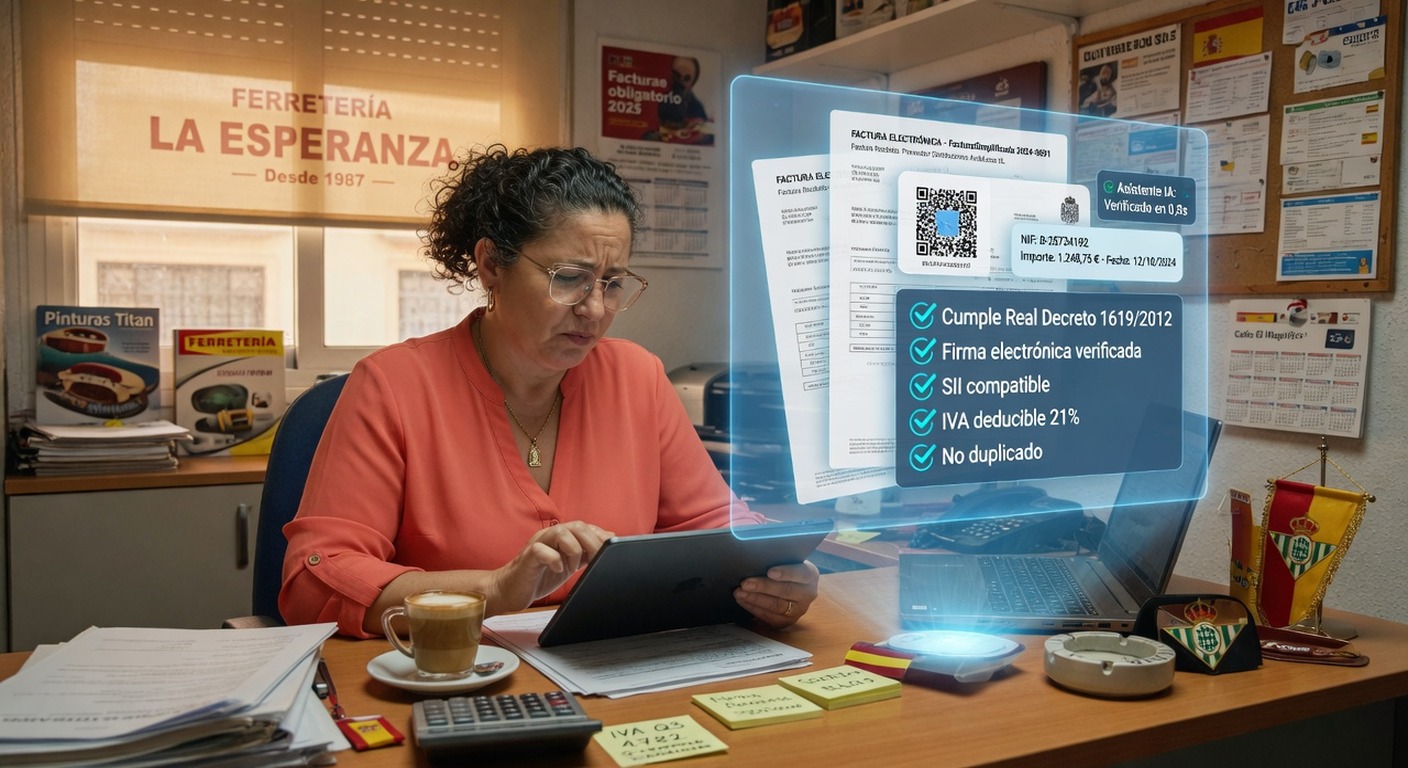
- Verifiable QR code on the invoice.
- Compatibility with Verifactu (Royal Decree 1007/2023), the other e-invoicing regulation already in effect.
If your current software doesn't comply, you need to change or update it. Ask your provider directly: Do you issue in UBL/EN16931 format? Do you integrate with the tax authority's SPFE? Do you manage invoice statuses? If they won't give you straight answers, find another provider.
How it affects freelancers specifically
Yes, freelancers are included. If you invoice other businesses or professionals, you'll need to issue B2B e-invoicing from October 1, 2028 (per the planned timeline).
But there's an important nuance: if your clients are large companies (>€8M), they'll be obligated from October 2027. When they send you an e-invoice, you as the recipient must manage it (accept, reject, log payment). So although your issuance obligation arrives in 2028, your reception and status management obligation may come sooner.
Freelancers in objective estimation (modules) are also obligated when invoicing other businesses or professionals. There's no exemption by tax regime.
How to prepare: action plan for the next 3 months
Don't wait until the last minute. This is what I'd do if I were you:
Month 1 (June-July 2026): Internal audit
- List all your B2B clients and B2B suppliers.
- Review what invoicing software you currently use.
- Contact your provider and ask about their Royal Decree 238/2026 adaptation plan.
- If they don't give clear answers, start evaluating alternatives.
Month 2 (August-September 2026): Tool decision
- Compare options: Holded, Billin, A3, the tax authority's public solution when available.
- Verify the chosen tool complies with UBL, EN16931, Verifactu, and status management.
- Plan data migration (issued invoices, received invoices, clients, suppliers).
Month 3 (October-November 2026): Implementation and testing
- Configure the new software with your data and your clients' data.
- Test issuance and reception with a trusted client or supplier.
- Define internal roles: who issues, who reviews, who accepts received invoices, who logs payments.
- Document the process so it doesn't depend on one person.
How AI and automation make this easier
This is where legal obligation meets real opportunity. Managing e-invoices with statuses, 4-day deadlines, and tax authority communication is exactly the type of repetitive, rule-based process that automates well.
With tools like n8n or Make you can build workflows that:
- Detect a received e-invoice in your inbox or platform.
- Auto-extract data (issuer, amount, date, description).
- Classify it by your rules (by supplier, cost center, expense type).
- Send it to the approval person.
- Report acceptance or rejection through the right platform.
- Log payment when made and report it on time.
- Alert if an invoice sits unreviewed for more than 2 days.
An SMB that issues or receives 50-200 invoices monthly can save €150-400 monthly automating this vs. paying accounting staff or employees to do it manually. Automation ROI pays for itself in 2-3 months.
And if you already use an ERP or management software, most automation platforms integrate directly. No tool switching needed, just connect what you have.
Verifactu and B2B e-invoicing: two regulations, one goal
Many people confuse Verifactu with B2B e-invoicing. They're distinct but complementary regulations:
- Verifactu (Royal Decree 1007/2023): Requires invoicing software that sends records to the tax authority. Affects freelancers and businesses in direct estimation. Entry into effect: July 1, 2026.
- B2B e-invoicing (Royal Decree 238/2026): Requires invoices in structured format between businesses and professionals. Affects all B2B transactions. Phased entry: October 2027 (large companies) and October 2028 (everyone else).
Your software must comply with both. When choosing a tool, verify it's adapted to both regulations. If it already meets Verifactu, specifically ask about Royal Decree 238/2026.
Frequently asked questions
Can I keep sending invoices as PDFs to my clients?
No, once the obligation applies to you. The PDF can accompany the e-invoice for the first 12 months as a transition measure, but doesn't replace it. The valid invoice will be the structured format.
What if I don't comply?
Royal Decree 238/2026 establishes a penalty regime. While exact amounts will be defined in additional rules, the tax authority already has power to penalize invoicing non-compliance. Plus, if you don't issue an e-invoice when required, your clients can't deduct the expense, damaging business relationships.
Is the tax authority's public solution free?
Yes. Access to the public e-invoicing solution is free for all uses: issuance, reception, interconnection, query, and invoice retrieval. You can use it via web forms or web services as needed.
Do I have to use the public solution?
No. You can use a private platform, the public solution, or both. But if you use a private platform, it must send a true copy of each invoice to the public solution in UBL syntax.
How does this affect invoices I've already issued?
The rule isn't retroactive. It only applies to invoices issued from your compliance date onward. Earlier invoices follow the regulations in effect when they were issued.
Do I need a digital certificate?
Yes, to electronically sign the invoices. If you use a private platform, it can manage the signature for you (delegated signature). If you issue directly through the tax authority's public solution, you'll need your electronic certificate or whatever identification system the tax authority enables.
Get a free assessment
If you want to implement this smoothly, request a free 30-minute assessment. Contact us here or message us on WhatsApp from the site.