The problem: sending emails is not the same as doing email marketing
Let me tell you something you probably already suspect: most SMBs that "do email marketing" just send mass emails occasionally. A monthly newsletter with updates, a seasonal promo, a holiday greeting. That's it.
It's not bad. But it's not real email marketing. It's like saying you have an online business because you posted something to Instagram once.
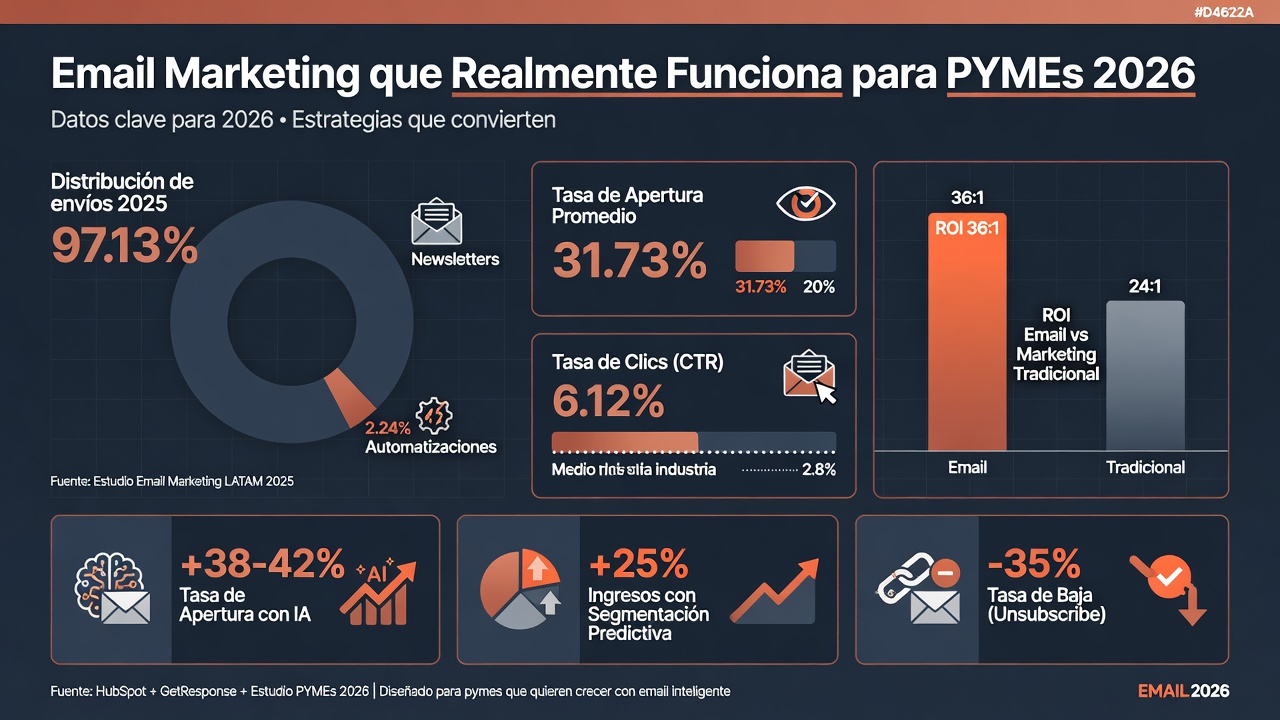
The data is clear. Per Acumbamail's 2025 Spanish market report:
97% does the same thing. 2.24% does what actually works. And that 2.24% captures most of the results.
Because the gap between a generic newsletter and a well-configured automation is huge. A newsletter opens if someone remembers they're subscribed and feels like reading. An automation fires because the user did something specific: registered, abandoned a cart, hit an anniversary, downloaded a resource. Intent is there. You just need to show up in that moment.
What exactly is email automation (and what it's not)
Automation isn't "schedule an email to send Monday at 9am." That's still a scheduled send, not automation.
Real automation works like this: if user does X, then Y happens. For example:
- Someone registers on your site → they get a welcome email with your best content and a starter offer.
- Someone abandons their cart → they get a reminder 2 hours later, another at 24 hours, and a final one with a discount at 48 hours.
- A customer hasn't bought in 60 days → they get a reactivation email with updates or an exclusive promo.
- Someone hits their one-year anniversary as a customer → they get a thank-you email with a gift or special discount.
Each email sends only when the condition is met. You don't do anything manually. The system watches, detects the action, and triggers the email. And most importantly: each email is relevant to who receives it because it responds to something they did.
"The best email campaign isn't the one that reaches the most people. It's the one that reaches the right person at the right time with the right message."
, Basic automation principle that 97% of SMBs still haven't appliedThe numbers that matter: why automated email wins
Here's concrete data. Not opinions, not theory. What platforms measure when comparing traditional email to automated email plus AI.
| Metric | Traditional Email | Email with Automation + AI |
|---|---|---|
| ROI per euro invested | 24:1 | 36:1 (Litmus, 2025) |
| Open rate improvement | Spain average: 31.73% | +38–42% with AI optimization of timing and subject (Klaviyo, 2025) |
| Revenue per email | Baseline | +25% with predictive segmentation (ActiveCampaign, 2025) |
| Unsubscribe rate | 0.3–0.5% | –35% by reducing frequency for at-risk subscribers |
Spain's average open rate is 31.73% and click rate is 6.12% (Acumbamail, 2025). If you're above that, you're doing fine. If you're below, something's wrong: probably subject line, send time, or segmentation (or all three). If you need help with email automation strategy for your SMB, we can set it up in an afternoon.
But here's what's interesting. Per Litmus (2025), email click rates fell 18% year-on-year in European retail. The "click collapse" is real. Yet companies applying predictive segmentation and AI report the opposite: their metrics climb while the rest decline.
Why? Because AI creates dynamic micro-segments. Instead of manual segmentation ("women 25–45 who bought in 30 days"), AI spots who has high purchase probability in the next 7 days, who's about to churn, who responds better to discounts vs. educational content. And adjusts sends automatically.
Tools you can use today (no coding needed)
If you got here thinking "this sounds good but I don't have a technical team," relax. Today's tools are built for marketing people, not engineers. In fact, in our SMB automation guide we explain how to get started with zero code.
Brevo (formerly Sendinblue)
Free plan up to 300 emails/day. Includes basic automation, drag-and-drop editor, and integrated CRM. For an SMB starting out, probably your best bet. Paid plans start around €20/month and add advanced automation, AI-powered send time optimization, and detailed reports.
Mailchimp
The most recognizable name. Free plan up to 500 subscribers. Their Customer Journeys editor (automation workflows) is visual and intuitive. Downside: they've raised prices in recent years, and some features that were free are now paid.
ActiveCampaign
The most powerful in pure automation. If email is central to your business (ecommerce, SaaS, subscription services), the investment is worth it. Plans start around €29/month. Their predictive segmentation with AI is best-in-class.
Klaviyo
Dominant in ecommerce. Integrates with Shopify, WooCommerce, and PrestaShop. Strength is behavior-based segmentation tied to purchase history. If you sell online and want automations like "customers who bought X also like Y," this is the benchmark.
My recommendation for most SMBs: start with Brevo. It's free to start, has everything you need for your first automations, and migrating to something more powerful later is painless.
First steps: your first automation in an afternoon
You don't need 15 workflows on day one. You need one. The simplest and highest-impact: the welcome sequence.
Here's how it works:
- Someone registers on your site (to download something, get offers, whatever).
- Email 1 (immediate): "Thanks for signing up. Here's what you'll get and how often." Set expectations.
- Email 2 (day 3): Your best content or best case study. Something proving it's worth staying on your list.
- Email 3 (day 7): An offer, useful resource, or next-step invitation (call, quote, first purchase).
That's it. Three emails. Set up once. Running forever. Every new subscriber automatically goes through this sequence with zero effort on your part.
Industry data shows welcome sequences open 50–80% higher than regular newsletters. Because the person just registered: they're interested, they're paying attention, they want to know what's next. It's the golden moment. Most SMBs waste it sending only a generic "thanks."
Mistakes I see repeatedly
After reviewing email strategies from dozens of SMBs, these are the most common errors:
Buying email lists
It's illegal in Spain (LOPDGDD + GDPR) and works terribly besides. They're people who don't know you, weren't expecting your email, and have no interest. Your open rate hits 5%, spam complaints spike, and email providers can block you. Don't do it. Ever.
Sending the same email to everyone
Your lifelong customer and someone who registered yesterday don't need the same message. Segment even at a basic level: new vs. active vs. inactive. Even that simple split noticeably improves results.
Ignoring deliverability
Even the best email fails if it lands in spam. Set up SPF, DKIM, and DMARC on your domain (your email provider tells you how). And clean your list regularly: remove bounced addresses and subscribers who haven't opened in 6 months.
Writing boring subject lines
The subject is the entry gate. "Newsletter for March" gets zero opens. "3 things we did this month you'll want to know" gets more. Test different angles, use AI to generate variants, and stick with what works.
Only measuring open rate
With Apple's privacy changes (MPP), open rate is increasingly unreliable. Focus on what matters: click rate, conversion rate, revenue per email sent, and unsubscribe rate. Those numbers don't lie.
Where AI fits in
AI won't write your email strategy. But it can make every piece work better:
- Send time optimization: AI analyzes when each subscriber opens and sends at their optimal moment. Not 9am because, but when that person actually checks email.
- Subject line generation: Tools like Brevo or ActiveCampaign generate subject variants and test which works best on a sample, then send the winner to the rest.
- Predictive segmentation: Instead of manual rules ("bought in 30 days"), AI spots complex patterns: "this subscriber has 78% likelihood to purchase in the next 7 days based on browse history, opens, and past purchases."
- Dynamic content: The same email shows different products, offers, or text based on recipient profile. Without creating 10 versions: AI does it automatically.
Per Spain's National E-Commerce Observatory, 41% of e-commerce sites with over €500k in revenue already use some form of AI in email marketing. In B2C services, adoption is 18%. That means real competitive advantage exists right now for early movers.
What it actually costs
Numbers matter when you're working with a tight budget.
Scenario 1: starting from scratch. Free tool (Brevo or Mailchimp) + your time to set up the welcome sequence. Cost: €0. Time: one afternoon.
Scenario 2: SMB with 1,000–5,000 subscribers. Paid Brevo plan or similar (€20–50/month) + welcome, cart recovery, and reactivation automations. Cost: roughly €30–60/month.
Scenario 3: ecommerce with 5,000+ subscribers needing advanced segmentation. Klaviyo or ActiveCampaign (€100–300/month by volume) + complex post-purchase, product recommendation, win-back flows.
At 36:1 ROI, even scenario 3 pays for itself with a handful of extra sales monthly. The real question isn't "how much does it cost?" but "how much does it cost to stay without it?"
Every month with generic emails erodes your domain reputation, trains subscribers to ignore you, and pushes you further from inbox placement. Acquisition costs on other channels (social ads, SEM) climb 15–20% annually. Automated email is the most efficient counterweight available.
Frequently asked questions
How much does email marketing cost for an SMB?
Tools like Brevo have free plans up to 300 emails/day. Mailchimp allows up to 500 subscribers free. For advanced automation, plans start €20–30/month. At 36:1 ROI, the investment is minimal. You can get started today with zero cost.
Do I need a technical team to automate emails?
No. Tools like Brevo, Mailchimp, or ActiveCampaign have visual automation editors. You drag blocks, set conditions ("if this email opens, send the next one; if not, wait 3 days"), and go. If you can use a web form, you can build basic automation.
Is it legal to send commercial emails in Spain?
Yes, with explicit consent from the recipient (opt-in). LOPDGDD and GDPR require the person agreed to receive communications. Buying email lists is illegal and ineffective anyway: open rates are terrible and you damage your sender reputation. Build your list organically.
What's a good open rate?
Spain's average is 31.73% (Acumbamail, 2025). Between 25–35%, you're fine. Over 40%, you're doing great. Under 20%, something's wrong: review your subjects, send times, and list cleanliness.
How often should I send emails?
Depends on your sector and what you promised subscribers. For most SMBs, 1–2 emails per month is a solid starting point. What matters isn't frequency, it's consistency and relevance. Better one great email monthly than four nobody opens.
Want your email marketing to work while you focus on sales?
BigLobster sets up email automations for SMBs: welcome sequences, cart recovery, segmentation, and campaigns that convert. No technical work needed on your end.
Tell us your story →