
Full confession: I've seen too many small businesses spend €500 a month on Google Ads when their website takes 4 seconds to load. €500 spent showing people a slow website. It's like putting a bright sign in front of a closed store. The sign works. The store doesn't.
It's not you. Digital marketing gets sold as a universal recipe: "invest in Facebook Ads," "do SEO," "start a blog," "open a TikTok." And each vendor tells you theirs is most urgent. The result? 70% of small businesses investing in digital marketing don't recover their investment in the first 12 months, according to CB Insights. Not because digital marketing doesn't work—it does—but because most start with what's shiny, not what works.
This article is about the second thing. What to do when you have €300–€1,000 a month, don't know where to start, and need results that show up on your bank statement, not just pretty metrics.
Before you spend a euro: get your basics right
If you don't have these, any marketing investment is money down the drain. Non-negotiable.
A website that loads in under 3 seconds. According to Google, 53% of users abandon a page if it takes more than 3 seconds to load. Before thinking campaigns, run it through PageSpeed Insights. If it fails, fix that first. Decent hosting (SiteGround, Raiola, Webempresa) costs €10–€20 a month and solves half the problem.
Your website must work on mobile. In Spain, 72% of web traffic is already mobile. If your site looks good on laptop but buttons overflow on an iPhone, you're losing 7 out of 10 visits. Open it on your phone right now and look at it with a customer's eyes.
A contact form that actually works. Sounds basic, but you'd be shocked how many SMB websites have contact forms that throw a 500 error or send data to a spam folder nobody reads. Test it yourself every month.
Analytics set up. Without data, you don't know what works. Google Analytics 4 is free. If you don't have it installed, that's what you do this week. Our article on automation with AI shows how to connect tools without a technical team.
If all this is solid, let's move up a level. If not, stop here. Fix the foundation before building the first floor.
"Digital marketing without a website that converts is like running a TV ad with a phone number nobody answers."
The channels that actually work for budget-conscious SMBs
You don't need to be everywhere. You need to be in the two or three channels with the most impact for your type of business. This is what works for 90% of Spanish SMBs:
1. Local SEO (free or nearly free). If your business has a physical location or serves a specific area, this should be priority one. A well-optimized Google Business Profile can bring more customers than any ad. And it's free. The local SEO guide for SMBs walks you through it, but the essentials are: correct category, real photos, exact hours, and respond to every review. This alone makes a difference in 1–3 months.
2. Useful content on your website (your best medium-term investment). Publish one article a week answering the questions your customers ask you every day. About them, not about you. "How do I choose a trusted plumber?" "How often should I check solar panels?" "What should a good air conditioning maintenance plan include?" Each article is an entry door Google can rank. And each door can bring you customers for years without paying another cent.
3. Smart Google Ads (starting at €300/month). Not for everyone. But if your industry has searches with clear buying intent ("emergency plumber Madrid," "labor lawyer Barcelona"), a well-segmented campaign with €10–€15 a day can bring leads from week one. Key: tight geographic targeting, intent-based keywords (not generic), and a specific landing page for each campaign—not everything to your homepage.
4. Email marketing (the highest-ROI channel and the most overlooked). Average ROI is €36 for every euro spent. And you can start free (MailerLite, Brevo) as long as you stay under 1,000 subscribers. The trick: don't buy lists, build yours slowly. A simple lead magnet—a PDF guide, a checklist, a signup discount—plus one weekly email with real content. No "monthly offer" every three days.
How much to invest by stage (real Spanish market numbers)
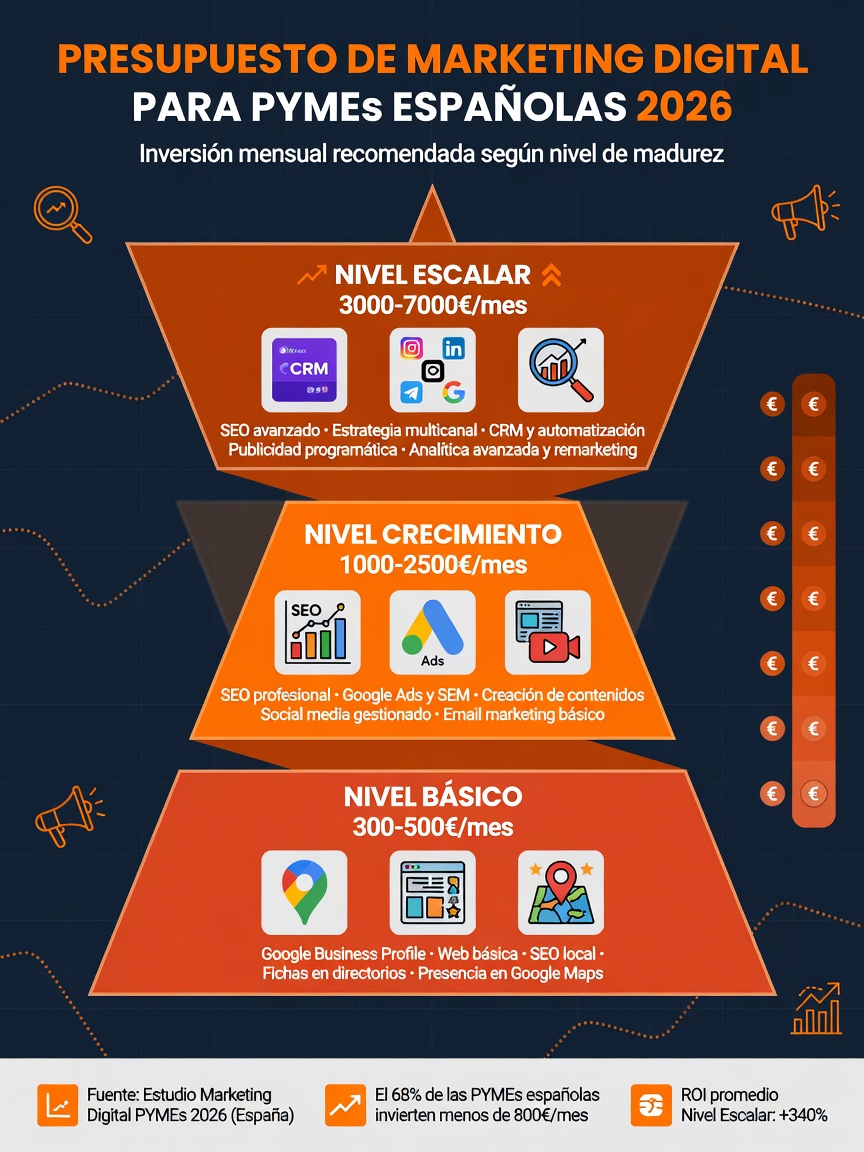
Here are actual 2026 Spanish market rates. Not friend pricing, not big consulting firm numbers. This is what good digital marketing costs for an SMB:
| Stage | Budget/month | What's included | Expected results |
|---|---|---|---|
| Starter | €300–€500 | Optimized GBP + 1 article/month + working basic site | 5–15 leads/month in low-competition sectors |
| Growth | €1,000–€2,500 | Professional SEO + Google Ads + 4–6 articles/month | 20–80 leads/month. SEO visible by month 3–4 |
| Scale | €3,000–€7,000 | Advanced SEO + multi-channel + CRM + automation | 100+ leads/month. Top 3 for main keywords |
If you're at Starter, don't try everything from Growth. Master the Starter basics for 6 months before moving up. The most common mistake is jumping from 0 to 100 in two months, ending up with €500 lost across four channels with zero results in any of them.
The right order for your first €500
Here's what I'd do with €500 a month starting from zero. Not the only way, but it works for 80% of cases:
Month 1 (€150): Fix your website's technical foundation. Decent hosting if yours is slow (€15–€20/month). Install Analytics and Search Console (free). Optimize for mobile. Complete your Google Business Profile. This takes no money but takes time. If you don't have the hours, pay someone €100–€150 to do it once.
Month 2 (€300): First blog article. Answer the question your customers ask you most. 1,500 well-written words with data and real examples. Start a Google Ads campaign with €200/month for 5 very specific keywords in your area. Geographic targeting 5–10km around your business.
Months 3–6 (€350–€500): Keep Ads running if they work (measure conversions, not clicks). Publish an article every 2 weeks. Start capturing emails with a simple lead magnet. Systematically ask satisfied customers for Google reviews. Adjust your Ads based on real data.
After 6 months you should have: growing organic traffic (not massive yet but clear trend), an optimized Ads campaign giving you leads at a known cost, a small but owned email list, and new reviews each week. That's enough to decide whether to move to Growth level or stay at Starter for another cycle.
The 5 mistakes that cost real money
I see these every week. Avoid these five and you're already ahead of 70% of small businesses that fail:
1. Starting with social media instead of a website. Instagram and TikTok are storefronts, not stores. Without a converting website, all the audience you build on social stays on social. People see you, but don't know how to buy or contact you beyond DMs that get lost.
2. Running Ads without conversion tracking. If you haven't set up what a conversion is for your business (form submitted, call over 30 seconds), Google Ads shows you pretty metrics ("10,000 impressions") but you don't know if that becomes customers. Setting up conversions in Google Ads and GA4 is free. Do it before spending the first euro.
3. Trying to do everything at once. An SMB with €500/month can't be in Google Ads, Facebook Ads, SEO, email marketing, TikTok, and Instagram. Can't. Pick two channels, master them for 6 months, then think about a third.
4. Expecting SEO results in one month. SEO works, but it needs time. Small businesses that hire SEO, see no results in 30 days, and cancel are throwing away their investment just before it bears fruit. Realistic minimum for seeing meaningful organic traffic is 4–6 months.
5. Not having a blog, or having one that sits dormant. A website with an updated blog generates 55% more traffic than one without, according to HubSpot. But one article every 4 months doesn't cut it. Consistency matters more than frequency. Better one article every 2 weeks than five in one month and nothing for six.
"You don't need more money. You need to spend the €500 you already have better."
Digital marketing with no budget: what you can do right now for free
If your budget is zero or close to it, here's what you do this month without spending:
Optimize your Google Business Profile to 100%. Don't just fill required fields. Specific category (not generic "services," but "plumber" or "dental clinic"), all relevant secondaries, exact hours every day, 15 real photos (not stock), description with words your customers use, respond to all existing reviews. This alone can move you up the Local Pack.
Write an article for your website. You don't need to be a writer. Open a document and write out the answer to the question your customers ask you most each week. "How much does...?" "How often should...?" "What's the difference between X and Y?" 1,000 well-structured words. If you don't have a blog, our SMB web design service includes a blog configured from day one.
Set up Google Analytics 4. Free, a hundred YouTube tutorials, one afternoon. Without data, you're driving with your eyes closed.
Ask for reviews. Every satisfied customer, at the point of payment, with a direct link to your Google listing. Don't wait for them to come naturally. They won't.
Start an email list. MailerLite has a free plan up to 1,000 subscribers. Every time you talk with a customer, ask if they want updates. When you hit 50 emails, send a monthly newsletter with useful content. Not promotions. Content that helps.
All this takes 2–3 weeks at half-time. Zero money. What it costs is time, and if your time is worth more spent on your business, then hiring someone makes sense.
Do it yourself or hire?
The million-euro question. Answer: do it yourself if you have 10–15 hours weekly, like learning, and your budget is truly zero. Hire if your time is worth more in your business, if you already tried and it didn't work, or if you need faster results.
The middle ground that works for many SMBs: handle content yourself (nobody knows your customers better than you) and hire the technical part (technical SEO, Ads setup, Analytics). Content is strategy. Technical is execution. Most SMBs can handle the first, not the second.
That's exactly what we do at BigLobster: we set up the technical foundation—optimized website, SEO, automations—so you can focus on your business and create content that resonates with your customers. No long contracts, no fluff, measurable results from month one.
Frequently asked questions
How much should an SMB invest in digital marketing monthly?
The realistic range for an SMB starting out is €300–€500 a month. To grow, €1,000–€2,500. Rule of thumb: 7–12% of your monthly revenue. But more important than the amount is having clear goals before spending anything.
Which marketing channel gives the best results for budget-conscious SMBs?
Depends on your business type. If you have a physical location: local SEO, no question. Free and best medium-term ROI. If you sell services online: blog content + targeted Google Ads. Email marketing has the best ROI (€36 per €1), but you need time to build the list.
Social media or Google Ads with €300?
Google Ads, almost always. Social media is great for building brand, but buying intent on Google is much higher. Someone searching "accounting firm in Valencia" has a problem and wants to solve it now. Someone seeing your Instagram post might forget it in 5 minutes.
Can I do digital marketing myself with no experience?
You can start. Content work (blog, social, email) is totally doable if you invest time. Technical work (SEO, Ads setup, Analytics) takes knowledge. Most practical approach: do content yourself, hire technical. But don't try Google Ads without knowing what you're doing—that's the fastest way to burn money.
How long before SEO shows results for a new SMB?
First results (Google Business Profile, brand keywords) in 1–3 months. Meaningful organic traffic starts 4–6 months in if you post consistently. SEO isn't fast, but once it works, it's the most profitable channel long-term because traffic keeps coming without paying per click.
Is digital marketing worth it with only 3 employees?
Yes, especially if you need new customers every month. A freelancer with a solid Google Business Profile and 10 blog articles can generate more leads than a 20-person company with no digital presence. The barrier to entry has never been lower. Problem isn't size—it's execution.