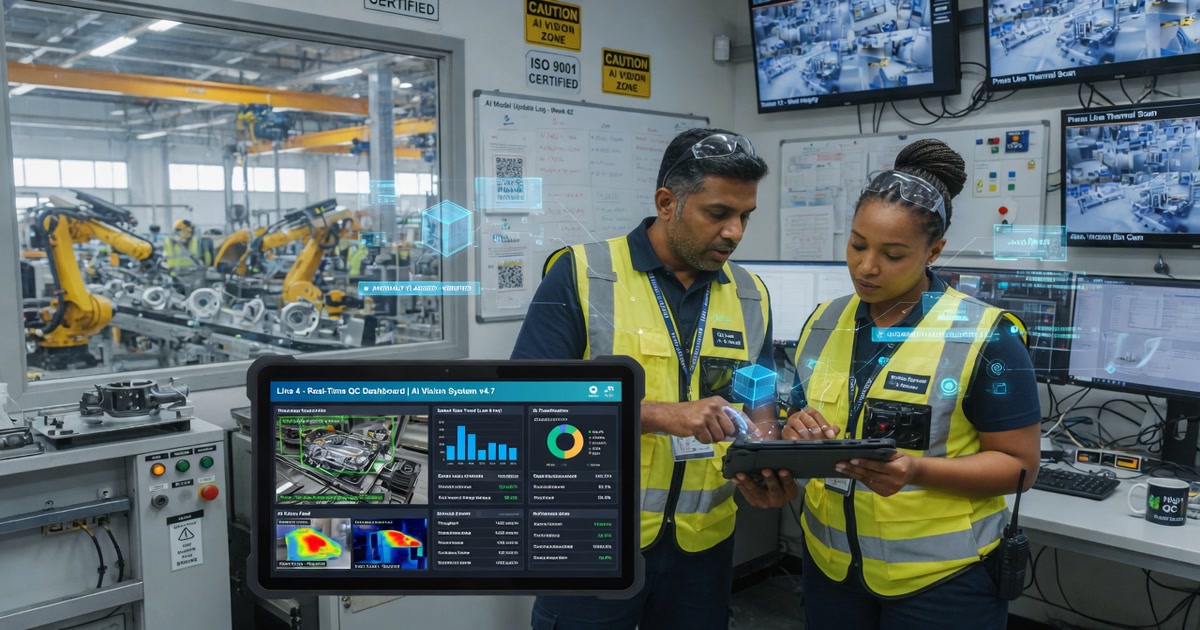
The problem isn't the machine. It's the human eye.
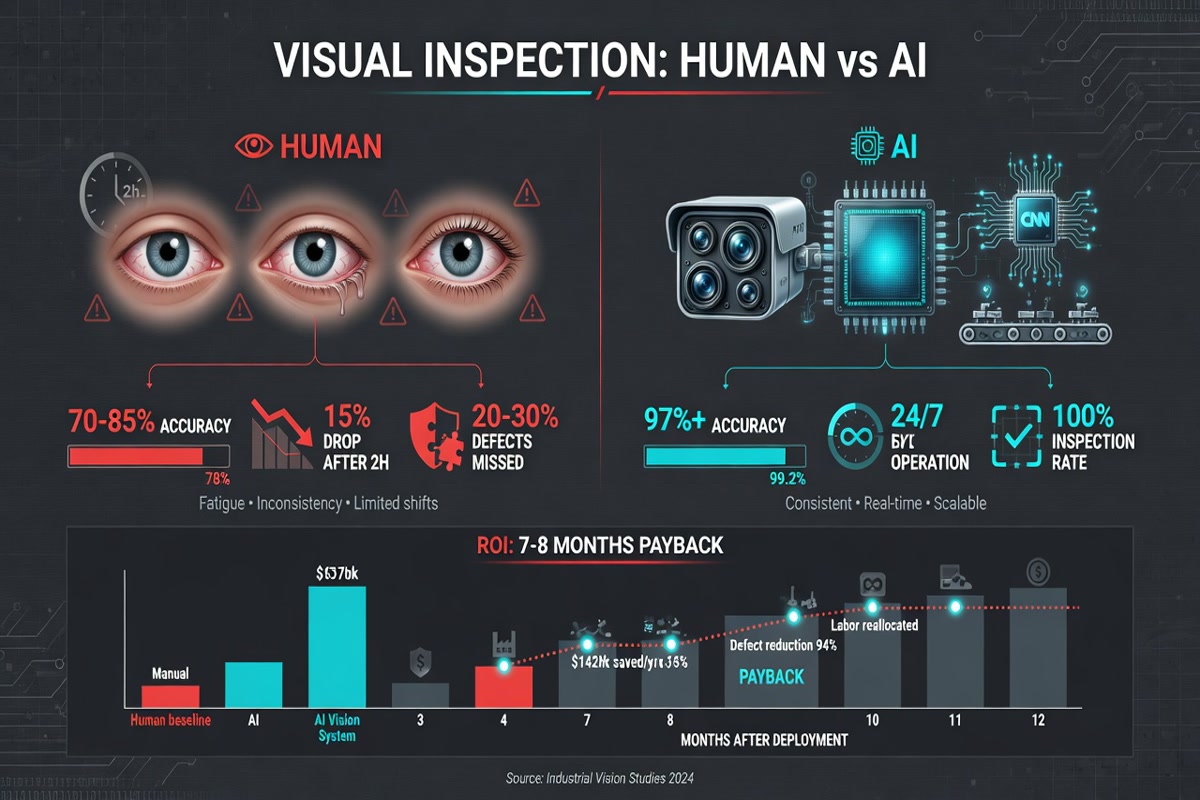
If you have a production line, you know the pattern. An operator inspects parts for hours. At first they're sharp, but by hour three their accuracy drops 15-20%. It's human nature. Even more telling: two inspectors looking at the same part only agree 60% of the time. That's 40% variable judgment.
The data is stark: human visual inspection misses 20-30% of defects. Not because inspectors don't try—it's biology. Eyes get tired, focus drifts, and 0.2mm microcracks disappear at line speed.
Meanwhile, the machine vision market grows 18% annually. Why? Because factories that have implemented it reduce customer-returned defects by 55% and recoup their investment in less than 8 months. That's not futurism. That's 2026 data.
What machine vision is (and why it's not science fiction anymore)
It's not mounting a security camera and having someone watch a screen. That doesn't work. Modern machine vision operates like this:
- Capture: High-resolution industrial cameras (from €800) with controlled lighting capture the part as it moves.
- Processing: An industrial PC or edge processor analyzes the image in milliseconds.
- Decision: The AI model (trained on your actual defects) judges: OK or NO OK.
- Action: If defective, it triggers automatic reject, an alarm, or a log in your ERP system.
What changed in 2026 is Deep Learning. Before, you had to program rules: "if the pixel is red, it's bad." Now you show the system 200 photos of good and bad parts, and it learns to tell them apart on its own. It's like hiring an inspector who learns your product in a week and never takes vacation.
3 real-world cases from industrial SMBs
Let's skip Tesla and Airbus. Let's talk about companies like yours—20 to 100 employees.
Metal stamping: cracks too small for the eye
A stamping SMB was losing customers due to a 4.1% rejection rate from microcracks. They installed two cameras with grazing-angle lighting. The system detects 0.2mm cracks at production speed. Result: rejection down to 0.8% within 3 months. Contract renewed for 3 years.
Plastics: savings in returns
Injection-molded containers with bubbles and warping. Manual inspection of 5%. Entire batches returned due to sampling errors. After implementing machine vision: 100% inspection at 120 units/minute. Returns dropped from €12,000/month to €1,800/month. Payback in 5 months.
Technical textiles: inspection 3x faster
Female inspectors with magnifying glasses worked at 8 meters/minute. A high-speed line camera: 25 meters/minute. It detects 7 defect types and marks the exact position on the roll. 3× faster, +62% better detection.
"23% of manufacturing SMB operating costs go to managing defects: rework, returns, and manual inspection hours. Machine vision targets that margin directly."
Manufacturing sector data, 2026What it costs and what's included (real numbers, not made up)
Machine vision isn't off-the-shelf software. It's an engineering solution. But 2026 pricing has dropped significantly.
| Component | Price range | Notes |
|---|---|---|
| Hardware (Cameras + Lighting) | €3,000–12,000 | Depends on complexity and number of inspection points. |
| Software and Licenses | €2,000–8,000 | Includes trained AI model and user interface. |
| Integration and Deployment | €1,500–5,000 | Mechanical, electrical engineering, and ERP/MES connection. |
| Total turnkey project | €6,500–25,000 | For a standard line at a typical SMB. |
Expensive? Compare that to a single batch of defective parts returned by an automotive customer. Or to the cost of paying three inspectors for 8-hour shifts to cover 100% of production.
Also, if your industrial SMB is in Galicia, industrial automation grants cover up to 50% of this investment, cutting your actual cost even further.
How to integrate it (without stopping production)
The most common question I get: "Will I have to shut down the factory for two weeks?" No.
Machine vision installs on top of your existing line. Cameras are mounted (they're small), lighting is adjusted, and everything connects to an industrial PC. Model training uses photos you already have or shots taken during a normal production day.
The system runs in parallel for a week ("shadow mode") while the human inspector keeps working. Once the system proves it catches more than humans do, you flip on automatic reject. No construction, no cables on the floor, no new bottlenecks.
Frequently asked questions
What if my product design changes?
You retrain the model. It's not like reprogramming a 1990s industrial robot. You upload new photos and the system learns the new standard in hours. Maintenance cost is minimal compared to a series defect.
Can the AI get it wrong?
Current models have a false-positive rate (rejecting a good part) below 1%. And here's the good part: the system learns from mistakes. If it rejects a good part, you tell it and the model improves for next time.
Is it mandatory for compliance?
More and more OEMs (major customers) demand 100% production traceability. If you can't prove you inspected every part with objective criteria, you're out of their procurement. Machine vision creates automatic, part-by-part records.
Can I start with a pilot?
Yes, and that's recommended. Install it at one critical point on the line for a month. If the numbers work (they usually do), scale to the rest. That way you don't bet your whole year's budget on one shot.
Is manual inspection costing your production line money?
We evaluate your case free. We'll tell you if machine vision makes sense for your product, what equipment you need, and what return you'd see in year one. No commitment, no technobabble.
Evaluate my production line →