
The problem it solves (and the one nobody mentions)
If you run an industrial plant, your reality is this: machines fail whenever they want. And when they fail, you don't just pay for the repair. You lose production hours, idle labor, damaged parts from the cascade effect, missed delivery deadlines, and if it repeats, you lose customers.
Corrective maintenance (fix it when it breaks) is cheapest to set up and most expensive to run. Preventive maintenance (check every X operating hours) is better, but it generates unnecessary interventions: you replace parts with life left and do scheduled stops that weren't needed.
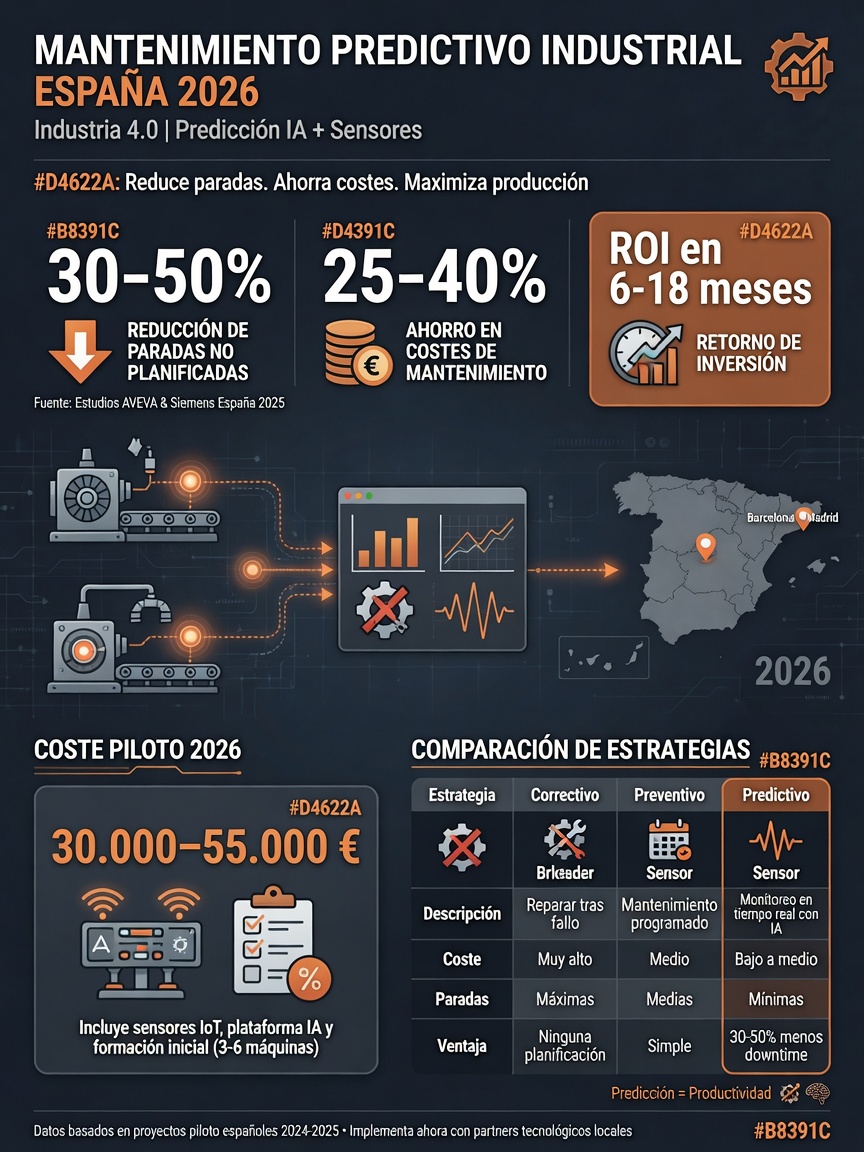
Predictive maintenance promises the best of both: intervene only when the data says it's necessary. Not before, not after. It sounds good, and the numbers back it up. According to Spanish industrial sector data compiled by Davisa and SectorIndustrial, companies running predictive maintenance cut unplanned downtime by 30–50%.
But here's what sales presentations don't tell you: most predictive maintenance pilots die quietly before month 12. Not because the tech fails, but because alerts sit on a screen nobody looks at. The maintenance manager gets 40 notifications a week, can't investigate them all, and gives up by month three. The pilot becomes a pretty dashboard nobody uses.
"The most expensive sensor in the world is useless if the alert never becomes a work order someone executes, closes, and feeds back to the model."
Lesson learned from dozens of industrial deploymentsWhat it actually costs (no fine print)
Let's talk numbers. A predictive maintenance pilot for an industrial SMB in Spain in 2026 falls into these ranges, based on real sector data:
| Item | Cost estimate | What's included |
|---|---|---|
| Sensors + gateways + installation | €12,000–24,000 | Triaxial vibration, temperature, current clamps, cycle counters. Installation on 3–5 machines. |
| Cloud platform (12 months) | €4,800–9,600 | Dashboard, pre-trained ML models, alerts, data storage. |
| CMMS/ERP integration | €8,000–18,000 | Auto-convert alerts to work orders. 100–160 hours professional services. |
| Team training | €2,000–4,000 | 16–24 hours for maintenance lead and production manager. |
Total pilot cost (12 months): €30,000–55,000.
Now the question that matters: what does that translate to in savings? If your facility loses €250,000–600,000 yearly from unplanned downtime (typical for 10–30 machine SMBs), a 30–50% reduction means €75,000–300,000 in annual savings. The pilot pays for itself in 6–18 months in most well-run implementations.
Three ways to run maintenance (and why the third wins)
To decide if predictive makes sense for your plant, it helps to understand all three options. Each has its place, but not everywhere:
| Type | When you act | Downtime cost | Investment | Best for |
|---|---|---|---|---|
| Corrective | After breakdown | Very high (emergency) | None | Non-critical, easily replaceable equipment |
| Preventive | Fixed schedule | Medium (scheduled) | Low | Predictable wear cycles |
| Predictive | When data indicates | Low (scheduled intervention) | Medium–high | Critical equipment, high downtime cost, observable failure modes |
The key: not every machine justifies the investment. Monitoring a standard conveyor with IoT sensors doesn't make sense if its downtime doesn't affect production. But a bottleneck extruder, central compressor, or industrial refrigeration system? That's where predictive earns its keep.
Real case: 1990s machines that never got replaced
One of the clearest examples comes from Tenerife. Industrias Atlánticas, a manufacturing plant in Granadilla de Abona Industrial Park, faced a familiar dilemma: much of their machinery dated to the 1990s and unexpected breakdowns cost them 4–12 hours of downtime each.
Management didn't want to replace machines that mechanically still worked. The solution was retrofit: they added sensors to existing equipment without touching its core function. Triaxial vibration sensors, non-invasive current clamps (clamp-on type), and optical cycle counters.
Year one results were clear: they cut unplanned downtime by 60%, cut maintenance costs 25%, and recovered the investment in six months. The key wasn't the tech—it was integrating alerts with their management system to auto-generate work orders.
This case matters because it breaks the myth that predictive requires new machines. It doesn't. It requires well-placed sensors, a system that turns data into action, and someone who reviews that data with judgment.
100-day roadmap to your first working workflow
If you think predictive makes sense for your plant, here's what we recommend. You don't have to do it all at once:
Days 1–20: Identify critical equipment
List all your machines. For each one, answer: How much per hour of downtime? How often does it fail? Are replacement parts hard to source? Does failure risk safety? The ones scoring high on these four points are your pilot candidates. Usually 5–15% of your machine fleet.
Days 20–45: Define metrics and baseline
Before you install anything, measure where you stand. Four KPIs: MTBF (mean time between failures), unplanned maintenance cost, unplanned downtime hours, and target false-positive rate (under 30%). Without a baseline, you can't prove ROI.
Days 45–75: Install sensors and integrate
Deploy sensors to your chosen 3–5 machines. Connect to your CMMS or ERP so alerts auto-generate work orders. This is where most projects break: if the alert stays in a separate dashboard away from daily workflows, the pilot dies.
Days 75–100: Validate and decide
Compare KPIs against baseline. Did MTBF improve? Did downtime drop? Did alerts convert to actual interventions? If the numbers validate the hypothesis, plan to expand to 8–15 more machines. If not, you've invested modestly and learned a lot about your equipment.
Five errors that kill a predictive pilot
After seeing plenty of projects, these mistakes keep repeating:
Error 1: Starting with too many machines
Trying to sensor the whole plant day one is the fastest way to burn money with no clear results. Start with 3–5 critical machines. Prove the ROI. Then scale.
Error 2: Skipping integration with your management system
This is the #1 killer. If alerts don't become work orders inside the system your maintenance team actually uses, the pilot's already dead. CMMS integration—or ERP integration if you don't have a CMMS—isn't optional. It's what decides success.
Error 3: Not training the maintenance lead
The system flags motor 3's vibration at 15% above normal. Is that a yellow alert or red? Act now or schedule next shift? Without training, your maintenance lead can't interpret data and loses confidence in the tool.
Error 4: Not measuring from day one
Without clear metrics from the start, you can't prove ROI. Without ROI proof, the project dies in the next budget meeting.
Error 5: Buying sensors without an analytics plan
Sensors are the cheap part. The expensive part is the platform processing data, the models detecting anomalies, and integration with your systems. Buying sensors without solving the rest is like buying a car without a driver's license.
When predictive doesn't make sense
I'd be dishonest not to say it: predictive maintenance isn't for everyone. Skip it if:
- Your machines aren't critical: if a breakdown doesn't halt production or risk safety, standard preventive maintenance is enough.
- You're not digitalized yet: if you don't even have a basic CMMS to log interventions, start there first. Predictive needs a digital foundation.
- Your team is overwhelmed: if your maintenance lead is already drowning, adding a new tool without dedicated time just creates frustration.
- You want results in under 6 months: predictive models need a learning period. The first months are calibration, not immediate savings.
If you're in any of these situations, start with the basics: digitalize your work orders, run a proper preventive program, and when you have solid ground, jump to predictive.
Grants and subsidies available in 2026
Good news: this type of project has public funding. In 2026, the main subsidy lines for industrial SMBs deploying predictive maintenance include:
- Digital transformation grants for SMBs (Galicia Feder 2021–2027): Xunta de Galicia runs the IG300C initiative for advanced digitalization projects, including industrial sensor networks and automation. Applies to Galician-based SMBs.
- Kit Digital 2026: now includes AI and data analytics tools in its catalog, with up to €12,000 in grants for SMBs with 10–49 employees.
- Activa Industria 4.0: specific financing for digital transformation in manufacturing, with favorable terms for Industry 4.0 projects.
- Green Industrial PERTE: targets projects combining digitalization with energy efficiency in manufacturing.
These programs can cover 30–60% of your pilot investment, significantly reducing financial risk. If you're in Galicia, the Xunta grants are especially relevant because they explicitly cover industrial process digitalization and digital supply chain integration.
Frequently asked questions
What does a predictive maintenance pilot cost for an industrial SMB?
A 3–5 machine pilot runs €30,000–55,000 in year one, including sensors, cloud platform, CMMS/ERP integration, and team training. With 2026 subsidies (Kit Digital, Galician Feder grants), you can recover 30–60% of that investment.
What types of machines can be monitored?
Critical equipment where downtime costs serious money: electric motors, compressors, centrifugal pumps, extruders, industrial refrigeration, fans, furnaces, production bottlenecks. Standard sensors (vibration, temperature, electrical draw) cover 80% of failure modes in mid-sized industrial equipment. You don't need new machines—retrofit lets you sensor 1990s equipment without modification.
How long until you see ROI?
First 2–3 months are model calibration. Real anomalies surface month 4–5. Financial ROI appears month 6–8 in most cases. Typical payback is 6–18 months depending on your equipment's downtime cost.
Do I need a data team or ML engineer?
Not for an initial pilot. Today's platforms ship with pre-trained models for common machines (motors, pumps, compressors) that only need calibration with your data. What you need is a maintenance lead willing to learn alert interpretation and a vendor to handle CMMS integration.
What if my plant has poor connectivity?
That's a detail many overlook. Data must flow from sensor to platform without loss. If your facility lacks industrial WiFi or LTE/5G coverage, connectivity becomes your first problem. Some solutions use edge gateways that preprocess data locally, sending only relevant events and reducing bandwidth.
Ready to know if your plant is a predictive maintenance candidate?
We analyze your setup at no cost: which machines to monitor, pilot costs, and real ROI based on your operation's data.
Request free analysis →