
Almost every small business owner I speak to uses AI for the same single thing: writing. Drafting an email, cleaning up a product description, summarising a long document. It saves a bit of time, nobody complains, and then it stops there.
That "stops there" is the whole story. The OECD ran its 2026 Digital for SMEs survey across 12 countries, and the pattern it found is not that small firms are ignoring AI. It is that they are using it in one narrow lane and quietly assuming the payoff scales on its own. It does not. The firms that push AI into a second and third part of the business report dramatically bigger gains than the ones who stop at the first.
This is the version of that data written for the person who runs the business, not for the policy meeting.
What the OECD asked, and what came back
The survey covers 2,018 small and medium businesses in Canada, Finland, France, Germany, Greece, Italy, Japan, Korea, Poland, Spain, the United Kingdom and the United States. The respondents are not a random slice of those economies; they are firms already doing business on digital platforms, so the numbers skew a little optimistic. That makes the finding harder to wave away, not easier.
Sixty-one percent report using at least one AI-enabled application. That is the headline, and it is the one every news piece ran. It is also the least useful number in the report.
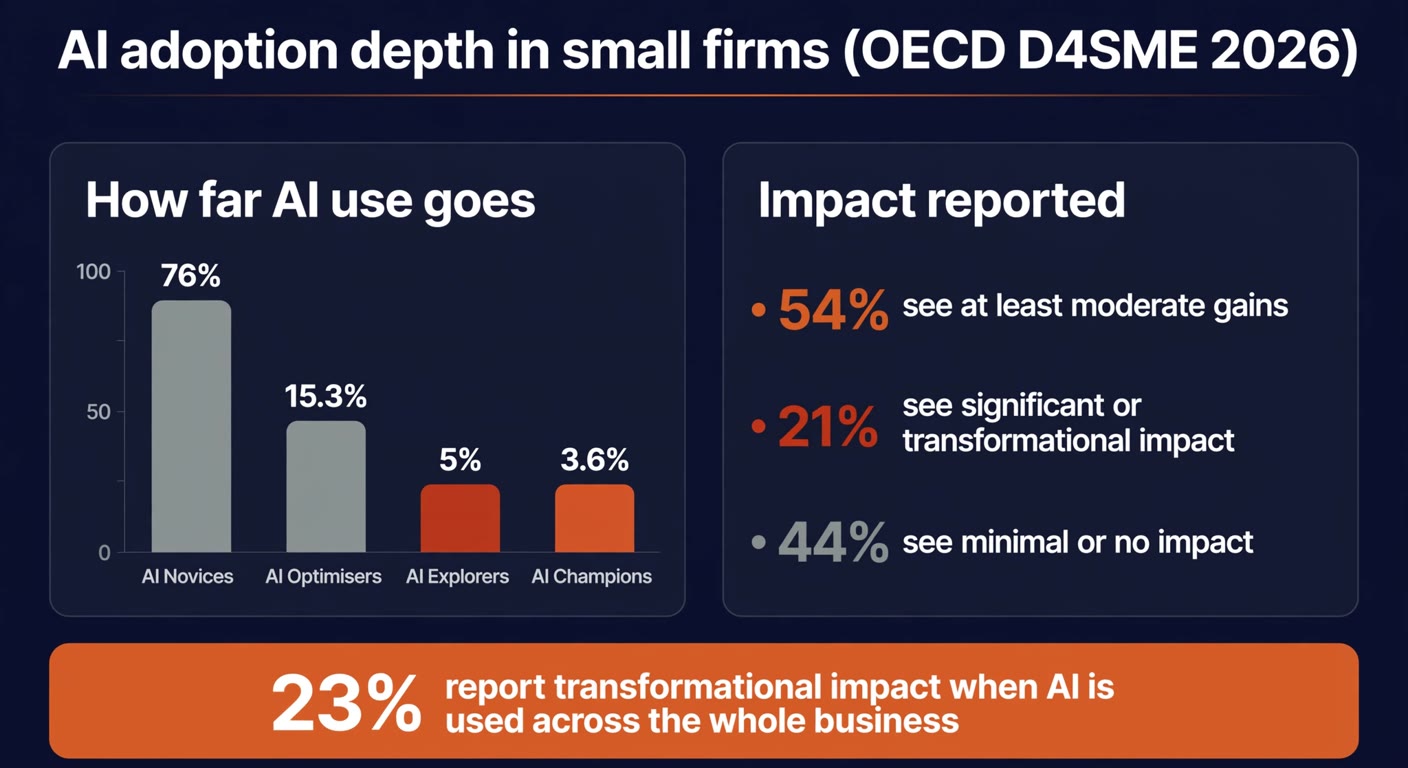
The useful number is what happens next. The OECD sorts AI users with a taxonomy it helped develop for the G7, and the result is lopsided:
| Where the firm sits | Share of AI users | What that looks like in practice |
|---|---|---|
| AI novice | 76% | Off-the-shelf tool, one task, unconnected to the rest of the business |
| AI optimiser | 15.3% | Broader use, but still on simple, standard tools |
| AI explorer | 5% | Customised or connected AI in specific functions |
| AI champion | 3.6% | AI working across functions or the whole business |
Read the first row twice. Three out of every four small firms that use AI are using it for a single, isolated task. Even in a sample weighted toward digital businesses, the deeper stages are rounding errors.
Why one task is a ceiling, not a stepping stone
Using an AI writing tool is genuinely useful. It also does almost nothing to change how the business works, and that is the mistake. A single tool in a single place replaces one chore. It does not connect two systems, it does not free a person up to do something else, and it leaves no trail you can build on.
Compare that with a second use that touches the first. Say you already use AI to draft quotes. The obvious second step is not another writing tool; it is letting the same system read the enquiry email, pull the product and price from your own spreadsheet, and file the draft in the CRM. Now the AI is doing a process, not a paragraph. One task becomes a workflow, and the time it saves stops being ten minutes and starts being a job nobody has to hold in their head.
That is why "novice" is a ceiling. The reason is structural, not motivational. A tool in one lane has nothing to hand off to, so the savings cannot stack. A tool wired into two lanes has outputs that feed inputs, and the savings compound from there.
The number that should change how you plan
Here is where the OECD data earns its keep. It does not just measure how many firms use AI; it measures whether that use is worth anything to them, and the gap is wide.
Just over half of surveyed firms, 54%, report at least moderate gains from AI. A further 33% describe the benefit as reducing manual tasks or improving accuracy. Only 6% call it transformational, with another 15% describing a significant effect on efficiency, productivity or decision-making. On the other side, 44% report minimal or no impact at all.
Now the part that matters. The OECD found that reported transformational impact is rare when AI sits in one function, but rises sharply, to 23% of firms, when it is deployed across the business. The same report notes that firms using AI in an isolated way almost never reach that level. Same tools, same country, same year. The variable is not the software. It is how far it reaches.
The software you buy is a floor. How far you wire it into the business is what sets the ceiling.
The finding underneath the OECD's adoption numbers
Picking your second function
You do not need a plan, a committee or a consultant to take the next step. You need one afternoon and an honest answer to a few questions.
First, list the tasks you repeat every week. Not the big projects; the recurring ones. Chasing payments, answering the same five customer questions, building the same Friday report, re-typing order details into a second system. Those are the candidates, because repetition is what makes a process automatable.
Second, pick the one that already touches your first AI use. If AI writes your quotes, move the quote through to the invoice. If AI drafts your social posts, let it pull the product details and schedule the post. The second step should be the next thing in the line, not a new island.
Third, connect it to a system you already own. A shared inbox, a spreadsheet, your accounting software, the CRM you half-use. The OECD survey keeps finding the same thing: most small firms are running off-the-shelf tools in isolation. The point of the second step is to introduce a connection the first step never had.
If you do only one thing after reading this, do that: take the AI use you already have and drag it one step further down the process. That single move is the difference between the 76% and everyone else.
What "across the business" looks like in a six-person company
"Enterprise-wide AI" sounds like something a bank does. In a six-person company it looks much smaller and much more concrete. It means the same AI layer shows up in more than one corner of the week, and the corners talk to each other.
Take a small joinery or repair business. The owner uses AI to write quotes. Step two: the quote tool reads the incoming job email, matches the job to a price list, and drafts the reply. Step three: when the customer says yes, the same system creates the job in the scheduling sheet and texts the crew the address. Nobody called it an "AI programme". It is one connected line running from enquiry to job sheet, and it replaced three separate moments of manual re-typing.
The same shape works in a small online shop. AI drafts product descriptions today. Add a second function: it reads the return reasons from support tickets and flags which listings keep getting the wrong items sent. That is not a bigger tool. It is a second, connected use of the one you have, and it produces a result a human would never have had time to compile.
Notice what is common in both: the second function is downstream of the first, and it writes into a system the business already runs. You are not adding software. You are removing the gaps between the software.
When staying at one task is the right call
There is a real case for stopping at one task, and it is worth saying plainly because nobody selling you AI will. If your first AI use is saving meaningful time, the business is small enough that one person holds every process in their head, and you cannot yet name a second repeated task worth automating, then spreading AI around is busywork. A second integration you never check is worse than no second integration, because it fails quietly while you assume it is running.
The honest test is not "could AI do more here". It is "is there a repeated task, downstream of the one I already automated, that costs real hours and has a clear finish line". If the answer is yes, the second step pays. If you are stretching to invent one, you are at the right depth for now, and pushing further just adds maintenance you will resent by month three.
What you should not do is assume depth will arrive on its own. The OECD data is clear that it does not: given the same access to the same tools, three-quarters of small firms stay exactly where they started. The second step is a decision, not a natural next stage.
Frequently asked questions
Is it a problem to use AI for only one task?
Not as a starting point, but as a permanent state, yes. The OECD's 2026 survey found 76% of small firms using AI stay in a single isolated task, and that group reports far less impact than firms using it across the business. One task replaces one chore; it cannot compound because there is no second step for it to feed.
How many small businesses actually use AI?
In the OECD's 2026 survey of 2,018 small and medium firms across 12 countries, 61% reported using at least one AI application. Remember that the sample was drawn from firms already trading on digital platforms, so it runs higher than a true cross-section of the economy. The share is growing fast either way.
What counts as an "AI champion" in the survey?
It is the top band of the OECD's taxonomy: firms where AI runs broadly across functions or the whole business. Only 3.6% of surveyed AI users reached it. The bands below are AI explorer (5%), AI optimiser (15.3%) and AI novice (76%).
Do I need technical staff to go deeper with AI?
No. The second step is usually a connection between two tools you already run, not a new build. A shared inbox, a spreadsheet, an invoicing tool and one automation platform cover most small-business cases. The scarce resource is identifying the right second task, not writing code.
How do I know if I am a novice or an optimiser?
Ask whether your AI use is connected to anything. If it drafts something and a person moves that something onward by hand, you are in the novice band. If the output feeds straight into another system and someone checks it, you have moved up.
Stuck using AI for one thing?
BigLobster takes the AI a small business already uses and wires the next step into the systems you already run, so the time saved stops being ten minutes and starts being a process nobody has to hold in their head.
Ask where your second step is