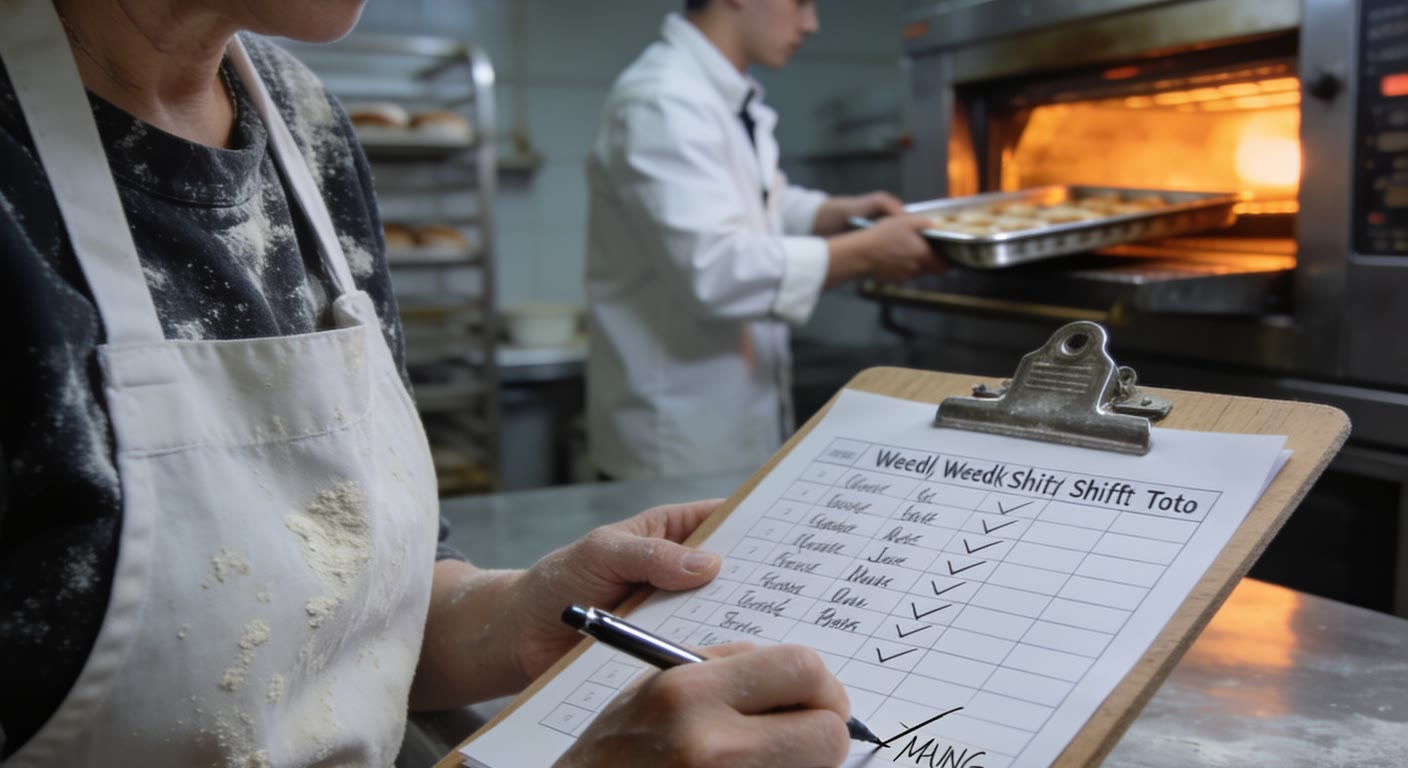
Ask a small business owner which decisions they would never hand to software and most answer in seconds. Ask where that rule is written down, and the answers get vague. It lives in the owner's head, and it changes depending on who is on shift that day.
That gap is worth closing, and a survey published on 14 October gives you the numbers to argue it with. The European Commission's Eurobarometer on AI and algorithmic management in European companies interviewed heads of 12,826 small and mid-sized firms across all 27 EU countries between March and April 2026. One finding is the one to remember: 90% of those companies say people take the decisions, and just 2% say their decisions are fully automated.
This is a Europe survey, but the question it answers is not a European one. If you run a business of four people or forty, you are already making this choice, usually by accident. Reading the data is a cheap way to make it on purpose.
What the survey actually asked
First, the size of the thing. Forty-two percent of the firms surveyed said they already use AI or algorithmic management, and 21% said they plan to. Add those and roughly two thirds of European small and mid-sized companies are in or heading into this territory. A separate analysis published the same day by the Commission's Joint Research Centre, using Eurostat data, found AI use in EU strategic sectors rose from 7% of firms in 2021 to 18% in 2025. The direction is not in doubt.
The useful detail is where the tools go. The survey asked companies what they use AI and algorithmic management for, and three answers dominated:
| Area | Share of firms |
|---|---|
| Customer service and client relations | 47% |
| Monitoring performance and productivity | 36% |
| Logistics, planning and staff scheduling | 30% |
Source: European Commission, Eurobarometer on AI and algorithmic management, 14 October 2026.
Look at that list again. Two of the three are not customer-facing at all. They are the places where a small business decides who works when and who is doing well. Those are the decisions people care about most, and the ones where a wrong call costs you a good employee rather than a bad review.
The line gets drawn at people, not at tasks
Here is the tension in the same survey. Seventy-five percent of respondents said they believe AI and algorithmic management will improve job quality, and 61% said AI helps them take decisions. So this is not an audience of sceptics.
Now put the boundary next to it. Ninety percent said people take the decisions and only 2% said decisions are fully automated. And when the survey asked specifically about decisions related to staff matters, 49% said they do not trust AI or automated systems to make them.
Read as one thing, that is a coherent position, not a contradiction. Companies are happy for software to prepare a decision and unhappy for it to own one. Recommendation yes, authority no. The 2% figure says almost nobody has crossed that line, even after five years of tools being available at low cost.
Why the 2% number is worth copying
You could read that as European caution, or as firms moving slower than the technology. I think it is closer to a lesson learned the hard way in bigger companies: an automated decision nobody owns is a decision nobody can fix. When the schedule is wrong and no manager chose it, the person who suffers is the one on the wrong shift, and the person who has to apologise is whoever happens to be holding the rota.
There is a second, less obvious reason the boundary survives. Owners keep the final call on staff matters because those calls are cheap to make and expensive to get wrong. Deciding whether to move Ana to the afternoon is thirty seconds of judgement. Getting it wrong, and having her hear about it from a roster instead of from you, costs you trust you will not get back with an apology.
So the sensible target is not zero automation. It is a line you chose, not one that arrived with the software. Most small firms already behave as if they have one. The problem is that it lives in the owner's head, so nobody else can apply it, and every new tool quietly tests it.
An afternoon is enough to write it down
You do not need a policy consultant. You need a whiteboard and two hours, and the output is one page. This is the version that works for a team of three as well as a team of thirty.
- List the decisions you actually repeat. Not the strategy, the recurring ones: who works which shift, who gets the credit for a job, who gets a discount, which supplier gets the order, which candidate moves to interview. Two columns, one page.
- Give each one a label. AI recommends and a person decides. AI executes and a person checks the exceptions. Or a person does it and AI stays out. Three labels cover almost everything you will ever automate.
- Name the owner of each automated one. A specific person, by role if not by name, who is answerable for the outcome. No owner, no automation. This is the step that separates a working system from a complaint waiting to happen.
- Write down how a bad call gets caught. Who reviews the schedule before it goes out? What number would look wrong? Automation fails quietly by design, so detection has to be designed in.
- Put the page where the team sees it. A rule that only you know is not a rule, it is a preference. It also protects you: if the tool is the one that moved the shift, your team should already know that a human signs off before it happens.
That is the whole exercise. It takes an afternoon, and it has a useful side effect: the moment you try to write "AI does it on its own" next to a decision, you find out whether you actually believe that.
If you already automate shifts or performance
Two of the three top use cases in the survey are staff-facing: monitoring performance and productivity at 36%, and logistics, planning and staff scheduling at 30%. If either sounds like your business, the decision line matters more, not less, because the tool is now touching people's pay and their free time.
Three habits keep that from going wrong. Tell people the tool is there and what it does; a system staff discover by accident reads as surveillance regardless of what it actually measures. Keep a named person approving the exceptions rather than the averages — the algorithm is fine at the normal week and worst at the strange one. And record who overrode what, so that when a schedule is disputed you can show the decision instead of arguing about it.
None of this needs a compliance department. It needs the same rule for everyone and a person who owns the outcome.
When letting the machine decide is fine
I am not arguing for a human gate on everything. That would be slow and, in a small company, it would kill the project. The test is not how serious the topic sounds; it is the cost of a wrong call and how fast you would notice.
Let the system decide alone when the decision is small, reversible, high-volume and cheap to detect: which support ticket goes to which queue, when to reorder a product that sells steadily, how to sort a batch of returns. A wrong answer there costs minutes and shows up in the next report.
Keep a person on the hook when the cost lands on someone else: hiring, firing, pay, schedules, refusing a customer, cutting off credit. Those are the calls where, if the software is wrong, the first person to find out is the person who was harmed. That is the boundary 49% of European companies drew for themselves, and it is a sensible place to start.
Frequently asked questions
Do I need a written policy for a business of five people?
You need a written rule, which is not the same thing. One page is enough: the decisions you repeat, which ones AI may execute, and who owns the outcome. The reason to write it is not the auditor, it is that a rule living in the owner's head cannot be applied by anyone else, and it changes shape the moment a new tool arrives.
Does keeping a person in the loop not make the automation pointless?
No, because the loop is on the exception, not on every case. The system handles the normal week; a person looks at what it flagged or what looks off. The time you save comes from not building the schedule by hand, not from pretending nobody needs to check a strange week.
Is this the same as the rules in the EU AI Act?
No, and this article is not legal advice. The survey is European and some AI uses in employment are regulated there, but the rule described here is your own operating choice, and it applies whether or not any law asks for it. Write the line because it makes you faster and safer, then check your local obligations separately.
We have not automated anything yet. Is it too early to think about this?
This is the cheapest moment. Drawing the line before the first tool arrives means the tool has to fit your rule instead of your rule having to fit the tool. It also makes the first project easier to approve, because everyone already knows what the software can and cannot decide.
Want the repeatable work handled without losing the judgement calls?
BigLobster maps the decisions and tasks that eat your week, automates the repeatable ones and leaves the calls that need a person where they belong. You keep the authority; the software gets the busywork.
Show me where my line sits