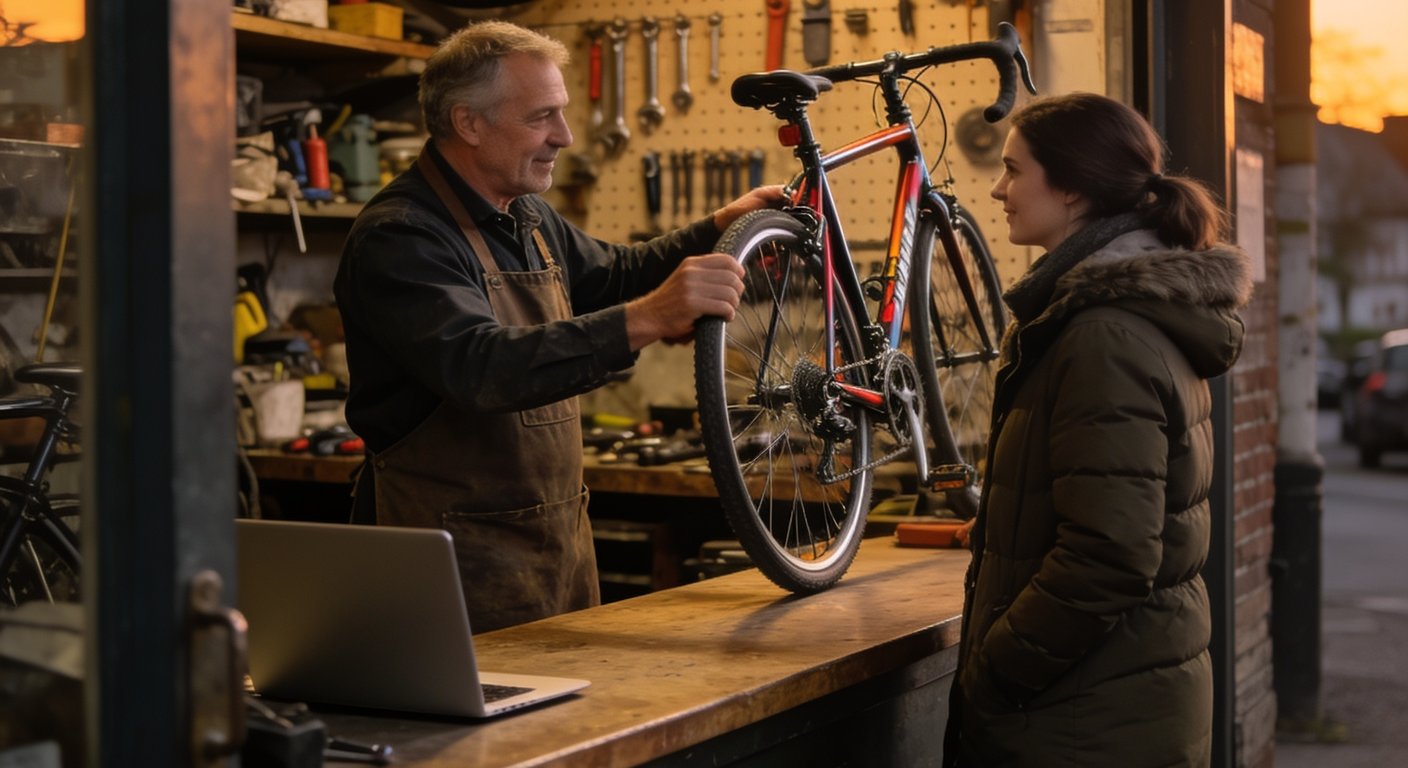
Everyone is selling you the same story: put AI on the front desk, cut the cost of the person, move on. Then a customer walks in, hears a chatbot, and asks for somebody real. That moment is not a bug in your automation. It is a market signal, and most small businesses are reading it backwards.
PYMNTS Intelligence published the October 2026 edition of its SMB Growth Monitor, "AI Goes to Work: How SMBs Grow Without Growing Payroll." It surveyed 533 US small businesses in August 2026. The headline finding is that AI is now the default operating layer for most of them: 88% have tried it, 74% use it at least occasionally, and 44% use it often. The interesting part is what happened next.
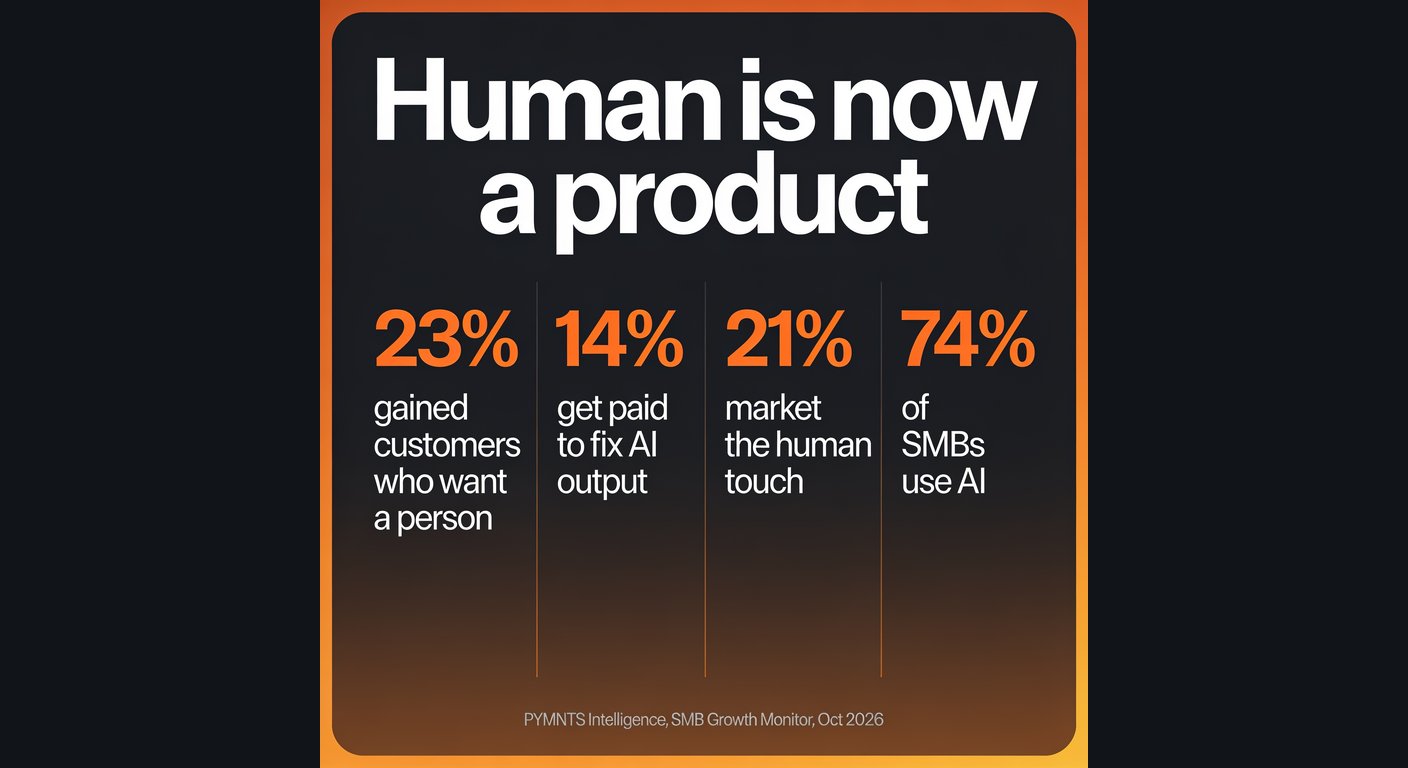
Nearly one in four of those businesses (23%) gained customers who specifically wanted a person doing the work. Another 14% picked up paid assignments fixing AI-generated output. And 21% have already started emphasizing the human touch as a selling point, or plan to. Read those three numbers together and you get something the AI-hype cycle keeps skipping: as machine output becomes cheap and everywhere, the human part stops being a cost line and starts being a product.
What the survey actually found
The number that should shape your next quarter is not the 74%. It is the gap between the businesses that use AI often and the ones that barely touch it.
Among SMBs whose revenue grew in 2025, 57% use AI frequently or very frequently. Among those whose revenue stayed flat, only 29% do. Both groups have tried the technology at almost the same rate — close to nine in ten — so the difference is not whether they adopted it. It is how often they lean on it. The report is careful about this, and so should you be: it does not claim AI causes the growth. It found a connection, and the connection is real enough to act on.
Speed is the benefit owners name most. Of the 474 businesses that had used AI, 72% said they finish tasks faster, 64% said it helps them compete, and 63% said it increased revenue. Six in ten said they produce more work without adding staff. A quarter (26%) skipped a full-time hire, ended a contract, cut hours or let someone go because of what AI took over — and they were roughly four times as likely to skip a hire as to lay anyone off.
On money, the picture is more honest than the marketing. Forty-four percent rate AI's financial impact as positive. Twenty-two percent see equal good and bad. Twenty-seven percent report no impact so far. Only 7.5% call it negative. That last group matters as much as the first: widespread use has not been a clean win for everyone.
Here is the part that gets lost when people quote the headline number. Automation is not showing up as a smaller wage bill. It is showing up as capacity. The same people get more done, and the freed time either gets reinvested into sales or quietly evaporates. Which one happens is a management decision, not a technology one.
The part nobody put in the business plan
Now to the finding that should genuinely change how you price things.
Customers are not neutral about AI. Nearly a quarter of these businesses gained customers who specifically wanted a person doing the work. Fourteen percent now get paid to fix AI-generated output — the draft that sounded fine until someone read it, the report with a number that does not add up, the reply that upset a client. And 21% have started selling the human touch on purpose.
Put a number on how lopsided that is. A business was more than four times as likely to win a customer who wanted a human than to lose a sale to a competitor using AI (5.1%). Requests for lower prices (7.4%) and fewer inquiries (9.1%) were both smaller effects than the human-touch gain. The demand for a person did not shrink as AI spread. It grew a new edge.
There is a second cost worth naming. Frequent AI users estimate saving the equivalent of 16% of revenue by doing work themselves instead of paying for outside help — but they also estimate losing 7.0% of revenue as their own customers use AI instead of hiring them. The same force that cuts your costs is cutting into the services you sell. If you sell something a machine can now do, you feel it. If you sell something a machine cannot, you gain.
Where to keep a human on purpose
Most owners automate whatever is easiest, then discover the easiest things to automate were the ones customers barely noticed. The better move is to decide, function by function, which parts of your business should stay human — and which should not.
The test is not "could a machine do this?" Almost anything repeatable can be automated. The test is "does the customer notice, and do they care?" Work the customer never sees can go to software without a second thought. Work that touches trust, money or a relationship deserves a person, even when the software is perfectly capable.
| Function | Automate it | Keep a human |
|---|---|---|
| Quotes and invoices | Standard pricing, same fields every time | Negotiated deals and anything with a discount |
| First contact | Booking, reminders, FAQs, after-hours | The conversation that decides whether they buy |
| Support | Order status, password resets, how-to questions | An upset customer, or a problem nobody has seen |
| Follow-up | The schedule and the sequence | Checking in on a client you actually care about |
| Reporting | Pulling the same figures on the same day | Deciding what the numbers mean for next month |
Notice the pattern. The automation takes the volume; the person takes the judgment. That is also where the 14% of businesses getting paid to fix AI output found their opening — they are not competing with the machine, they are cleaning up after it.
How to price the human part
If your customers are asking for a person, stop giving the person away for free.
This is the mistake I see most often. An owner keeps a human on the phones because it feels right, then charges the same as the competitor whose bot answers everything, and quietly absorbs the cost. The customer who wanted a human got exactly what they came for and paid nothing extra for it. That is not service, that is a subsidy.
There are three honest ways to capture the premium. Charge for it directly, as a named-account or priority service where the client always reaches the same person. Bundle it into a higher tier so the human contact is one reason the price is higher, not an apology for it. Or make it the whole offer — the fix-it service for AI output, the second pair of eyes, the local expert who will put their name on the work.
None of that requires new technology. It requires deciding that the human part is a feature you sell, not an overhead you tolerate. The 21% of businesses already emphasizing the human touch in their marketing have worked this out. The rest are still treating it as a cost to minimise.
The trap: automating the front desk first
Here is where the strategy goes wrong, and it is not about picking a bad tool.
The tempting first automation is the customer-facing one: the chatbot on the website, the voice agent answering the phone, the auto-reply on the support inbox. It is visible, it looks modern, and it is exactly where customers told the survey they want a human. Automate the front desk before you have automated the back office and you have spent your budget removing the one thing buyers were paying a premium for.
The order that works is the reverse. Automate the invisible work first — the quotes, the reminders, the reporting, the bookkeeping — and use the hours that come back to put a real person where the customer is looking. Then price accordingly. The data describes businesses that got both: the back office ran on software, the customer still met a person, and the two together is what let a flat team carry more work.
Frequently asked questions
Should I remove the chatbot from my website?
No. Keep it for the questions a person should not be answering at eleven at night — opening hours, order status, how to book. What you should stop doing is letting it be the last word on anything that involves money or a complaint. Route those to a human, and tell the customer that is what happens.
How do I find out which functions customers want done by a person?
Ask, then watch. The survey's numbers came from owners who noticed which customers asked for a human and which work they were paid to fix. Add one line to your intake — "would you like to deal with a person on this?" — and track it for a month. The pattern shows up faster than you would expect.
Does charging more for a human not lose me the price-sensitive customers?
It loses some, and that is fine. The businesses that gained human-wanting customers were more than four times as likely to win that work than to lose a sale to an AI-using competitor. You are not raising prices on everyone. You are separating the customer who wants cheap and fast from the one who wants a person and will pay for it.
What does "getting paid to fix AI output" look like in practice?
It is the draft that reads well but gets a fact wrong, the report with a broken formula, the reply that damages a relationship. A customer used a tool, the result was not good enough to send, and they paid someone to make it right. If you already do careful work, that is a service you can sell instead of a competitor you fear.
Not sure which parts of your business should stay human?
BigLobster automates the back office — quotes, reminders, reporting, bookkeeping — and helps you keep, and price, the customer-facing work that wins you clients. No new platform to learn.
Map my first automation