Why your support queue is the easiest place to start
Think about where your time actually goes in a week. Someone asks where their order is. Someone else wants to return a thing they bought last month. A third person types the same "what are your opening hours" question you answered nine times on Monday. None of it is hard. It's just endless, and it arrives at the worst times: after you close, on Saturday, while you're on the job site.
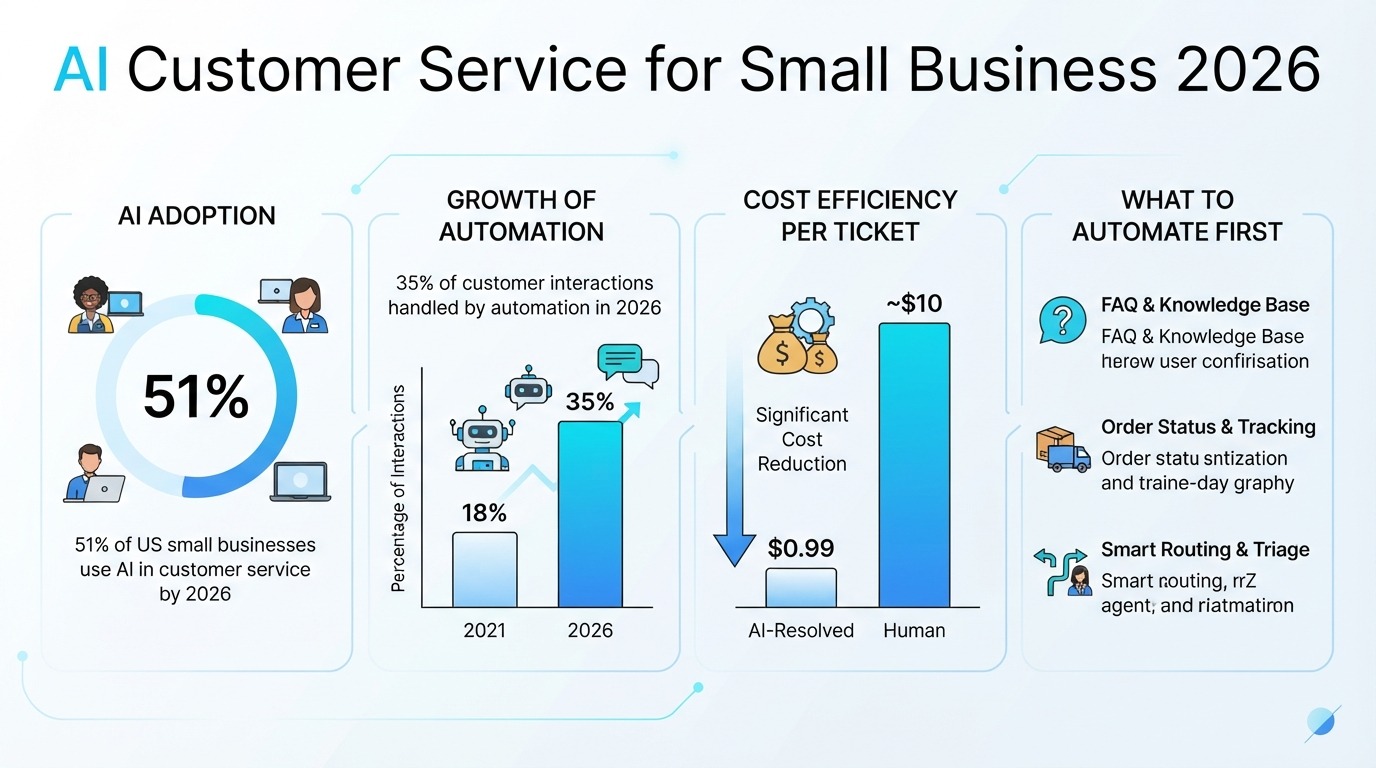
That's exactly why support is the first automation most small businesses should touch. The questions repeat, the answers live in your own docs, and the cost of getting one wrong is low as long as a human can step in. The data backs this up. In a 2025 survey of 400 US small business owners, 51% had already folded AI into their customer service, and 65% of them said it made resolutions faster.
Here's the part people miss: the win isn't "replace the team." It's "stop the team from answering the same five questions forever." One owner in Intercom's published numbers said the bot took 60% of their tickets and handed the small team back 142 hours in a single month. That's not headcount slashed. That's the owner sleeping through the night because the refund policy question answers itself.
Chatbot, AI agent, or copilot: what's the difference
The words get used like they mean the same thing, and they don't. Knowing which one you're buying changes what you can expect.
- Rule-based chatbot. The old kind. It matches keywords to fixed answers. Cheap, but it breaks the moment a customer phrases something slightly different, and it scores low on satisfaction for a reason.
- AI agent (retrieval-augmented). This is the one people mean by "AI support" in 2026. It reads your help center and past conversations, answers in plain language, and pulls live data like order status. Most deployments use a retrieval setup (RAG) rather than custom training, because it's 10 to 100 times cheaper and every answer points back to a source document.
- Copilot (agent-assist). Not a customer-facing bot at all. It sits next to your human agents, drafts replies, and summarizes long threads so they close more conversations a day. Intercom reports its copilot pushes agents to close 31% more chats.
If you want "answers itself at midnight," you want the AI agent. If you want to make your existing people faster, you want the copilot. A lot of platforms now sell both in one inbox, which is the setup worth looking at.
What the data says about small businesses in 2026
The adoption curve is steep and it's led by the smallest firms, not enterprise. Heeya's 2026 benchmark puts SMB adoption of AI support automation at 28% in 2026, up from an estimated 14% in 2023, and they're now the fastest-growing segment for new deployments. The driver is flat-rate pricing: when the bill is the same whether you get 50 tickets or 5,000, the math stops being scary.
QuickBooks' 2026 AI Impact Report, drawn from 34,000 surveyed owners across the US, Canada, the UK, and Australia, ranks customer service as a top-three use case everywhere, right behind marketing and admin. Among owners who paid for AI, roughly 8 in 10 were still paying a year later. That retention is the real signal: the tools that don't work get dropped, and these are sticking.
And the human team isn't going away. In that Talkdesk survey, 94% of owners planned to keep or grow their service headcount. The pattern repeats across every study: AI takes the repetitive volume, people take the judgment. The businesses doing best are the ones that told the bot "escalate anything with a complaint or a refund" and let it clear everything else.
What it costs (and what you actually get)
Prices have fallen to the point where the question is "why am I still doing this by hand," not "can I afford it." The models split into two shapes: per-seat subscriptions and per-resolution pricing.
| Approach | Typical monthly cost | What you get |
|---|---|---|
| No-code helpdesk (Desku, Tidio, and similar) | $20-50 | Unified inbox, bot trained on your FAQs, basic routing |
| Established platforms (Zendesk, Intercom) with AI add-on | $50-90 per agent, or per-resolution | Advanced agent, copilot for humans, analytics, integrations |
| Built-in features you already pay for | $0 extra | Many email and commerce tools now ship basic AI replies |
A flat $30-50 a month for a bot that answers the recurring questions is cheaper than one hour of outsourced support. The per-resolution model (paying only when the AI actually closes a ticket) is the one to prefer if your volume swings a lot, because you're not paying for quiet weeks.
Where a human still has to stay in the loop
I won't sugarcoat this: the bot will confidently answer things it shouldn't if you let it. Keep a person on these:
- Complaints and refunds. Anything with money leaving the business or a customer who's already angry should route to a human, fast.
- Anything account-specific and sensitive. Pulling a customer's order is fine. Acting on it without confirmation is not.
- New situations. If the question has never shown up in your docs, the agent is guessing. Teach it, don't trust it.
The right mental model is a bouncer, not a replacement. The AI handles the line at the door; the human handles the table that's about to walk out.
The businesses getting real value from AI support are the ones that told the bot exactly when to step aside. "Escalate anything with a complaint or a refund" is the single setting that matters most.
Pattern across 2025-2026 SMB support surveys
The mistakes that turn AI support into a mess
These fail in predictable ways, and almost none of them are the software's fault.
- Pointing the bot at an empty help center. If your docs are a mess, the agent repeats the mess. Write down your top 20 questions first; the bot is only as good as what it reads.
- Letting it answer everything. Turn off autonomous replies for refunds and complaints on day one. You can widen the lane later once you trust it.
- Never reviewing the transcripts. Set a weekly 10-minute check of what the bot got wrong. The fixes are usually one sentence in your FAQ away.
- Buying per-seat when you needed per-resolution. If your tickets spike seasonally, a per-seat plan punishes you in quiet months. Match the pricing shape to your volume.
Frequently asked questions
Do I need a developer to set this up?
Almost never. Modern no-code helpdesks connect to your website, WhatsApp, and email in under an hour, then learn from your existing FAQs. The "too complex to set up" objection is a hangover from the 2019 generation of bots that really did need months of training.
Will customers be annoyed that it's a bot?
They're annoyed by slow replies, not by bots. The surveys show generative AI bots score higher on satisfaction than the old rule-based ones precisely because they sound human and solve the problem. The trick is to disclose it and to hand off cleanly when it's stuck, so nobody feels tricked.
What if the bot gives a wrong answer?
It will, eventually. That's why you keep a human on refunds and complaints, review transcripts weekly, and use a retrieval setup where every answer traces back to a source doc you control. Wrong answers become one-line doc fixes, not fires.
Is my customer data safe?
Reputable platforms encrypt data and keep it inside your account, and most AI features don't train public models on your tickets. If you handle health or payment data, read the vendor's security page before connecting anything.