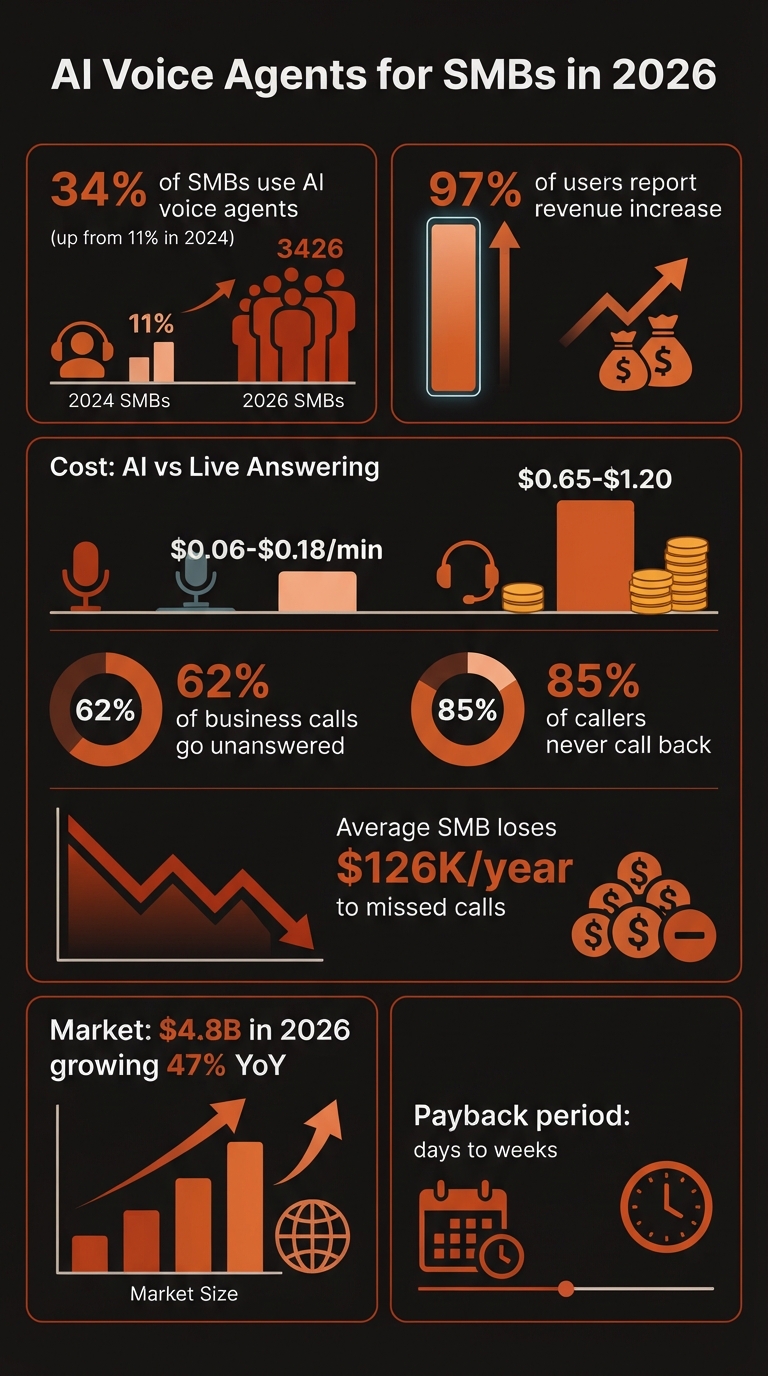
Here's a number that should keep you up at night: 62% of calls to small businesses never get answered. Not a voicemail that gets returned an hour later. Not a busy signal. Just nothing. The phone rings, nobody picks up, and the caller moves to the next name on Google Maps.
Another 30 to 40% of calls arrive after hours, when your line rolls straight to voicemail. And 85% of callers never call back after one missed attempt. They call your competitor instead.
The average small business loses about $126,000 a year to missed calls, according to aggregated data from Prestyj's 2026 voice agent benchmarks. Each unanswered call is worth between $100 and $1,200 depending on your industry. If you run a home service company, a dental practice, or any business where the phone is your primary lead channel, you already know this pain — you just haven't put a dollar figure on it.
In 2026, AI voice agents have crossed from experimental tech into mainstream infrastructure. 34% of SMBs in the US and Europe now use some form of AI phone handling, according to Deloitte's Tech Trends 2026 report. That's up from 11% in 2024. The global market sits at $4.8 billion and is growing 47% year over year.
This guide covers what AI voice agents actually cost in 2026, the benchmarks that matter, where they fall short, and how to set one up without wasting time or money.
How much do AI voice agents actually cost in 2026?
This is where the numbers get interesting. At scale — roughly 50,000 minutes of call traffic per month — an AI voice agent costs between $0.06 and $0.18 per minute, fully loaded. That includes the platform, LLM calls, speech-to-text, text-to-speech, and telephony.
Compare that to a live answering service, which runs $0.65 to $1.20 per minute. Or an in-house receptionist, which costs $0.95 to $2.40 per minute once you factor in salary, benefits, and downtime.
| Option | Cost per minute | 24/7 coverage | Simultaneous calls |
|---|---|---|---|
| AI voice agent (scale) | $0.06–$0.18 | Yes | Unlimited |
| Live answering service | $0.65–$1.20 | Usually (with premium) | Limited |
| In-house receptionist | $0.95–$2.40 | No | 1 at a time |
For a typical SMB handling 500 calls per month at roughly 5 minutes per call, that works out to $150 to $450 per month for an AI voice agent. A human answering service for the same volume would cost $1,625 to $3,000. An in-house receptionist? $40,000 to $55,000 per year all-in.
A few things they don't tell you upfront: hidden fees add 18 to 35% to the advertised monthly price. Those come from per-minute overages, telephony pass-through costs, integration fees, and after-hours premiums. Read the pricing page carefully before signing up.
What 97% of businesses report after switching
Vida's SMB AI Voice Agent Adoption & Impact Survey — a March 2025 study of 320 SMB owners — found that 97% of businesses using AI voice agents reported an increase in revenue. 82% said it improved customer engagement. 80% reported saving five or more hours per week.
Some of those numbers come with caveats — the sample size is modest, and the survey was conducted by a vendor. But the pattern is consistent across multiple data sources. The SMB-managed-services segment of the voice AI market grew 216% between 2024 and 2026, per industry revenue analysis. That kind of growth doesn't happen without real returns.
Let's look at some real cases from the research:
- A small bakery in Pune, India deployed a voice AI agent and recorded an 18% revenue increase within 90 days. The owner had no technical background and handled the setup alone.
- Hospitality venues reported a 40% reduction in support expenses after deploying voice AI. Independent operators completed integration in under 60 minutes.
- UK SMEs recovering £3,000 to £15,000 per month in revenue against £299 to £500 monthly subscriptions — a return multiple of 10x to 50x.
- Restaurants saw a 35% average booking lift after deploying voice AI for call handling.
The payback period in most cases is measured in days to weeks, not months or years.
What AI voice agents actually handle well
In 2026, the technology has crossed the uncanny valley. Voice latency is under 300 milliseconds — indistinguishable from a human conversation. The best systems handle interruptions, jokes, and multi-topic conversations naturally. A caller cannot tell they are talking to AI.
The most effective use cases follow a clear pattern:
- Inbound sales inquiries (31% of deployments). A prospect calls. The AI qualifies the lead, answers questions about services or pricing, and either books a call or transfers to a human. No more "we'll call you back."
- FAQ answering (20%). Hours, location, pricing, availability. The kind of questions your team answers twenty times a day. The AI handles them instantly, 24/7.
- Appointment scheduling. The AI checks availability, books the slot, sends a confirmation, and adds it to the calendar. Dental practices and medical clinics lead adoption here — 48% of dental practices now use some form of AI phone handling.
- After-hours coverage. 30 to 40% of calls arrive when the office is closed. The AI answers every single one. This alone can recover 20 to 35% of revenue that was walking out the door to voicemail.
What AI voice agents don't do well yet: handling sensitive disclosures, negotiating pricing, managing angry customers, or anything requiring nuanced human judgment. The best setups follow a hybrid model: AI fronts every call and escalates the 10 to 30% that genuinely need a person.
Why adoption is accelerating right now
Three things changed in the last 18 months that made AI voice agents practical for any small business.
Cost dropped 90%. AI costs fell roughly 90% between 2024 and 2026, driven by competition between providers (OpenAI, Anthropic, Google, Meta, DeepSeek), open-source alternatives, and hardware improvements. What cost $10,000 a month in 2024 costs $1,000 in 2026. This brings enterprise-grade phone handling within reach of every SMB.
Voice quality fixed itself. In 2024, AI voice agents sounded robotic. Pauses were awkward. Callers hung up in frustration. In 2026, latency sits consistently under 300ms across every major provider. Voice quality is indistinguishable from a human. The technology is no longer the bottleneck — education and switching cost are.
The 30% threshold. There's a well-documented pattern in technology adoption: once a category hits 30% penetration, growth accelerates as social proof and competitive pressure kick in. AI voice agents crossed 30% in 2026. By 2027, not having AI phone coverage will be a competitive liability in appointment-heavy industries like dental, medical, legal, and home services.
How to set one up without wasting time
The biggest mistake small business owners make is trying to build everything at once. Here's a simpler path.
Start with one phone line. Pick your highest-volume inbound line — the one that rings most during business hours. Route it through the AI agent. Do not try to automate every department from day one.
Choose a managed service if you're not technical. No-code platforms like Synthflow and managed AI receptionist services let you go from sign-up to first call in hours. You configure the persona, load your FAQs and service info, connect your phone number, and you're live. No developers, no APIs, no IT project.
Plan for a 2-4 week optimization period. No AI gets it right on day one. Callers will ask things you didn't anticipate. The AI will respond to some questions incorrectly. Listen to the first hundred calls, refine the knowledge base, tighten the escalation rules. After a month, it should handle 70 to 90% of calls without human involvement.
Set clear escalation rules. Decide in advance which situations transfer to a human. Pricing negotiations. Complaints. Complex technical questions. Medical or legal advice. Then configure those rules before you go live, not after a caller gets frustrated.
Watch for hidden integration costs. Some vendors charge extra for CRM webhooks, custom knowledge ingestion, or multi-location support. Get a full TCO quote before committing.
Where AI voice agents fall short
I won't sugarcoat it — AI voice agents aren't right for every scenario.
If your business depends on deep, relationship-based phone conversations where trust is built over long calls, an AI agent will feel cold. High-end consulting, premium B2B sales, and therapy or coaching practices should think carefully about how much to automate.
The compliance landscape is also evolving. In regulated sectors — healthcare, legal, financial services — you need a vendor that meets specific compliance frameworks (HIPAA in the US, GDPR in Europe). Not all vendors offer this. Check before you buy.
And finally, hidden costs remain a real issue. The advertised monthly rate is usually 18 to 35% lower than what you'll actually pay once you factor in call overages, telephony fees, and integration charges. Ask for a fully loaded cost estimate, not the marketing price.
But for the vast majority of small businesses — especially those where the phone is the primary way customers find and hire you — the numbers are clear. The cost of not answering calls is higher than the cost of deploying AI to answer them.
Frequently asked questions
Can callers tell they're talking to AI?
In 2026, no. Voice latency is under 300 milliseconds across all major providers. The best systems handle interruptions, natural pauses, and multi-topic conversations. Most callers cannot distinguish AI from a human on the phone.
How much does a basic setup cost?
A managed AI receptionist starts at $29 to $99 per month for flat-rate plans with unlimited 24/7 coverage. No-code platforms run $99 to $299 per month for small businesses. At volume (500+ calls/month), costs range from $150 to $450 per month fully loaded.
Will it work for my industry?
Adoption varies by industry but is accelerating across all verticals. Dental practices lead at 48% adoption in 2026, followed by medical practices (41%), law firms (38%), hospitality (35%), and home services (33%). If your business gets phone calls, it can benefit.
What happens with complex questions the AI can't handle?
The best setups use a hybrid model: the AI handles the first interaction and escalates to a human for complex, sensitive, or high-value situations. 10 to 30% of calls typically need human involvement depending on your industry.
Do AI voice agents work in multiple languages?
Yes. Major platforms support English, Spanish, French, German, Italian, Portuguese, and many other languages. Some support real-time language switching during a single call.