
The hours you burn on quoting without noticing
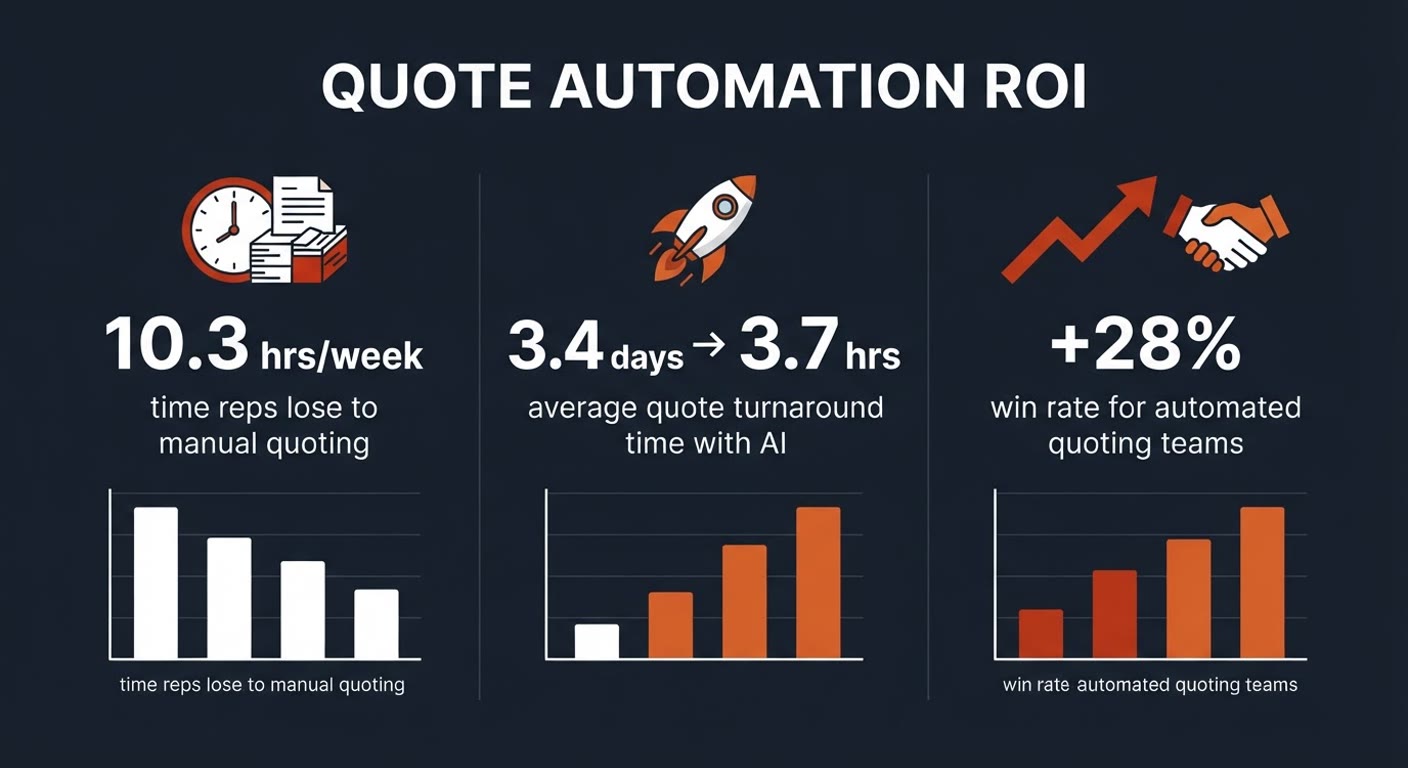
Salesforce's State of Sales 2025 asked reps what they actually spend their week on. The answer: the average rep loses 10.3 hours a week to quoting and proposal tasks — pulling configurations together, checking pricing spreadsheets, drafting the document, waiting on approvals, fixing it when the prospect asks for a revision.
Read that twice. Ten hours a week is a quarter of a full work week, gone into work that doesn't sell anything. Forrester's 2025 survey found the number runs even higher for companies with complex products — 12.7 hours per rep per week when there's no automation in place.
And it's not just slow, it's wrong. Forrester tracked down where the rework comes from: 43% of quote revision requests are caused by configuration errors made while building the quote by hand. Someone miscounted a line, used last year's price, or forgot the volume discount, and the whole document goes back for another pass.
Here's the thing nobody tells you about your own numbers: speed isn't a nice-to-have, it's the difference between winning and losing. Harvard Business Review's lead-response research found the best window to answer an inquiry is under five minutes, and that window matters more than almost anything else you control. PandaDoc's analysis of over 2 million proposals found quotes sent within an hour of the inquiry close at 35%, against 17% for quotes sent after 24 hours.
A quote that takes your team three days to send is starting from behind before the prospect even opens it.
What automating actually changes
Let me be precise about what automation does and doesn't do, because plenty of owners overthink this.
What the tool does
- Builds the quote from rules you set once. You define your products, price list, and discount thresholds one time. After that, the price is calculated correctly every single time — no digging through spreadsheets.
- Assembles a branded proposal. Product descriptions, images, terms, and your logo go in automatically. The proposal looks professional without anyone formatting it.
- Routes it for approval. Big discounts or unusual scope pause at an approval step. Gartner's 2025 analysis found automated systems handle 80-90% of standard quotes with no human touch; the tricky 10-20% route to a person with everything pre-filled.
- Handles the follow-up. It tracks opens, reminds you when a proposal sits untouched, and can send scheduled follow-ups. HubSpot found teams that automate five or more follow-up touches recover around 31% of proposals that would otherwise go unanswered.
What it doesn't do
- It doesn't win the deal for you. A faster quote gets your foot in the door; you still have to sell the value, handle objections, and close.
- It won't fix a messy price list. If your pricing is a tangled web of exceptions, the automation inherits the chaos. Clean it up first.
- It doesn't remove the human from complex work. Highly custom, multi-phase, engineered work still needs a person. Automation just does the 80% so you can spend the time on that 20%.
That split is the honest value: the machine handles the volume, and you keep the judgment. It's a shift from building documents to reviewing them — which is a much better use of your week.
The numbers that make it worth doing
The hardest part is usually the fear that it's expensive or complicated. The data says the opposite. Conga's 2025 benchmark of quote workflow data found the average time from quote request to delivered document drops from 3.4 days to 3.7 hours for complex multi-product configurations — a reduction above 85%. For standard quotes it's sharper still: from about a day down to roughly 20 minutes.
A 10-person team recovering 8 hours per rep per week from quote automation gains 80 hours of selling capacity weekly without adding a single headcount.
On win rate, Aberdeen Group's 2025 study found organizations using AI-enhanced quoting win 28% more often on comparable deals than teams quoting manually, with a 19% shorter sales cycle. Proposify's data across 1.4 million proposals lines up: automated proposals close at 36%, versus 24% for manually built ones — and the gap widens on larger deals. Over $10,000, automated proposals close at 29% against 16% for hand-built ones, because bigger deals involve more decision-makers who read quality and speed as a signal.
The cost side is the part most owners get wrong. You don't need a $50,000 enterprise CPQ platform. For a small service or product business, HoneyBook and Dubsado start around $19-20 a month; mid-tier tools like PandaDoc and Proposify run $35-49 per user per month. G2's 2025 pricing analysis puts the average small business spend at $45-85 a month — which pays for itself if it saves even three or four hours of quoting time.
| Approach | Time to deliver a quote | Typical close rate |
|---|---|---|
| Manual (spreadsheet + document + email) | 1-3 days, often 4-24 hours minimum | 24% |
| Template-based with e-signature | A few hours | ~30% |
| Automated with AI pricing & follow-up | Minutes (22 min for standard quotes) | 36% |
On payback, the reports are consistent. Salesforce's 2025 ROI study found the median business sees complete payback within three months; Forrester's Total Economic Impact work on larger CPQ deployments found a three-year ROI of 329% with payback in 8 to 14 months. The smaller your team, the faster the math works in your favor, because your starting baseline is usually fully manual.
The rollout that doesn't end in a mess
Quote automation fails in predictable ways, and — same as most software — rarely through its own fault. Here's the sequence that works:
- Clean up the price list first. Collapse the near-duplicate products, name things clearly, write down the discount rules. This is the highest-value hour you'll spend; automation that inherits a messy catalog just makes mistakes faster.
- Set up one approval rule. Pick a threshold — say, anything over a 15% discount needs a manager one-click approval. Don't build a complex approval tree on day one.
- Turn on e-signature. Proposals with electronic signatures close about 28% faster than ones that need a print-sign-scan cycle (Proposify, 2025). It's the single easiest win.
- Pilot on your simplest product line. Automate the one or two things you quote most often, get them flowing, then expand. Businesses that try to automate everything at once usually drown in review flags and give up.
- Automate the follow-up. Set the tool to nudge prospects who've opened the proposal but not replied. Then actually look at the open rate data to see which sections lose people.
The biggest mistake is turning it on and walking away. Treat the first month as a review period: check every price, watch the discount logic, and only trust the tool after it's been right a few dozen times. After that it becomes routine fast.
When automation isn't the answer
Not every business should rush into this. If you send fewer than a handful of quotes a month, or every single one is a bespoke, engineered, negotiate-every-line affair, a lightweight template with e-signature may be all you need. Quoting automation shines when there's repetition: a catalog, recurring service packages, or a sales team whose time has a real cost.
The honest threshold: if quoting eats more than a couple of hours of someone's week, or if a delay has already cost you a deal, the automation pays for itself. If it's a rare event, skip the tooling and just fix your template.
Frequently asked questions
How long does it actually take to set up?
A basic rollout on a lightweight tool — one product line, your branding in the template, e-signature on — takes an afternoon. A fuller setup with pricing rules, approvals, and follow-up takes a few days to a couple of weeks, depending on how messy your price list is. The software is rarely the bottleneck; cleaning up your catalog is.
Do I need a big CPQ platform to see results?
No. The enterprise platforms are sold to large sales orgs, and most small businesses should ignore them. Tools like HoneyBook, Dubsado, PandaDoc, and Proposify are built for exactly your size and include pricing rules, templates, e-signature, and tracking for under $100 a month.
Will automation make my proposals look generic?
Only if you make it that way. The tool pulls your branding in automatically, and PandaDoc's design research found professionally formatted, branded proposals close 32% higher than plain-text ones. The personalization that wins deals — reference projects, a tailored scope — is still your job. Automation handles the formatting and the arithmetic; you add the human context.
What if my pricing is genuinely complex and custom?
Gartner's 2025 analysis found automated systems handle 80-90% of standard configurations without a person, and route the unusual 10-20% to a human with all the standard calculations pre-filled. That cuts the manual work on even complex quotes from a few hours to well under an hour. You keep control of the exceptions; the tool just stops you rebuilding the basics every time.
Does faster quoting really raise close rates, or is that marketing?
The mechanism is concrete, not soft. A same-day, priced, accurate proposal keeps you in the conversation while the interest is hot, and it looks like you have your act together. Multiple independent datasets — PandaDoc (35% within an hour vs 17% after 24 hours), Proposify (36% vs 24%), Aberdeen (28% win-rate lift) — point the same direction. Speed isn't the only factor, but it's the one you can fix this week.
Want quotes and proposals that stop eating your week?
We build sales automation that connects your catalog, pricing, and follow-up so your team stops building documents and starts closing deals. No overblown promises — just systems that turn a three-day quote into a same-day one. Tell us where your quoting time goes and we'll show you what can be automated.
Talk to BigLobster →