
Why this matters even if you don't sell directly to multinationals
Maybe you run a factory, workshop, or industrial service in a Galician industrial park. Your direct customer might not be Mercadona, Inditex, or Iberdrola. But someone up the supply chain sells to them — and their requirements cascade down to you.
I'm not telling you this to chase an impossible contract. I'm telling you this because the standard these large companies set is what any serious industrial customer starts asking for. The SMBs that have it organized win bids. The ones improvising paperwork every time it's requested lose time and customers.
The evidence: McKinsey data shows that 70% of B2B buyers prefer digital channels, and Forrester reports that over 50% of industrial purchases start with an online search. Your customer isn't calling anymore — they're comparing you on a platform.
First it's not price: it's solvency
The most common mistake SMBs make is thinking supplier approval is about price and quality. It isn't. It's about whether the buyer can justify to their organization that you won't be a liability.
Two types of solvency don't get overlooked:
Legal and administrative
This is table stakes: current incorporation paperwork and power of attorney, active registration, current commercial registry, proof of tax and social security compliance, liability insurance, and occupational safety documentation. One expired certificate on evaluation day and you're out.
Economic
Many companies cap the contract size they'll give you based on your annual revenue. If you invoice €500,000 a year, don't expect a €2 million contract. And be careful promising volume or delivery times you can't hit — failing on your first contract is the fastest way to burn a relationship that took months to build.
The certifications nobody overlooks
In most sectors, ISO 9001 is the floor, not the ceiling. Without it you don't even get a questionnaire. After that, each industry adds its own stack:
- Food and beverage: HACCP, BRC, or IFS plus health registry. Mercadona, with its supplier network model, is Spain's most demanding distributor on food safety and manufacturing capacity.
- Construction and services: occupational safety certifications. Iberdrola and major utilities include them in their specifications without discussion.
- Data and systems: if you touch their network or handle their information, they'll ask for ISO 27001 and a security audit. Industrial cybersecurity stopped being optional in 2026.
What most underestimate: these certifications take months to get. You can't pull them together the week you get the RFQ. Plan them a year ahead if you're serious about competing.
What changed in 2026: ESG and e-invoicing are now gatekeepers
Two years ago, ESG criteria (sustainability, diversity, governance, carbon footprint, subcontractor traceability) were a nice-to-have in your pitch. In 2026 they're requirements in large company supplier approval.
And there's a technical piece that affects you directly: as of 2026, supplier portals now include e-invoicing and document traceability because of new legal mandates (Verifactu and B2B e-invoicing come into force this year). Showing up with a system that can't talk to their platform via EDI, API, or even a structured catalog disqualifies you — regardless of how good your product is.
"Large corporations don't buy products — they buy certainty. An SMB that only talks about price doesn't understand what the buyer has to justify to their own organization."
BigLobster B2B Strategy TeamHow the supplier approval process actually works (5 real steps)
It's not a formality — it's a multi-stage filter. Here's what you encounter when you apply:
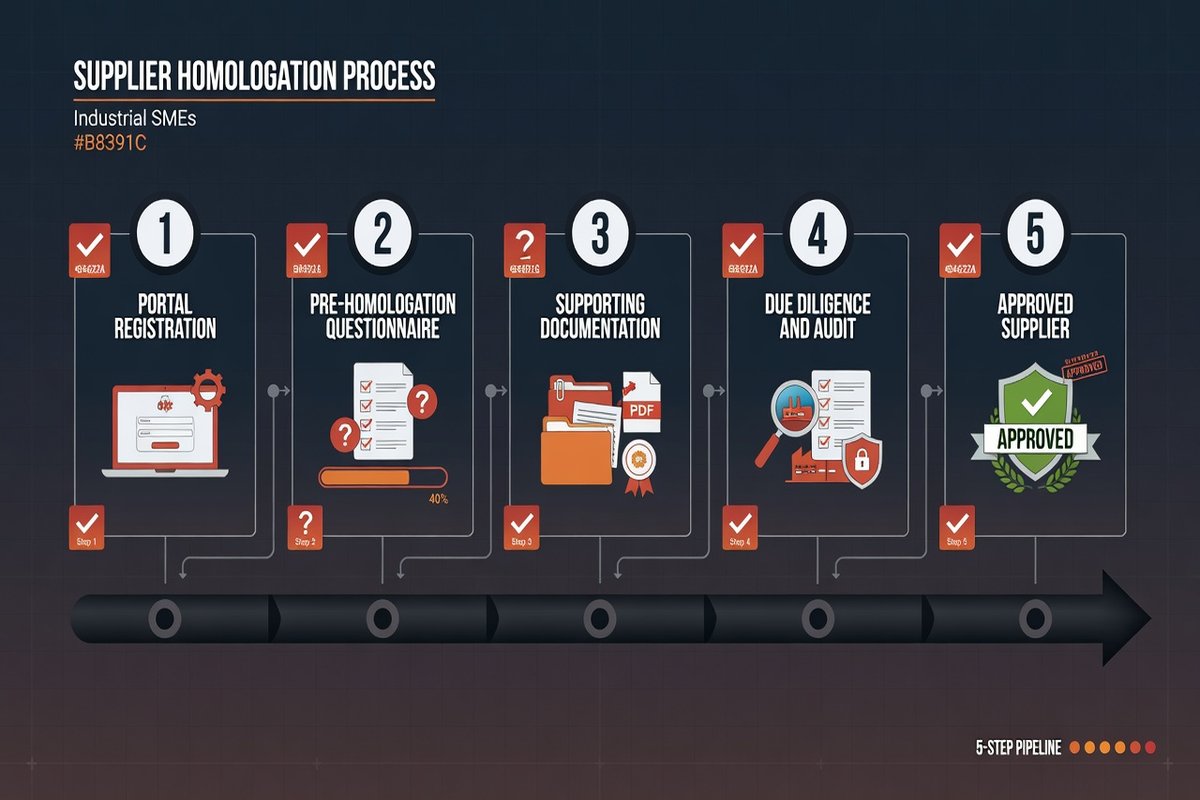
- Portal registration. Online account with tax ID, business description, size, and product/service categories.
- Pre-qualification questionnaire. Extensive forms on structure, experience, certifications, ESG, safety, and cybersecurity. This is where many SMBs lose weeks if they haven't prepared.
- Supporting documentation. Tax compliance certificates, social security clearance, annual accounts, ISO certificates, insurance policies, and industry-specific paperwork.
- Evaluation and due diligence. Procurement, finance, legal, safety, sustainability, and IT all weigh in. They may request site visits, audits, or pilot projects. Timelines stretch and communication slows here.
- Supplier activation. Supplier number, authorized categories, and transaction limits. Then comes ongoing work — annual renewals, new ESG conditions, compliance verification.
The detail that kills most deals: payment terms
You need to sustain payment terms of 60 to 90 days without cash flow collapse. Sounds boring, but this is where most SMBs realize too late that the contract they just won will suffocate them financially.
There's no point winning approval if you can't cash the invoices fast enough to pay your own suppliers. Cash flow is king, and a large-account invoice that takes 90 days to pay requires real financial muscle behind you. Think about this before signing, not after.
Where digitalization fits (and why Galician grants cover it)
This is where the problem becomes an opportunity with public money attached. The IG300C program from IGAPE (digital transformation grants for SMBs, part of Galicia Feder 2021-2027, co-funded 60% by the EU) finances exactly what you need to enter these supply chains:
- Digital interfaces and channels with third parties: platforms, EDI, API, or solutions that digitize orders, contracting, payments, and customer/supplier interactions.
- Integrated management systems (ERP) that tie multiple business areas together.
- ESG backed by technology: measurement and traceability of environmental, social, and governance indicators.
- Cybersecurity for digital operations: from risk analysis to penetration testing with real deployment.
The latest round (IG300C, published in Galicia's official gazette June 2026) accepted applications through July 2026, with a minimum €12,000 project size and funding of up to 35% for small companies, 25% for medium enterprises on investments, and 50% on consulting services. The Galicia Feder program continues in future windows — if you prepare now, you're ready for the next one.
At BigLobster we build exactly these integrations: we plug your catalog and ERP into your clients' platforms, set up e-invoicing and traceability, and get your certifications and documentation ready for when that questionnaire arrives. It's not magic — it's just letting machines talk to machines instead of doing it by hand every time.
Three real routes for small SMBs to break in
If you charge at a major account head-on, expect to get knocked back. But there are proven paths for a small Galician company:
Become a sub-supplier to an existing supplier
Instead of going straight at Mercadona, become a supplier to a company that already works with them. That proven track record in large corporate supply chains is exactly what procurement teams look for when evaluating a new direct supplier.
Specialize obsessively in one problem
Large companies have generalist suppliers for standard stuff. What they can't find are SMBs that solve one specific problem better than anyone else — a proprietary technology, a specialized process, a rare capability. That SMB has more negotiating power than one offering the same thing as twenty others.
Enter as part of a consortium with a larger partner
Many industrial projects in Galicia are won this way: a small company brings specialized capability and a larger partner brings sales and financial muscle. IGAPE actively rewards SMB-plus-enterprise consortiums in R&D projects.
Frequently asked questions
What certification do I need to be an industrial supplier to a large company?
ISO 9001 is the minimum in most sectors. In food and beverage you add HACCP, BRC, or IFS plus health registration; in construction and services, occupational safety certs; if you handle data, they'll ask for ISO 27001. These take months to obtain, so plan ahead.
Is e-invoicing mandatory to sell to large companies?
It's not just a legal requirement in many B2B relationships from 2026 — supplier portals now integrate e-invoicing and document traceability. Without a system that can speak EDI or API to their platform, you're out of the process.
How long does supplier approval take?
There's no fixed timeline. An SMB that arrives with organized documentation and processes can complete the pre-qualification questionnaire in weeks; one that improvises every time it's asked takes months and often gives up halfway. Due diligence can include site visits and security audits.
Can a small Galician SMB really get approved by Inditex or Iberdrola?
As a direct product supplier it's tough if you don't have the manufacturing scale for growth. But through specialized services — logistics, technology, consulting, engineering — or as part of a consortium, doors are open. Inditex and Iberdrola run extremely demanding but also mature supply chains.
What grants are available in Galicia for supplier and customer integration?
The IG300C track from IGAPE funds digital interfaces with third parties (EDI, API, order and payment portals), ERP systems, ESG with tech backing, and cybersecurity, with up to 50% support for consulting. It's the most direct route to get your company ready for supplier approval without paying 100% yourself.
Want to get your company ready to supply large clients?
We assess what certifications and digital integrations you need, then build the supplier portal interface and e-invoicing for you. Straightforward, no jargon, SMB pricing — not consulting-firm rates.
Let's talk →