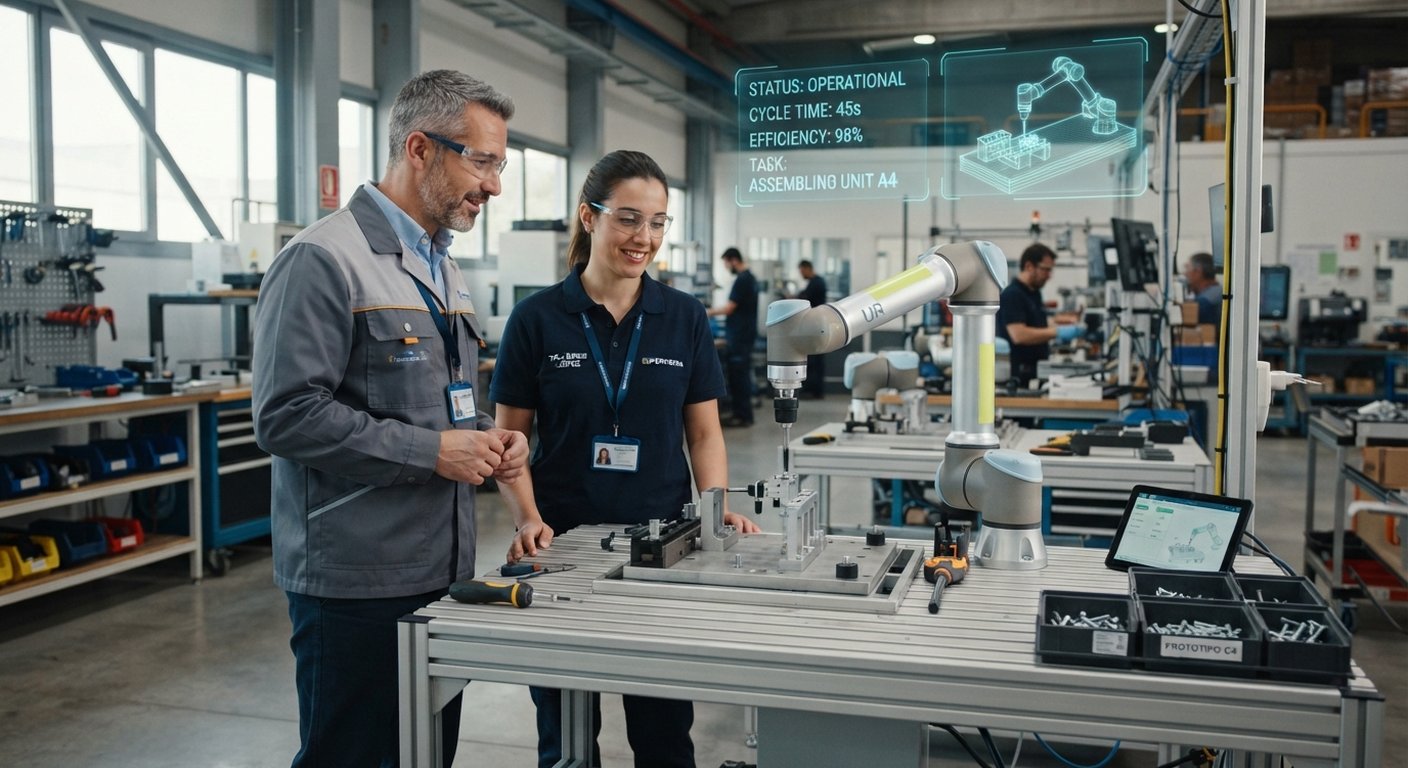
What's a cobot and how it's different from a traditional industrial robot
You've probably heard about robots on the factory floor for years, imagining them caged, massive, shooting sparks from a welder while no operator dares get close. That image isn't wrong—it's the traditional industrial robot, and it still exists. But a cobot (collaborative robot) is something else entirely. And that difference is exactly why it matters for an SMB.
A cobot is designed to work alongside humans without mandatory safety fencing in many applications. It's smaller, slower, and has less payload than a heavy industrial arm, but shop-floor staff can reprogram it in weeks, not months. And when production changes, you relocate it to a new task.
I'll be honest: the narrative of "anyone can program a cobot" has its limits. The 2026 reality is more nuanced, and that's what this article covers.
Why it's trending now: The global cobot market, per ABB Robotics, sits around $2 billion USD in 2026, heading for $10.9 billion by 2033—21.4% annual growth. What matters for SMBs: 70% of cobots sold in 2025-2026 go outside the auto sector to electronics, pharma, logistics, and industrial SMBs. It's not cutting-edge tech for only large-scale plants anymore.
What a cobot really costs in 2026
I'm giving you numbers that are hard to find because most articles mix arm price with full project cost. They're very different things.
| Item | Price range | What's included |
|---|---|---|
| Entry-level cobot | < €15,000 | Lightweight arm for simple tasks (3-6 kg payload), no tooling or integration |
| Mid-range cobot | €25,000 – 45,000 | Hardware only: arm, controller, and basic software |
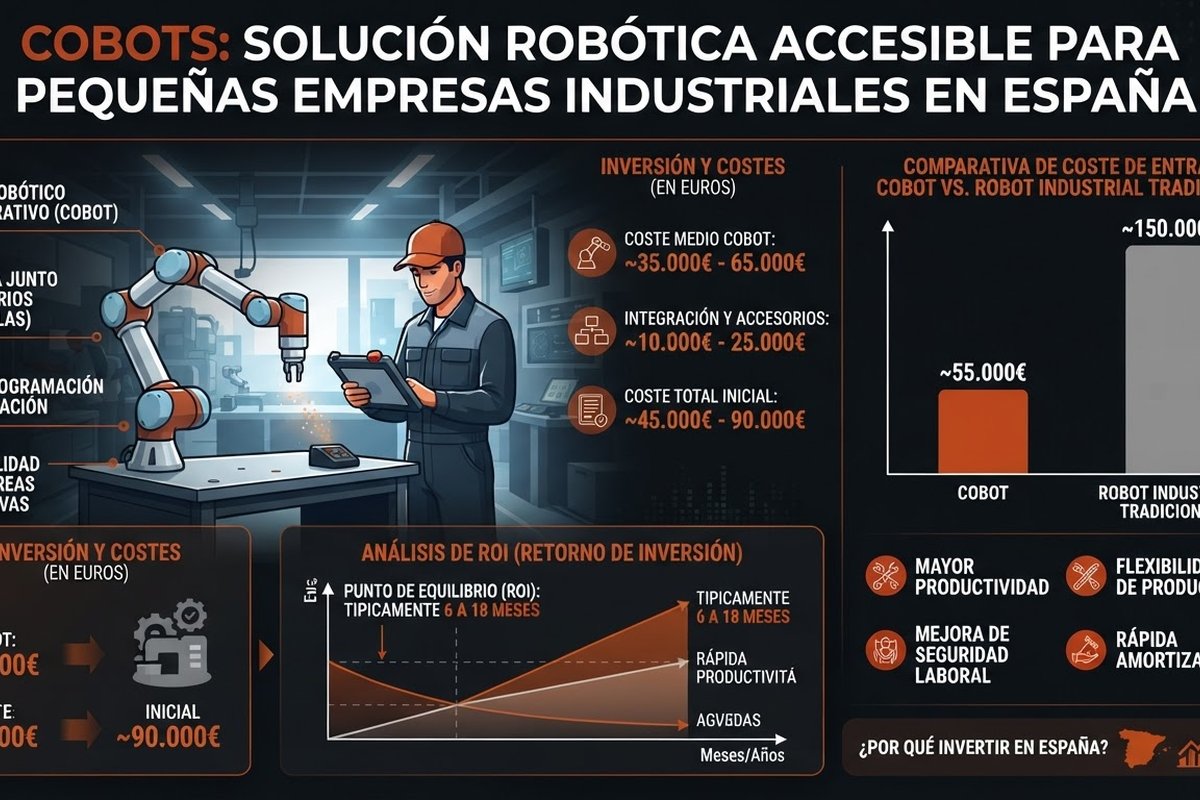
| Full production cell | €50,000 – 90,000 | Hardware + end-effector, safety certification, integration, MES/ERP connection, and training |
| Traditional industrial robot with integration | €80,000 – 150,000 | For comparison: much more expensive, requires fencing and facility work |
The cost people usually skip over is integration. A €30,000 robot from a brochure doesn't arrive ready to work: you add the gripper or end-effector (€3,000-8,000 depending on the tool), safety certification (€2,000-5,000), connection to your ERP or MES, and integration hours. A working production cell lands in the €50,000-90,000 range—similar to five years ago. Robot hardware has gotten cheaper; integration hasn't.
If you buy "arm" instead of "solution," your budget blows up later. That's the first mistake, and the most expensive one.
Which tasks work (and which don't)
A cobot isn't a universal tool. Some tasks pay for themselves; others are expensive decoration. Be honest with yourself before you commit.
Tasks where cobots usually work well: machine tending (loading/unloading CNC machines, presses), repetitive fastening and assembly, light palletizing, component assembly, quality control with machine vision, and pick-and-place operations. These are monotonous, repetitive tasks where an operator works on autopilot—exactly where humans make mistakes and cobots don't.
Tasks where it's not worth it yet: welding or painting large parts or complex shapes, assembly with tolerances that shift each batch, production runs so short that reconfiguration costs more time than it saves, and dirty or explosion-hazard environments that demand expensive equipment.
The decision rule is straightforward: Is it repetitive, high-volume, and is there someone today doing it that you'd rather have on higher-value work? If yes, you have a candidate. If the task changes weekly and you don't have someone to reprogram it, wait.
"A cobot doesn't replace the operator. It takes the repetitive, mind-numbing part so they can do what no robot does well yet."
BigLobster Automation TeamTimeline and who programs it
This has genuinely improved in the last two years—good news for SMBs.
The ISO 10218 standard update in 2025 unified collaboration modes and shortened typical deployment to 4-6 weeks. Before, a traditional robot project took months. And programming: modern cobots are taught by hand (grab the arm and move it to the position you want it to memorize), use visual block programming, and increasingly rely on generative AI that converts plain-English instructions into trajectories.
That doesn't mean you don't need an integrator. Connecting to your ERP or MES, selecting the right end-effector, and designing a safe cell still require someone who's done it before. But once it's running, your own team can reprogram it for a different task after a quick training session.
Integration costs in Spain run €600-900 per day of specialist work. It's a real cost, but bounded: not a permanent team, it's a project with a start and end.
ROI with real numbers: a concrete example
Forget theory. Here's a real example from a Galician precision manufacturing or components SMB:
A cobot for machine tending—loading and unloading a machining center. Total cell investment: €55,000 (mid-range arm, gripper, safety, integration, and training).
Before, one operator spent 3 hours per shift just feeding and unloading the machine—work that didn't use their skill. With the cobot doing that, the operator now spends those 3 hours on part prep, quality checks, or tending a second machine.
Just recovering half a day of a machinist's labor—whose real annual cost is around €25,000-30,000—already justifies much of the investment. And if the machine goes from 2 to 3 effective shifts because the cobot never stops for breaks, ROI shrinks fast. For well-chosen tasks, typical return lands between 12 and 24 months, tilting toward the shorter end in 2026 thanks to AI-powered programming savings.
The flip side: if the task you're automating is something a worker did half-time with no volume and no value-add, that €55,000 cobot takes years to break even. ROI isn't a property of the robot—it's a property of the task you assign it.
The tax deduction almost nobody figures
Spain offers two forms of relief that shift the math substantially—and many SMBs don't know about them:
- Technology innovation deduction (article 35.2 Income Tax Law): installing a cobot typically qualifies, with deductions up to 12% of eligible expenses. If your project touches the automotive supply chain, that deduction rises to 50%.
- Accelerated depreciation (article 103 Income Tax Law) for small businesses (under €10M revenue): a robot depreciates at 24% annually instead of 12%, recovering investment in half the time. Tooling and grippers depreciate at 50%.
These aren't speculation—they're current tax law. And they stack with public grants like CDTI or Galician Igape programs. If someone tells you there's "nothing to scratch" on the tax side of a cobot project, they're not telling you the whole story.
Grants and financing: where to find part of the money
Upfront cost remains the #1 barrier for SMBs, and rightly so. But there are real options that lower it:
CDTI is mobilizing €1.817 billion in 2026 and explicitly prioritizes smart manufacturing. It's not for every project, but if your cobot fits into a digitalization initiative with some scale, it's a real candidate.
Robotics as a service (RaaS): around 20-25% of new cobot cells in Spain already use subscription pricing with monthly fees of €1,200-3,000 covering hardware, software, and maintenance. Converts capital investment to operating expense—good fit for an SMB that doesn't want to tie up cash.
In Galicia: Igape has dedicated lines for automation and digital transformation. If your project qualifies, these complement the tax deductions. Worth asking before you kill the project on price.
The combination of deduction + accelerated depreciation + possible grant is what separates a project you "think about" from one you execute.
Expensive mistakes when buying your first cobot
Every mistake I'm about to list, I've seen in real projects—always the same ones:
Mistake 1: Buy the arm, not the solution. A budget that skips the gripper, safety, and integration isn't real. Always ask for the full cell cost, not the robot brochure price.
Mistake 2: Choose the task for ease, not returns. "Let's try the easiest one" sounds prudent, but if that task has no volume or value, the cobot won't pay for itself. Pick the one that frees the most skilled labor.
Mistake 3: Don't calculate the real cost of the hour you're saving. If the operator was low-cost and unskilled, actual savings are small. Value what the freed hour really costs you.
Mistake 4: Ignore maintenance. A cobot isn't "install and forget." Validation, calibration, and remote monitoring add 8-12% annually. RaaS usually includes this.
Mistake 5: No plan for reprogramming. The cobot's advantage is moving it to new tasks. If you don't plan who reprograms it when production shifts, you bought expensive decoration.
My advice if you're on the fence
If you're at an industrial SMB and you've been thinking about this for a year, here's what I'd do this week:
First, pick ONE candidate task—repetitive, steady volume, frees up skilled labor. Write down hours per month and real cost.
Second, get a full-cell quote, not just the arm. Have them put in writing the gripper, safety, integration, training, and maintenance.
Third, calculate ROI using your numbers over 12, 18, and 24 months, and add tax deductions and accelerated depreciation. Don't use someone else's template—use your hours and costs.
Fourth, explore financing before you write it off on price: RaaS, CDTI, Igape. There's more than one way to pay for this.
And one caveat: if your answer to "do I have a repetitive, high-volume task?" is no, not now. A cobot is a production tool, not a tech showpiece for the shop floor.
Frequently asked questions
How much does a cobot cost for an SMB in 2026?
Entry-level arms start below €15,000 and mid-range ones run €25,000-45,000 in hardware only. But the real cost of a working production cell—gripper, safety, integration, training—lands at €50,000-90,000. Don't compare arm price to project cost.
How long does it take to break even on a cobot?
For a well-chosen task, 12-24 months, leaning short in 2026 due to AI-assisted programming savings. ROI depends on the task: automating low-value, low-volume work can take years.
Do I need an engineer to program a cobot?
For initial deployment and ERP/MES integration, yes—hire an integrator (€600-900/day in Spain). But redeploying to a new task your own team can handle after a few hours of training, thanks to visual block programming and AI.
Does a cobot need a safety fence?
One big cobot advantage: many work without fencing when used collaboratively alongside operators, under standards like the revised ISO 10218 (2025) and ISO/TS 15066. Some applications do require extra safeguards—risk assessment decides per application, not by default.
Are there grants to buy a cobot?
Yes. Technology innovation deduction (up to 12%, up to 50% in automotive supply), accelerated depreciation for small businesses, CDTI funding, and Igape automation programs in Galicia. You can also lease via RaaS with €1,200-3,000 monthly fees instead of buying.
What tasks don't suit a cobot?
Large or complex-shape welding or painting, assembly with batch-to-batch tolerance shifts, production runs so short reconfiguration wastes more time than it saves, and explosion-hazard environments needing expensive equipment. Traditional robots or no automation often make more sense there.
Is a cobot the same as an industrial robot?
No. Traditional industrial robots are large, fast, require mandatory fencing, need specialist programming, and cost €80,000-150,000 with integration. Cobots are smaller, collaborative with humans, programmed on the shop floor, and are the natural entry point for SMBs.
Not sure if a cobot pays for itself in your plant?
We help you pick the right first task, calculate ROI with your numbers, and navigate the tax and grant side—no hype, real numbers.
Talk to BigLobster →