
Somebody raised the price of your website address again, and it was not your hosting company, your web designer, or the registrar whose invoice lands every year. It was a company you have never spoken to and cannot switch away from, and the notice went out in April.
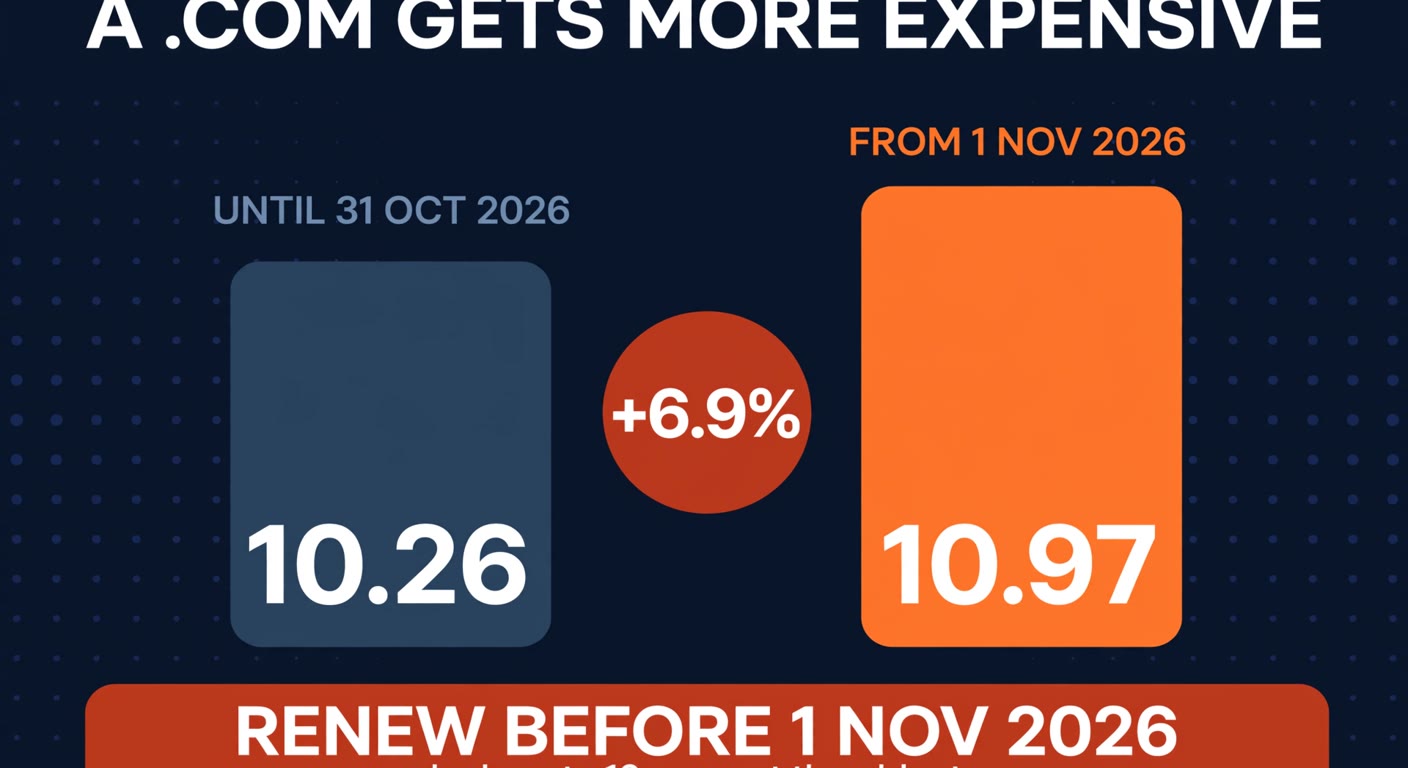
On November 1, 2026 the wholesale price of a .com goes from $10.26 a year to $10.97. That is 71 cents. If you own one domain, this is a rounding error and you can stop reading after the next section. If you own fifteen, or you look after domains for clients, or you simply do not want to be surprised by an invoice, there is one thing worth doing before the price changes.
What actually changes on November 1
Verisign said it plainly in its Q1 2026 results, filed with the SEC in April: it will raise the annual registry-level wholesale fee for each new and renewal .com domain from $10.26 to $10.97, effective November 1, 2026. The formal notice to ICANN went out on 23 April 2026, which is the six months of warning its contract requires.
The change covers new registrations, renewals and inbound transfers. It is the first move since September 1, 2024, and it works out to 6.9%. For a domain investor with thousands of names that is a real budget line. For a plumber with one domain it is two-thirds of a coffee.
What you will actually be charged is a different number, and this is where most of the confusion sits. Registrars pay the wholesale fee, then add the ICANN fee and their own margin before invoicing you. A registrar can pass on the 71 cents, absorb it, or use the moment to reprice a plan it has been wanting to raise anyway. Which is why the useful question is not "how much is the increase" but "what does my registrar say it will charge me from November".
Why a company you never hired can raise your price
There is no market for registry operators. Verisign runs .com, and under the registry agreement renewed in November 2024 it keeps doing so through 2030. That same agreement gives it a very specific permission: raise the wholesale price by up to 7% in each of the final four years of every six-year cycle.
The current cycle opened on 26 October 2024. 2025 was not one of the permitted years, which is why nothing changed last autumn. 2026 is the first year it can, and it has taken the full 7%. If it takes every remaining increase at the maximum, the wholesale fee would be somewhere near $13.40 by 2029 — that is the ceiling written into the contract, not a forecast, but it is the direction of travel.
Nobody opted into this. There is no cheaper .com registry to move to, no plan downgrade, no annual discount for loyalty. The only variable you control is when you pay.
The one lever you have: pay before the cutover
Here is the rule that makes this article worth reading. Renewals paid before November 1, 2026 at 04:00 UTC are billed at the current wholesale rate for the entire term purchased — and the term can run up to ten years. The registry agreement obliges Verisign to keep offering those longer terms at the price in effect when you pay, right up to the switch.
So a .com renewed for a decade on 31 October costs $10.26 a year at the wholesale layer. The same domain renewed for a year from November costs $10.97, then whatever the next permitted increases bring in 2027 and beyond. You are not dodging 71 cents. You are dodging the next few years of increases on a name you were going to keep anyway.
Doing it takes about twenty minutes:
- Log in to your registrar and export the domain list with expiry dates. Every registrar has this somewhere under Domains or Portfolio.
- Mark the names you intend to keep for at least three years. Your main domain certainly. The ones attached to live email, a website, or a product, yes. The campaign lander from 2021, probably not.
- Extend the keepers now, and pick the number of years deliberately rather than clicking "renew one year". Registrars usually cap the cart at ten years; some discount the longer terms.
Two cautions, because "renew everything for a decade" is bad advice. First, if you are planning to move to a different registrar anyway, move first — an inbound transfer adds a year at the receiving registrar's rate, and it is cheaper to do that than to pre-pay ten years somewhere you are leaving. Second, do not lock a decade on a domain you might sell or abandon; a multi-year prepayment is money you will not get back if you let the name go.
The renewals you should not pay at all
Pull that export and count the domains. Almost every small business has more than it thinks: the original name with the hyphen nobody uses, the one bought for a product that never shipped, two spellings of the company name, the redirect someone set up in 2019 and forgot. They are all quietly renewing every year.
This is where the real money is, and it is not 71 cents. The whole portfolio is the cost, and the deadline is a good excuse to look at it. Run three questions over the list:
- Does anything still use it? Check the DNS records and the inbox. If mail still flows through the domain — an invoicing address, a supplier contact, a forwarding rule — it is not dead, and dropping it breaks something. Move the mail first, then decide.
- Would you buy it again today? If the answer is no, you are paying rent on a mistake. Letting a name expire is legal and free, though be aware that someone else can register it the moment it drops.
- Is it a brand risk if someone else took it? The spellings of your company name are worth keeping even if unused. That is the one category where "we never use it" is not a reason to cancel.
The honest arithmetic on the deadline, then. One .com, one year: the wholesale step is 71 cents, and whatever your registrar adds on top. A portfolio of twenty .coms locked for five years before November 1 pays $1,026 at the old wholesale rate against a new floor of $1,097 — and skips the increases the contract still permits. Seventy-one dollars, plus whatever the next years would have added, on money you were spending anyway.
Renewing early saves pennies. Cancelling what nobody has looked at in five years saves more, and it costs nothing to find out.
The part of a price increase that is actually worth your afternoon
If you look after domains for somebody else
Agencies, web shops and IT suppliers hold domains on behalf of clients, and the arithmetic changes there. The wholesale fee is a floor, not your price: registrar margin, reseller margin and support sit on top, and a 6.9% registry-level step does not translate neatly into a 6.9% customer increase. It comes through whichever layer reprices first.
Two things are worth doing before the cutover if that is you. First, decide whether you absorb the increase or pass it on, and put it in writing to clients before November rather than letting them find it on a January invoice they did not budget for. Second, be careful with multi-year renewals on client-owned names: locking five years is usually good value, but it is your client's money and their renewal plan, so ask. Where you hold a name with a decade-long renewal already paid, the increase does not touch it at all.
And if you are the client, reading this because your supplier sent you a link: the questions to ask are short. How many domains do you hold for us, what does each one cost, and which of them is still doing something?
Frequently asked questions
Does the November increase apply to domains I already own?
Not retroactively. A registration you already paid for runs to its expiry date at the price you paid. The new wholesale fee hits the next renewal that falls on or after November 1, 2026, which is why renewing one more term before the cutover changes what you pay.
Can I really renew a .com for ten years?
Yes. The registry agreement requires Verisign to keep offering terms of up to ten years, and the price in effect when you pay applies to the whole term. Most registrars cap the shopping cart at ten years and will show the total before you check out. A few discount multi-year renewals further.
How much more will my registrar charge me?
Unknown, and worth asking them directly. The wholesale fee is going up by $0.71, but retail .com prices are the wholesale fee plus the ICANN fee plus registrar margin, and each layer can absorb it or pass it on. The honest answer is that your registrar decides, and it should be able to tell you the number for your next renewal.
Is it worth moving to a cheaper registrar instead?
Sometimes, but not for this. Every registrar pays the same $10.97 floor from November, so nobody escapes the increase — they can only be cheap on the layers above it. If a transfer is worth doing, do it before November so the year that comes with the transfer is also billed at the old rate.
What about .net and other extensions?
The 23 April 2026 notice covers the .com wholesale fee. Other extensions sit under separate contracts with separate schedules, so do not assume .net moved with .com. If you hold several extensions, ask your registrar which of them have changes coming.
Should I register new .com domains before November 1?
Only if you have a project for them or a name you need to defend. A 71-cent saving is not a reason to buy domains you would not otherwise own — the cheap decision is the one that keeps the portfolio small.
How many domains are you actually paying for?
BigLobster maps the domains, hosting, mail and software a small business runs — what each one costs, what it still does, and which ones can be cancelled without anyone noticing. Renewals are the easy part; the pile underneath them is where the money is.
Ask for a subscription and domain audit