
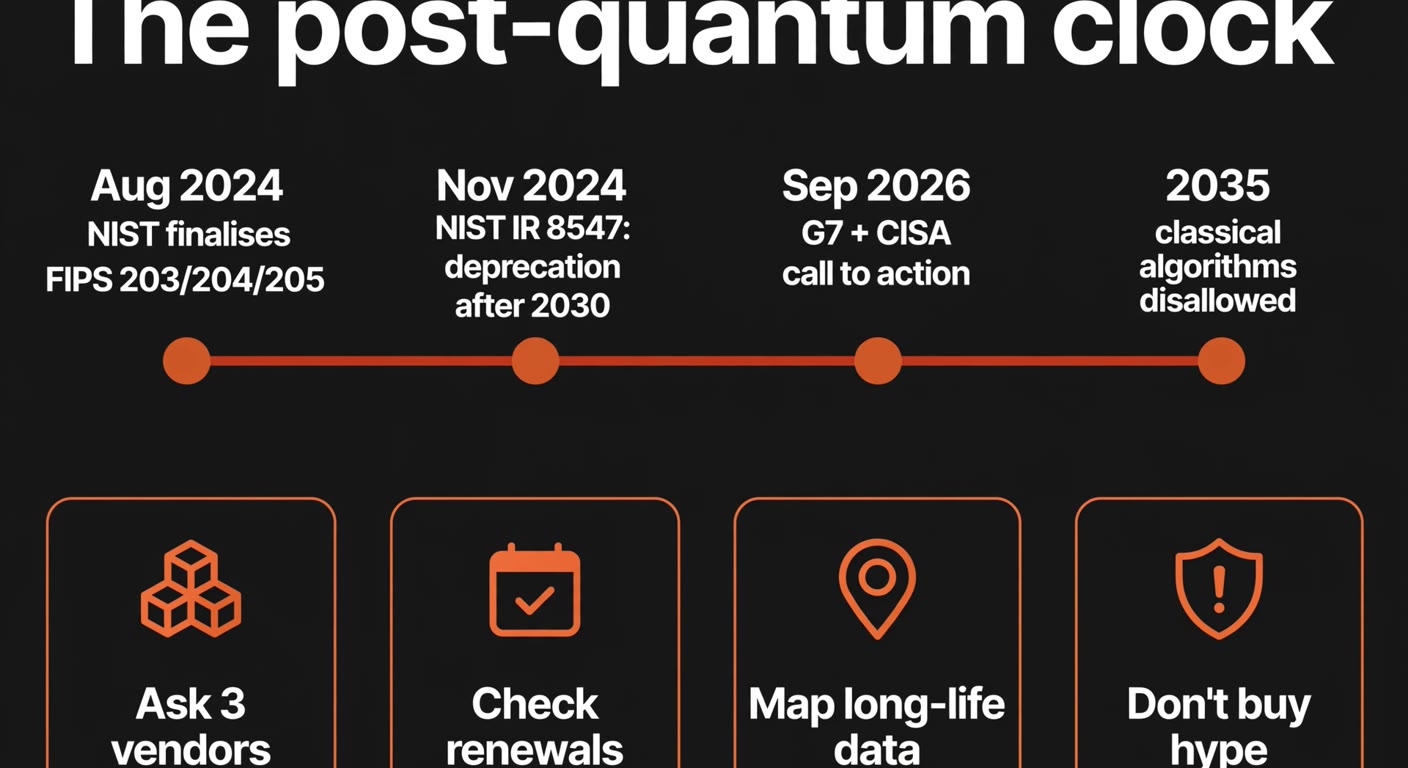
On September 3, 2026, CISA and the G7 Cyber Security Working Group published Preparing for the Post-Quantum Era: A Call to Action. It was co-issued by the cyber agencies of all seven members — ANSSI, the Canadian CSE, Germany's BSI, Italy's ACN, Japan's NCO, the UK's NCSC and CISA — with the European Commission and ENISA sitting in.
The document does one thing that earlier guidance did not. It stops treating quantum risk as a problem for defence contractors and banks and says plainly that it applies to all sectors, not just critical infrastructure. It also says organisations that delay "may lose competitive advantage or may be excluded from contracting opportunities, including public procurement".
If you run a fifteen-person business, your first instinct is probably to file this under "someone else's problem". That instinct is about 80% right. The other 20% costs you an afternoon, and it is worth doing now rather than in 2029 when your biggest customer sends a supplier questionnaire you cannot answer.
What the call to action actually asks for
Strip out the diplomatic language and there are five priorities: raise awareness of quantum risk, build national strategies, fund research, share expertise between public and private sectors, and — the one that touches you — fold post-quantum requirements into cybersecurity and procurement processes.
The companion technical document from the same working group, published under Canada's 2025 G7 presidency on June 1, 2026, is more concrete. It tells organisations to adopt a phased, risk-based approach, inventory their cryptographic assets, map dependencies, update procurement policy to require PQC, and buy PQC-integrated products as part of normal renewal schedules. Read that list again and notice what is missing: nobody is telling you to rebuild your network this year.
The instruction is not "replace your encryption now". It is "stop buying things that cannot be updated, and know where your sensitive data lives".
"Harvest now, decrypt later" is the part that is about you today
No quantum computer can break today's public-key encryption yet. The reason the G7 wants movement anyway is a threat model with an ugly name: harvest now, decrypt later. An attacker copies encrypted data today — from a server, a backup, a mail archive, a stale S3 bucket — and keeps it, because decryption becomes possible once a cryptographically relevant quantum computer exists. NIST's transition plan, IR 8547, says the same thing in drier language and adds the number that explains the urgency: moving from a standard to full integration across products and infrastructure has historically taken ten to twenty years.
So the question that decides whether this is your problem is not "do I own a quantum computer". It is: which of my files would still be damaging if someone read them in 2036?
For most small businesses the honest answer is a short list. Contracts with unusual terms. Product formulas, recipes, tooling drawings. Customer lists with pricing. Anything medical, legal or financial. Source code. Scanned identity documents sitting in a shared folder. That is typically five to ten places, not five thousand — and that is exactly the point. The inventory is small enough that a spreadsheet is the right tool, not a consultancy.
The supplier questionnaire is how this reaches you
You will not read the G7 document in your inbox. You will read its consequences in a procurement form from a larger customer, a bank, an insurer, or a public tender, asking whether your organisation has a plan for cryptographic migration. Those forms already exist for ISO 27001 and NIS2 work. The September 2026 wording shifts the incentive: in June the working group told organisations to require PQC in procurement, in September it told them that failing to do so may cost them contracts.
Here is the uncomfortable part. A four-person software supplier and a four-hundred-person manufacturer get asked the same question, and only one of them can afford a two-week consultancy. So the answer a small business needs is not a strategy document. It is a page and a folder: what you store, who looks after your encryption, and what your vendors told you when you asked. That is a defensible answer to the questionnaire, and it takes an afternoon to produce.
Four things worth doing in the next 30 days
None of these involve touching your encryption. All four produce evidence you can reuse when someone asks.
Ask three vendors one specific question
Pick the three whose software or hardware would be hardest to replace — hosting, backup, the firewall or VPN, your ERP or the accounting platform. Send them the same short email. Vague questions get vague answers, so be precise: "Does your platform support hybrid post-quantum key exchange on TLS today, and if not, what is the timeline? Which of your products are crypto-agile, meaning you can swap cryptographic algorithms with a software update rather than a hardware replacement? Who in your organisation is responsible for the PQC migration plan?" Keep the replies in a folder. That folder is the whole deliverable.
Put crypto agility into your next hardware renewal
The one genuinely expensive mistake available to a small business is buying a long-life device in 2026 that cannot be updated. Firewalls, VPN concentrators, NAS boxes, backup appliances, access-control panels, badge readers and some MFA hardware have firmware that gets replaced on a five-to-seven-year cycle. Before you sign, ask whether the vendor can deliver new cryptography through a firmware update, and get a date rather than an assurance. If the answer is "we'll see", buy the other model. This costs nothing today and saves you a forklift upgrade in 2032.
Map where long-life data lives
One page. Where do you keep the information that would still hurt in ten years — the contracts, the drawings, the client pricing, the medical and legal records, the archives you never delete? Most small businesses can answer this in twenty minutes, and it doubles as a data-minimisation exercise: anything on that list that nobody needs is a deletion you can make now, which shrinks both the quantum problem and your GDPR exposure.
Pick the renewal calendar answer, and stop
The G7's own technical guidance says to buy PQC-ready products as part of standard renewal schedules. That is the entire migration plan for a business your size: no project, no budget line, no committee. Your renewal calendar is the plan. Write it down in one sentence so you can quote it later, and get back to work.
What not to buy, and what not to worry about
There is money to be made from this document, and most of it is being made badly. A short list of things to decline:
- "Quantum-proof" or "quantum-safe" branding on a VPN, an antivirus or a hosted service. No product is fully post-quantum today. The practical state of the art is hybrid: a classical algorithm combined with a post-quantum one, so you are protected if either one falls. If a vendor claims more than that, ask which FIPS standard they implement and which version.
- Ripping out working encryption this year. Nothing in the G7 or NIST guidance asks for it, and a botched migration is a far more likely way to lose data than a quantum computer is.
- A consultant to "assess your quantum readiness". For a business under about fifty people, the assessment is the four steps above. If someone offers to run it for a monthly retainer before you have asked your three vendors a single question, you are paying for a template.
- "Harvest now, decrypt later" panic about routine data. A delivery note from 2024 is not a national secret. Only the long-life list is worth this level of attention.
Where 2030 and 2035 come from
Those dates are not a countdown to quantum apocalypse. They are NIST's own transition plan. The three primary post-quantum standards were finalised on August 13, 2024: FIPS 203 for key establishment (ML-KEM), FIPS 204 for digital signatures (ML-DSA) and FIPS 205 as a hash-based backup signature scheme (SLH-DSA). NIST published the migration plan, IR 8547, on November 12, 2024, and it is blunt about the schedule — classical public-key algorithms such as RSA and elliptic-curve cryptography are deprecated after 2030 and disallowed after 2035, with high-risk systems moving much earlier. A US national security memorandum sets 2035 as the federal target.
None of that is a law that fines a small business. It is the schedule your software vendors are building to, which means it is the schedule on which TLS libraries, browsers, cloud services and hardware firmware will actually change. You do not have to track the calendar yourself. You just have to avoid buying things that will be stranded by it.
One last thing worth knowing: the algorithms are already in the wild. Hybrid key exchange using ML-KEM alongside X25519 is deployed in the current TLS stack, which is why asking a vendor "do you support it today?" is a fair question with a checkable answer rather than a futurology quiz.
Frequently asked questions
Does my small business need post-quantum cryptography right now?
Not urgently, and not as a project. What you need now is to avoid buying long-life hardware and software whose cryptography cannot be updated, and to know which of your data must stay confidential for a decade or more. Products bought this year on a five-to-seven-year cycle will still be in service when the 2030 deprecation dates arrive.
What is "harvest now, decrypt later"?
It is the reason the timeline is shorter than the quantum computers themselves suggest. An attacker records encrypted traffic or copies encrypted files today and stores them, then decrypts once a cryptographically relevant quantum computer exists. It only pays off against data that keeps its value for years, which is why the practical question is which of your records would still be sensitive in 2036.
Which standards should I ask my vendors about?
FIPS 203 (ML-KEM, for key establishment), FIPS 204 (ML-DSA, for digital signatures) and FIPS 205 (SLH-DSA, a hash-based backup). For today's networks the realistic answer is hybrid deployment — ML-KEM paired with a classical algorithm such as X25519 — so that traffic stays protected if either side is broken. Ask which of those a vendor implements and in which product version.
Do web browsers and cloud providers already support this?
Hybrid post-quantum key exchange is already part of the current TLS stack, which is why "do you support it today?" has a checkable answer. Digital signatures are the slower half of the migration: certificate chains, code signing and document signing take longer to change than key exchange does.
Is there a legal deadline for a private company?
No. The 2030 and 2035 dates come from NIST's transition plan and a US national security memorandum covering federal systems, not from a regulation that fines private businesses. The practical pressure arrives through contracts and supplier questionnaires, and through whatever schedule your vendors build to.
Need a plain-English second opinion?
BigLobster helps small teams turn vague security requirements into a short list of concrete checks — the vendor questions, the data map and the renewal decisions that actually matter for a business your size.
Talk through your setup