
There is a quiet line item inside Microsoft Power Platform that most small teams never look at, because for years it did not cost anything. Every eligible Power Automate or Power Apps licence came with a monthly allowance of AI Builder credits — capacity that paid for the AI steps inside your flows: reading an invoice, pulling numbers off a PDF, classifying an email.
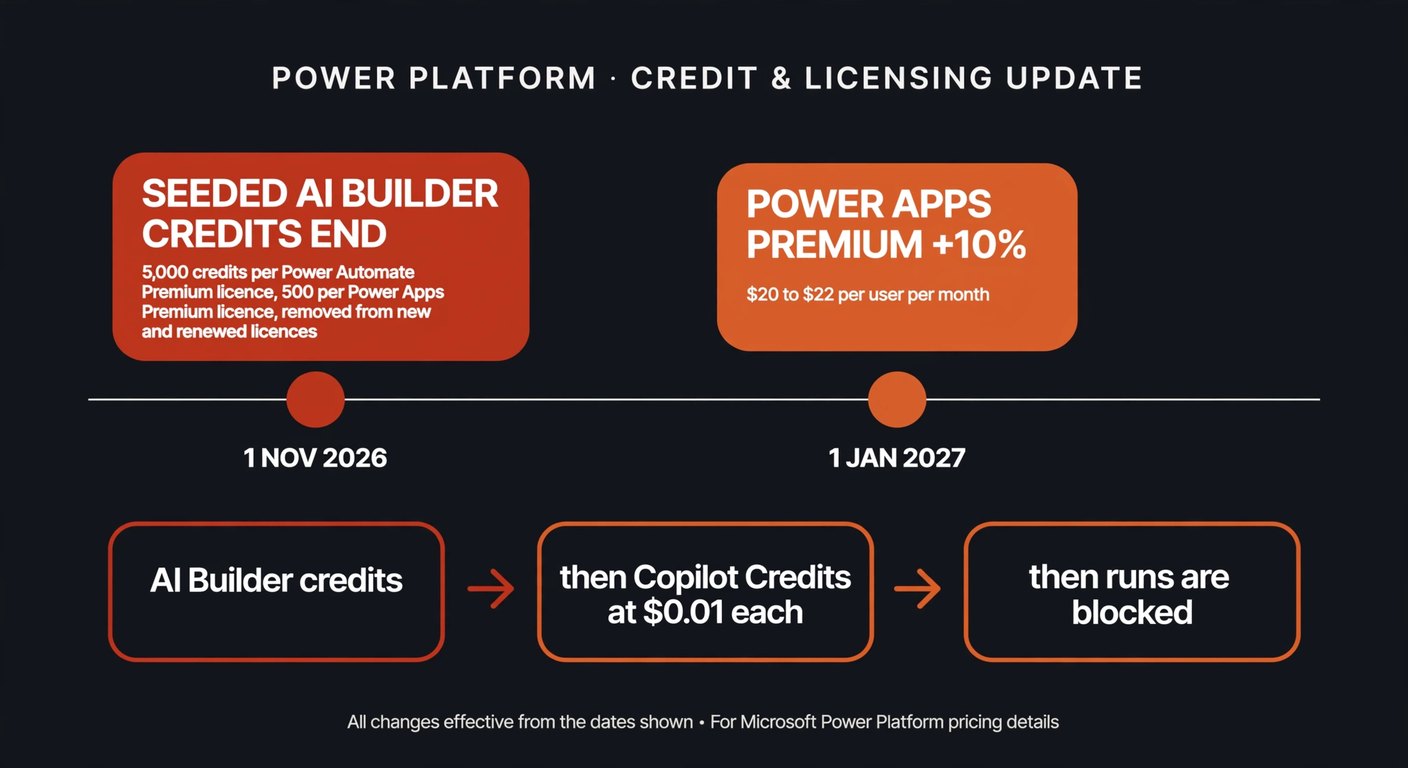
Those credits stop being seeded. Microsoft's own licensing documentation is blunt about it: from 1 November 2026, no new or renewed Power Platform or Dynamics 365 licence receives them.
Then there is a second date. On 1 January 2027 the Power Apps Premium licence itself goes from $20 to $22 per user per month. It is the first list price increase for that product in more than five years, and it lands a couple of months after the credits disappear.
Two separate changes, one direction of travel: the per-seat licence is becoming the entry ticket, and what you consume on top is the bill.
What actually changes on 1 November 2026
Microsoft's licensing documentation states it in one line: starting 1 November 2026, no new or renewed Power Platform or Dynamics 365 licence will receive seeded AI Builder credits. Anyone who bought or renewed an eligible licence before that date keeps the allowance until the end of the contract term.
The word doing the work there is renewed. If your annual Power Automate Premium licences renew in March, the credits are already gone by the time the renewal invoice arrives. There is no separate email for this and no line on the invoice that says "capacity removed". The removal is an entitlement change, not a charge.
What the credits pay for is easy to underestimate. AI Builder is the AI layer inside Power Apps and Power Automate: document processing that pulls the vendor, date and total off an invoice, text recognition that reads a scanned delivery note, category classification that routes an email to the right queue, and prompts that run against a model. Building and testing a model is free. Running it in a flow or an app is what consumes credits.
So the bill only moves for teams that automated something. A small wholesaler that scans supplier invoices into its accounting system, a clinic that reads intake forms, a service company that extracts meter readings from photos — those are the flows that were quietly funded by the licence.
Which licences lose the allowance
The seeded amounts differ by product, as Microsoft's AI Builder credit table sets them out, and one line in the table is the one that survives.
| Licence | Seeded AI Builder credits per month | Active after 1 Nov 2026 |
|---|---|---|
| Power Automate Premium | 5,000 | No |
| Power Automate Process | 5,000 | No |
| Power Apps Premium | 500 | No |
| Power Apps per app | 250 | No |
| Dynamics 365 Finance and Operations | 20,000 | No |
| AI Builder capacity add-on | 1,000,000 | Yes, on add-ons held from before the cut-off |
Two details worth knowing. Seeded credits from licences are pooled at tenant level and capped at 1,000,000 per tenant, so a bigger estate does not build an unlimited buffer. And the add-on that does survive is closed to new customers since 1 November 2025, with existing customers able to renew or true up only until 1 November 2026. After that, the add-on route is a dead end and Copilot Credits are the only way to pay for these features.
The practical arithmetic is this: fifty Power Automate Premium licences have been sitting on 250,000 credits a month. From November, that number starts at zero for any licence renewed from that date.
What happens when the allowance is gone
Microsoft built a fallback chain rather than a hard switch, and the order matters.
An AI Builder action in an app or a flow spends AI Builder credits first. If there are none left, or none available, it spends Copilot Credits instead, at $0.01 each on pay-as-you-go billing. If there are neither, the model run is blocked — the action fails with an EntitlementNotAvailable or QuotaExceeded error and the flow editor tells you the environment has consumed all its AI Builder credits.
That last one is the scenario nobody plans for. A flow that has worked for two years stops mid-month, and the failure looks like a bug rather than a bill. Nothing is charged for the overage itself; the process simply stops until capacity is restored.
Two behaviours make it worse than it sounds. Consumption resets on the first of each month, so an environment that is only lightly used early on can still be blocked on the 22nd. And unused credits do not roll over — whatever you buy or allocate covers one month's expected peak, not a year's average.
The second date: Power Apps Premium goes up in January
While everyone watches the credits, the seat price moves too. On 9 September 2026 Microsoft announced the first list price increase for Power Apps Premium in more than five years, effective 1 January 2027.
Power Apps Premium goes from $20 to $22 per user per month on annual billing terms. The 2,000-seat minimum tier goes from $12 to $14 — the same $2, which is 10% on the standard plan and closer to 17% on the volume one. Those are the only two SKUs affected, no entitlements are removed, and the increase applies whether you pay monthly or annually.
Twenty-two dollars a seat only stings at scale, which is not where most of this site's readers live. Ten Power Apps Premium licences go from $2,400 to $2,640 a year. The reason to care is not the $240. It is that the same January renewal is the one where the AI Builder credits are already gone, so two changes land on one invoice and neither of them was requested by you.
The renewal clause that is actually worth money
Microsoft's pricing notice contains the same kind of sentence Atlassian used in October: existing subscriptions retain their current price through the end of the subscription term, and the new list price applies to new purchases, renewals and co-terminations with a term beginning on or after 1 January 2027.
Read that as a lever, because that is what it is. A renewal or term extension that starts before 1 January 2027 keeps the old price for that term. If your Power Apps Premium renewal falls in the first half of 2027, the question to ask your reseller or account team is whether the term can start in December instead — you are not asking for a discount, you are asking to renew slightly early under the published rule.
Do the same maths on the credits side. Any eligible licence bought or renewed before 1 November 2026 keeps its seeded AI Builder credits through the contract term. A renewal that could move into October keeps 5,000 credits a month per Power Automate Premium seat for the length of that term. That is the only window in which the old commercial model can still be locked in.
Both levers pull in the same direction and both have short fuses. If your renewal lands in the next eight weeks, it is worth a conversation this week rather than a spreadsheet in December.
What to do in the next thirty days
None of this requires a licensing consultant. It requires about an hour, in this order.
Find out which flows actually use AI Builder. In the Power Platform admin center, open the environment, then the AI Builder consumption view. You are looking for the flows and apps that have run document processing, text recognition or prompts in the last 90 days, and how many credits they burned. If the number is zero, close the file and stop reading; this change costs you nothing.
Turn consumption into money. Take your busiest month, divide the credits consumed by the allowance you are about to lose, and price the shortfall at $0.01 per Copilot Credit on pay-as-you-go. Most small deployments land in single-digit or low-double-digit dollars a month. Some land in the hundreds, and those are the ones worth redesigning rather than paying for.
Check your renewal date against the two deadlines. November 1 for the credits, January 1 for the seat price. If either is close, ask your reseller in writing whether the renewal or co-termination can start earlier. Get the answer before you decide anything else.
Decide what to pay with before the block happens. Copilot Credits are the route after the change, and they are bought as prepaid capacity packs or used on a pay-as-you-go meter. Either way, someone has to own the balance, because a runaway flow spends real money and a depleted one stops the process.
Put a monthly number next to the flow. The features that used to be free-feeling are the ones nobody monitors. A consumption alert on the environment costs nothing and turns a mid-month outage into an email you ignore.
Frequently asked questions
Do I lose the credits I already have?
No. Licences bought or renewed before 1 November 2026 keep their seeded credits until the end of the applicable contract term, and credits from an AI Builder capacity add-on you already hold stay usable until that contract expires. What ends on 1 November is the seeding: renew or buy a licence after that date and the monthly allowance is simply not part of it any more.
Is my flow going to break on 1 November?
Only if it runs out of credit. AI Builder actions spend AI Builder credits first and fall back to Copilot Credits, so an environment with Copilot Credits available keeps working and starts paying per action. A flow breaks when both balances are empty, and it breaks with an error rather than an invoice. That is why the consumption number matters more than the date.
Can I still buy the AI Builder capacity add-on?
Not after the cut-off. New customers have been unable to buy it since 1 November 2025, and existing customers can only renew or true up until 1 November 2026. From there, Copilot Credits are the only currency that runs these features, which is a change of billing model rather than a change to the features themselves.
Does the Power Apps Premium increase apply to my existing licences?
Not until your term ends. Existing subscriptions keep their current price through the end of the subscription term; the new list price applies to new purchases, renewals and co-terminations with a term starting on or after 1 January 2027. Microsoft also confirmed that nonprofit and education pricing moves in line with commercial pricing, with existing discounts continuing to apply where eligible.
Is it worth moving off Power Platform over this?
Almost never. Migrating years of flows, connectors and data to another platform costs more than the credits you are losing, and the Copilot Credits rate at $0.01 per credit keeps small document-processing volumes cheap. The exception is a flow whose consumption is genuinely large — that is a case for redesigning the flow, not for replacing the platform.
Want someone to price the change before the renewal lands?
BigLobster maps the SaaS and cloud stack a small business is actually paying for — licences nobody uses, capacity that quietly stopped being included, meters left uncapped — and puts the numbers next to the renewal calendar so decisions happen before the deadlines do.
Ask for a software cost review