
Update, 13 October 2026: the new prices are in effect since 13 October 2026. This article was written on 1 October; where it counts days left, it refers to the period before that date.
Want an AI agent to handle this for you? See the agents and their prices →
Most price rises give you a choice between paying more and leaving. This one gave you a third option: pay the old price for another year, if you asked before 13 October 2026.
That is not a marketing reading of Atlassian's announcement. It is written into the vendor's own FAQ, in the same paragraph that confirms the increase applies to renewals and upgrades.
Atlassian is updating Cloud list prices for Jira, Confluence, Teamwork Collection, Jira Service Management and Service Collection, Bitbucket Premium, Atlassian Guard, Jira Product Discovery, and Government Cloud. The change lands on 13 October 2026 at 12:00 AM Pacific Time. Increases run from 3% to 10% depending on the product, the edition, and in a few cases how many seats you hold.
Below: what actually changes, the old-price clause, four levers that lower the bill, and a second invoice arriving on 3 December that almost nobody is watching.
What actually changes on 13 October
The headline number anyone quotes is "up to 10%", and that is where it stops being useful. The increase depends on what you run.
Jira and Confluence Standard and Premium move by 7% below 5,000 seats and 10% at 5,000 seats and above. Jira Service Management and Service Collection move by 7.5% on Standard and Premium, and 10% on Enterprise. Bitbucket Premium goes up 10%, and Bitbucket Standard loses its five-seat minimum tier, which changes the entry price for a very small development team. Jira Product Discovery moves 5%, Atlassian Guard 3% on Standard and 5% on Premium. Enterprise editions of Jira and Confluence sit at 8%.
Read that list again and notice what it means for a team of eight: you are nowhere near the 5,000-seat threshold where the worst numbers live. On standalone Jira Standard you are looking at 7%, and 3% if the only thing you pay for is Guard. On a small bill, a few percent is annoying rather than existential, and that is exactly why most small teams will ignore it and pay it.
The deadline that matters is narrower than it sounds. From 13 October, any bill, renewal, upgrade, tier change or new product added to your site is priced at the new list. Annual subscriptions renewing automatically after that date are charged the new price. So the question is not "should we switch tools" (mostly not worth it — see below). It is "can we move our renewal date in front of 13 October".
The clause nobody reads: your old price is still on the table
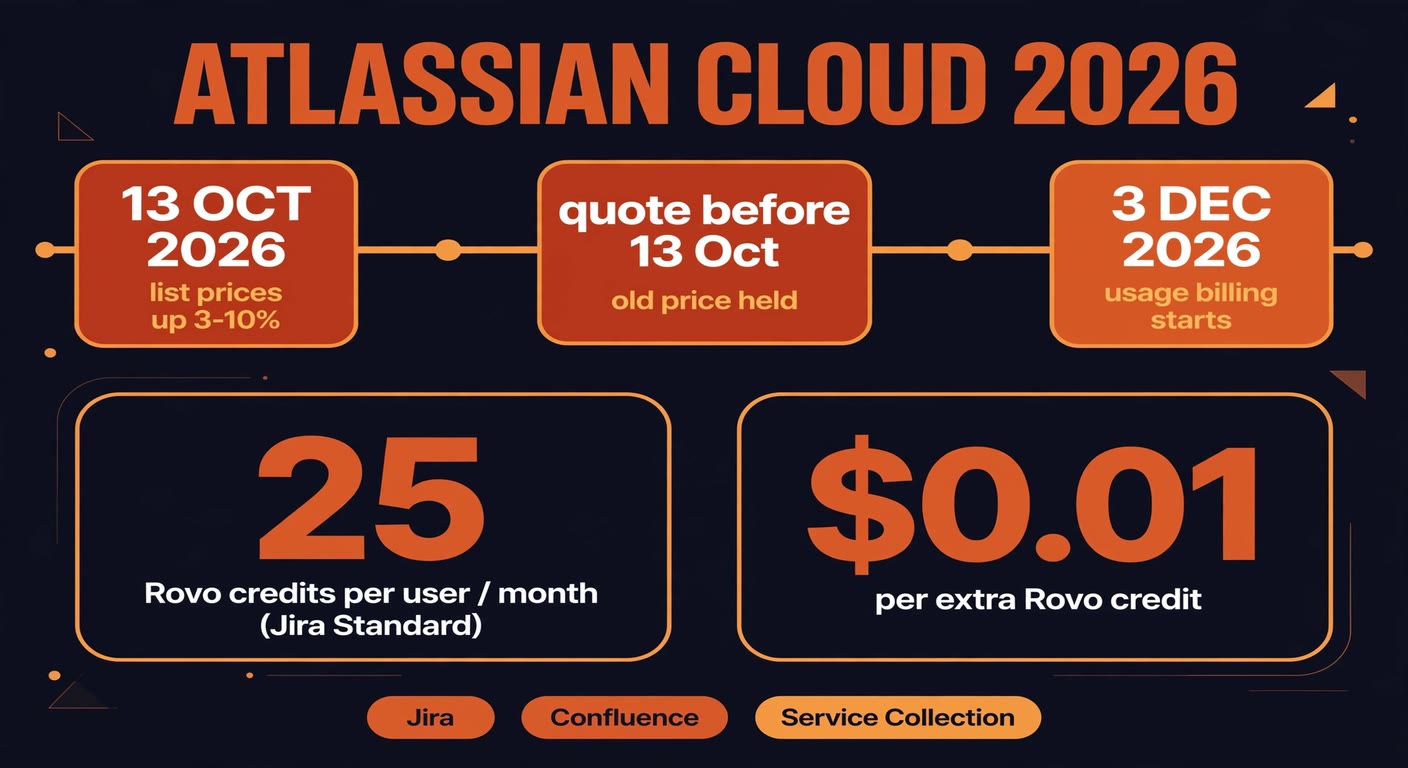
Here is the part worth twelve days of urgency. Atlassian's FAQ says that if a quote is generated before 13 October 2026 PT, it will be honoured under the prior price until the quote expires. Any quote created on or after that date uses the new, higher list.
For an annual subscriber, that is close to automatic: renewal quotes are issued 90 days before expiry, and you can only buy a renewal once you are inside that 90-day window. If your window is already open, ask for the quote now rather than in November.
For anyone on a monthly plan the mechanics are different, and this is where the money is. Customers on monthly billing cannot renew early — but they can request an annual quote at any time before 13 October to receive existing pricing. Payment has to arrive before the quote expires, and the quote cannot be extended beyond 11 November 2026 PT.
Two caveats worth knowing before you plan around it. Moving to annual already cuts the bill on its own — Atlassian's own guidance puts the annual discount at up to two months free depending on user count. And an open quote is not a contract: if you generate it and never pay, nothing is locked.
So the practical version is this. Log into the Atlassian billing record, open your most recent paid invoice PDF, and compare your actual line items against the new price tables. You are looking for one number: what does 7% or 10% come to in currency, on your seats, on your plan. Then decide whether a quote is worth requesting; the deadline for doing so was 13 October, not the last day.
Four levers that lower the bill without leaving Atlassian
Switching project management tools to save 7% is a bad trade. Migration eats weeks, the team relearns everything, and integrations get rebuilt. Atlassian knows that, and it is why the increase is small enough to absorb. Look at the bill line by line instead; there is usually more money in these four moves than in the whole percentage.
Deactivate the seats nobody uses. Atlassian's own guidance lists this first, and for good reason. Someone who left eight months ago, a contractor whose project ended, the shared account nobody remembers creating — every one of them is billed every month. Pull the user list, sort by last activity, and deactivate anything that has been quiet for a quarter. This is a one-hour job that pays back immediately and does not depend on any deadline.
Check what the tiers actually cost together. Atlassian's fixed annual model bills you at a tier boundary, not by exact headcount: Jira Standard at 480 users is charged at the 500-user tier. If you are at 495 users, you are already paying for 500 and can add seats without spending more. If you are at 501, you just jumped a tier for one person. That single seat can be worth real money, and it is invisible until you look at the invoice PDF.
Consolidate before you renew, not after. If you run separate Standard or Premium subscriptions for the same product, folding them into one Enterprise subscription can cost less because Enterprise prices seats centrally. If you are paying for Jira, Confluence, Guard and Loom separately, Teamwork Collection bundles them, and the Rovo credit allowance inside it is 10x the standalone Jira or Confluence allowance per user. On a small team, that credit difference matters more than the percentage — see the next section.
Only then decide about the increase itself. If the recalculated bill after the three moves above is a rounding error against what you pay a contractor for a week, absorb it and get back to work. If it is not, the quote had to be requested before 13 October.
The second bill arrives on 3 December
This is the change small teams are least prepared for, and it is not in the percentage table at all.
Atlassian is moving metered capabilities to usage-based billing. Billing starts on 3 December 2026 for most meters: Rovo credits, Automation steps, and Assets objects. Your subscription includes a monthly allowance per meter, pooled across the organisation; usage beyond the allowance is charged at published rates, and for Rovo that is $0.01 per credit, or $10 per 1,000 credits.
The allowance is not large once you look at the arithmetic. Jira Standard and Confluence Standard include 25 Rovo credits per user per month. Premium is 70, Enterprise is 150. A ten-person team on Jira Standard gets 250 credits a month across the whole company. AI features that consume credits include Chat, agents, and Teamwork Graph queries — the things the platform has spent the last year telling you to use.
Now the detail that should make you open the admin console: extra usage is enabled by default. Nothing pauses when the allowance runs out. The platform keeps working and the overage lands on your next invoice, subject to whatever spending cap has been set — and if no cap has been set, there is no ceiling applied by you at all.
You can change that in Atlassian Administration in a few clicks. Two options: set a monthly spending limit so the meter pauses at a number you chose, or leave extra usage on and accept the cap. Doing nothing is the third option, and it is the one that produces a surprise invoice in January.
Frequently asked questions
My subscription renews in March. Do I have to do anything now?
Probably not, and that is the honest answer most vendors avoid. Renewals from 13 October onward are priced at the new list, so your March renewal will already carry it. The only lever you had — requesting a quote before the deadline — is effectively unavailable unless you are already inside the 90-day renewal window. Do the seat cleanup instead; it survives the price change.
Am I better off moving to a competitor?
Not for a small team, no. A 7% increase on a handful of seats rarely covers the cost of migration: exporting years of tickets, rebuilding automations, retraining everyone, reconnecting the tools you integrate with. The exception is when you were already unhappy with the tool for other reasons. A price rise is a bad reason to migrate and a fine trigger to finally review a decision you were postponing.
Does the free tier change?
No. The update covers paid Standard, Premium and Enterprise plans. Jira and Confluence Free stay free for up to 10 users. If your team is under that limit, nothing on this page applies to you.
Where do I see what my own bill will become?
Two places, and neither requires asking sales. If you are a billing or technical contact, log into my.atlassian.com, open Order Center, Invoices, and download your most recent paid Cloud invoice as a PDF. If you are a site administrator, go to admin.atlassian.com, pick the site, choose View billing and then Billing History. Compare the line items against the published future price tables, which list the new prices by app and user tier.
Want the invoice looked at by someone who does this weekly?
BigLobster reviews the SaaS stack a small business is actually paying for — seats nobody uses, tiers priced by rounding, meters left uncapped — and puts the numbers next to the renewal calendar so the decisions land before the deadlines do. No migration pitch unless the numbers say so.
Ask for a software cost review