
For the last two years, replying to a customer on WhatsApp has been the cheapest thing in your support stack. Someone messages you, someone on your team types back, and nothing lands on a bill. That ends on 1 October 2026.
There is no dramatic headline here — no product being killed, no price doubling overnight. What there is: a quiet line that was free moving into the paid column, on a channel a lot of small businesses now run most of their customer conversations through. Meta published it on its own developer documentation, alongside the rate card that confirms the prices. Here is what it means if you are the person who signs the invoice.
What actually changes on 1 October 2026
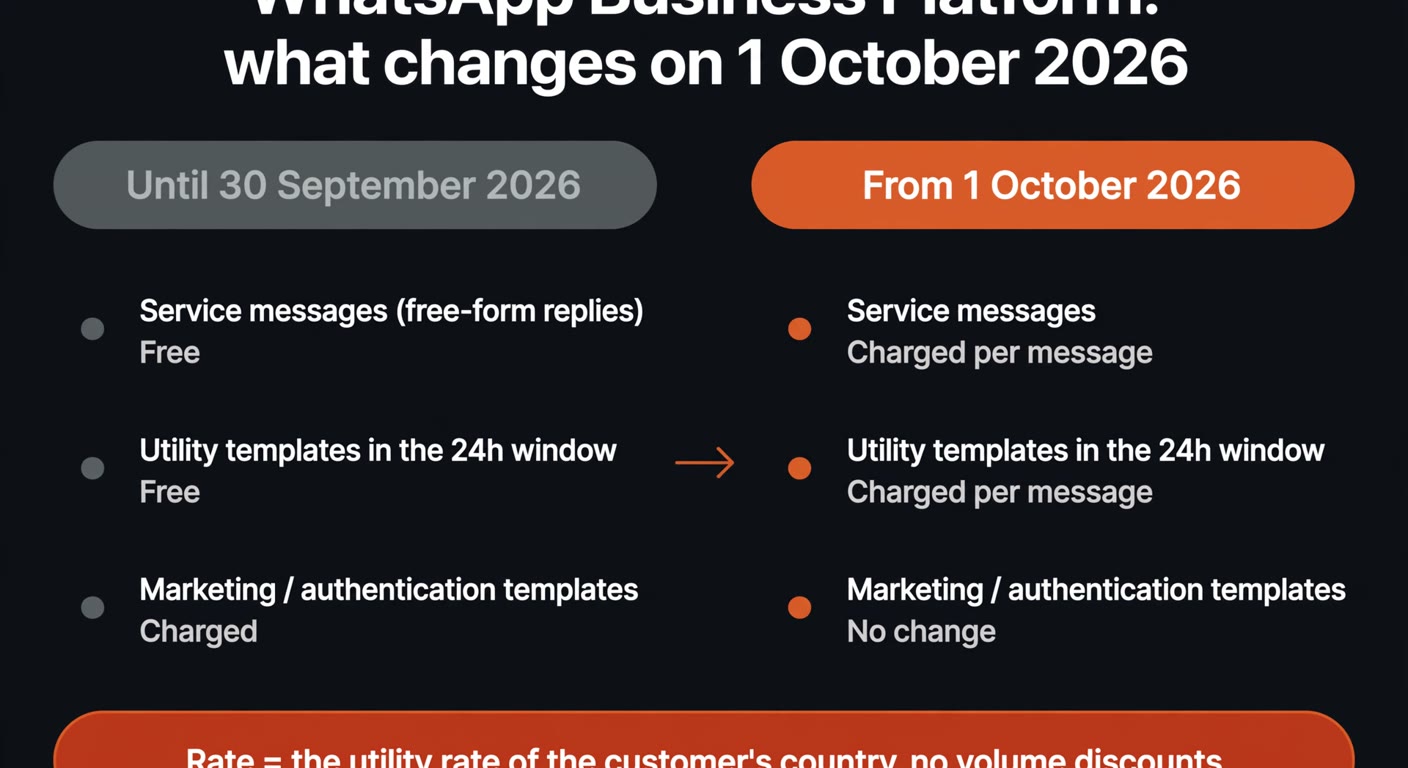
Two message types become billable on the same date. Neither is new; both were exceptions carved out of the per-message model Meta introduced in July 2025, and October closes them.
| Message type | Until 30 September 2026 | From 1 October 2026 |
|---|---|---|
| Service messages (free-form replies sent inside the 24-hour customer service window) | Free | Charged per message |
| Utility templates sent in response to a customer, inside that same window | Free | Charged per message |
| Marketing and authentication templates | Charged | No change |
A service message is not a template. It is the ordinary thing your team or your chatbot sends when a customer has just written to you: a plain text reply, a photo of the item they asked about, a document, a couple of reply buttons. As long as the customer messaged you first and less than 24 hours have passed, whatever you send back inside that window is a service message. Meta's pricing documentation for non-template messages sets the charge at the same rate the market pays for utility and authentication messages, and it rules out volume discounts: a business sending 50,000 replies pays the same per message as one sending 1,100.
Two things stay as they are. Messages your customers send you are still free, and so are conversations opened from a Click-to-WhatsApp ad or a Facebook Page button, which keep their 72-hour free window. If you buy those ads already, that free window is now worth more than it was.
Your reply count is the number that decides the bill
Support conversations are not one message. They are five, six, ten small ones. A customer asks whether you have the part in stock; you say yes; they ask the price; you send it; they ask whether it fits their model; you ask for the model number; they send it; you confirm. That is seven messages, and until 30 September it cost nothing. From October it is seven charges.
That is the whole change in one sentence, and it is why you should count your replies rather than your conversations. A business answering 400 customer conversations a month at an average of six replies each is sending around 2,400 messages. Meta's published rate card for October prices a service message the same as a utility template in the customer's market, and those rates differ by more than an order of magnitude: roughly $0.0014 in India, $0.0034 in the United States and Canada, and $0.0550 in Germany. The same support desk sends the same messages and pays a bill anywhere between three dollars and a hundred and thirty a month, depending on where its customers live.
Two details soften the number. Meta's pricing changes carry a monthly free allowance, which providers reading the published documentation put at 1,000 service messages per business number — check the figure with the platform you send through before you budget on it, because it is the one line in this change that is easy to misread. And the rate follows your customer's country calling code, not yours. A shop in one country serving customers in another is billed at the customers' rate, which is why two businesses with identical volumes can end up with very different invoices.
Meta's own agent and your own chatbot no longer cost the same
This is the part almost nobody is talking about, and it matters if your replies are automated.
Meta Business Agent — the AI that answers customers inside WhatsApp — moved to token billing on 1 August 2026, at $2.00 per million tokens. In practice that is around four to five cents for a typical reply, and it is the same price worldwide. Meanwhile, a reply sent by your own chatbot or by a platform you pay for is billed as a service message: per message, at the customer's country rate, with no volume discount.
So the comparison flips depending on where you sell. If most of your customers are in markets with cheap per-message rates, your own automation stays clearly cheaper. If you sell into expensive markets at volume, Meta's flat four to five cents can undercut your own bot once you add what you already pay the provider for sending the message. Do not switch on the strength of this paragraph alone, but do run the arithmetic — the two models are no longer the same shape, and until October the difference was invisible because your side of the comparison was free.
Add a payment method this week, or your replies stop
There is one hard deadline before the billing date, and it is easy to miss. Meta's documentation is explicit: any solution provider or directly integrated business that does not have a payment method on file by 30 September 2026 will have service messages stopped when charging begins on 1 October. Not charged — stopped.
If you pay through a provider, they handle it and it is their problem to solve. If you integrated the Cloud API yourself, or your developer did and then left, go and check the billing settings of your WhatsApp Business Account today. This is the one item on the list where doing nothing breaks something that currently works.
Five changes worth making in your support flow
You cannot make the charge disappear, and for most small businesses the bill will be small enough that a migration is not worth the disruption. What you can do is decide how many messages you send, because the meter counts messages and not conversations.
- Merge your replies. A WhatsApp message holds up to 4,096 characters, and billing is per message, not per character. Three short messages cost three times one complete one. Answer the question, give the context and state the next step in a single reply.
- Delete the filler from your automations. "One moment", "Thanks", "Let me check" were free habits. They are now line items. Every automated flow that sends three messages where one would do is a small, permanent cost increase.
- Replace open questions with buttons and forms. Collecting a name, an order number and the problem in one structured interaction beats a four-message interrogation, and it is the same work for the customer.
- Stop automations re-firing at the same person. A follow-up nudge sent twice within an hour is two charges for one intention. Check the trigger logic, not just the copy.
- Measure cost per resolved conversation. A single conversation now contains several billable types, so your old per-conversation number is gone. Whatever you used to track support volume needs a second figure next to it.
There is also an argument for looking at what you pay the platform underneath all this. Most small businesses on the WhatsApp Business Platform pay a provider a per-message fee on top of Meta's charges, and that fee has not gone down just because Meta's has gone up. If your provider bills per message, your October increase is the sum of two lines, not one.
Frequently asked questions
Does this affect the WhatsApp Business app on my phone?
No. The change applies to the WhatsApp Business Platform — the API, whether you use it directly or through a provider. The consumer app and the free WhatsApp Business app are untouched. If your team replies from a phone with the app installed and no provider in between, nothing on your bill changes on 1 October.
What counts as a service message?
Any message that is not an approved template, sent inside an open 24-hour customer service window. A window opens when the customer messages you and stays open for 24 hours. Plain text, images, documents and reply buttons are all service messages; marketing, utility and authentication templates are separate categories with their own rules.
Can I get out of the charge by switching to templates?
Not for support replies. Utility templates sent inside the window become billable on the same date, so the template route is charged too. Marketing and authentication templates were already billed and stay unchanged. There is no message type that lets you answer a customer for free within the window, apart from the ones that arrive through a free entry point.
How much is a service message?
The same as a utility or authentication message in the customer's market, per Meta's published rate card. There are no volume tiers, so the rate does not fall as your volume rises — the opposite of how utility and authentication messages work. Expect a fraction of a cent in some markets and several cents in others, with the figure following the country calling code of the customer's number.
Is there a free monthly allowance?
Meta's pricing documentation includes a monthly free allowance for service messages, and providers reading that documentation put it at 1,000 messages per business number. Since providers have described the allowance slightly differently, confirm the exact figure and unit with the platform you send through before you build a budget on it. Unused messages do not carry over.
What happens if I do nothing?
If you pay through a provider, you get billed and the service keeps working. If you integrated the API directly and have no payment method on your WhatsApp Business Account by 30 September 2026, Meta stops delivering service messages from 1 October — your customers write, and nothing comes back from you until billing is sorted. That is the failure mode worth avoiding, and it takes minutes to fix.
Not sure what a customer conversation actually costs you?
BigLobster maps the messaging and support flows a small business is running — how many messages each one sends, what the platform charges for them, and which steps can be merged without the customer noticing. The price change is the easy part; the twenty extra messages a day underneath it are where the money went.
Ask for a support flow review