
On August 14, 2026, Anthropic started watermarking text that Claude generates. Twelve days earlier, on August 2, the transparency chapter of the EU AI Act became enforceable. And roughly 190 organisations had signed the Code of Practice that explains how to comply with it.
If you run a small business and you use AI to write a newsletter, a product description, or a proposal, this probably sounds like one more thing to worry about. It mostly isn't. But there is a real split of responsibilities hiding in the announcement, and almost nobody writing about it explains which half belongs to you.
What actually changed on August 14
In a plain-language explainer published on August 14, 2026, Anthropic explained that future Claude models will produce text carrying a watermark. Not a visible one. Nothing is added to the text, there are no hidden characters, and the output does not cost more or run slower.
The trick is subtler than that. A language model picks the next word by weighing candidates — "overcast" or "grey" after "the weather today was cold and…". Which one it chooses barely matters. Watermarking changes where the randomness for those low-stakes choices comes from: instead of an arbitrary random number, it comes from a secret key plus the preceding words. The result reads the same to you. But someone holding the key can check the sequence of choices and estimate how likely it is that Claude wrote it.
Anthropic is not doing this out of enthusiasm. The EU AI Act's Article 50 requires providers of generative systems to mark synthetic audio, image, video and text in a machine-readable format, and the deadline passed on August 2, 2026. Anthropic signed the Code of Practice on Transparency of AI-Generated Content in July, alongside a long list of other model vendors and large companies, and applied the marking globally because it has no reliable way to limit it by region.
Which half of the job is yours?
The Act splits the work in two, and this is the part worth getting straight.
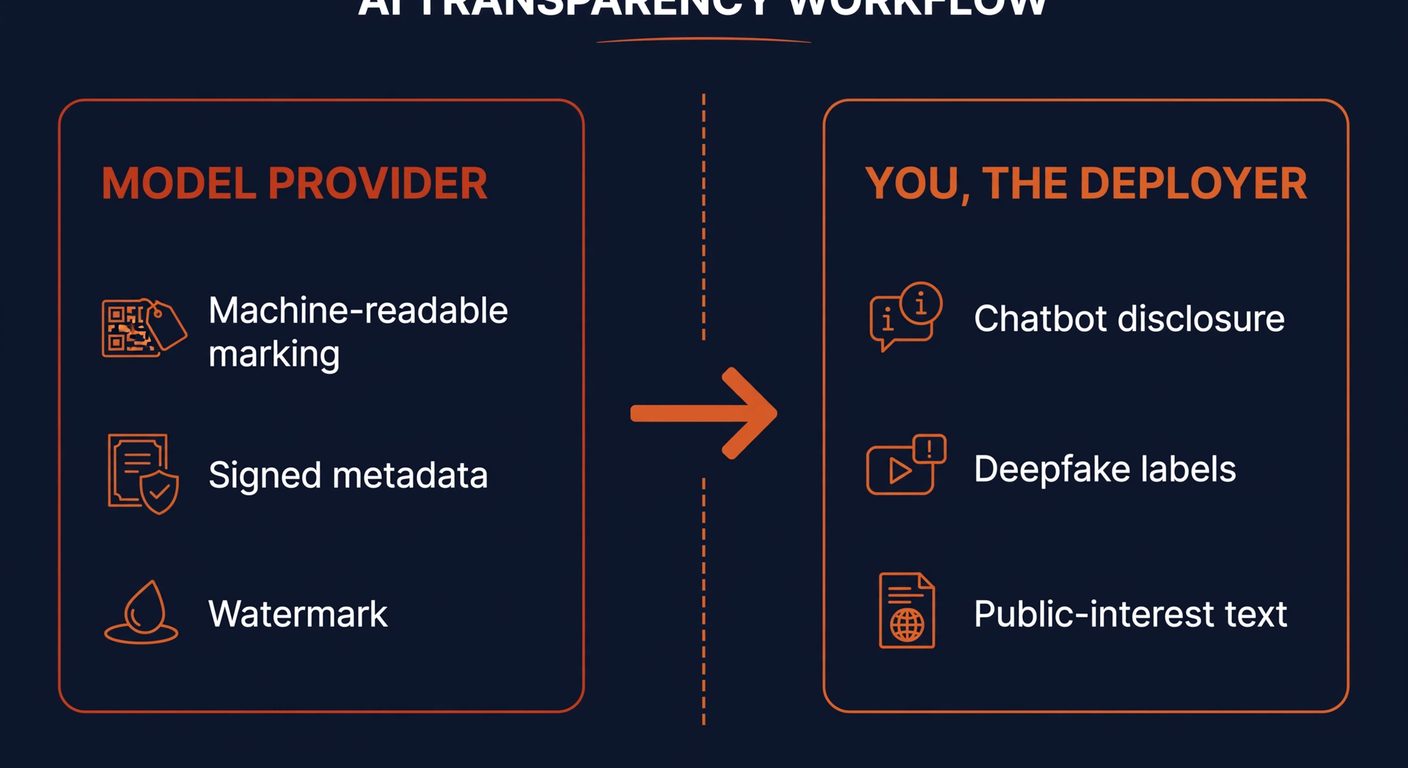
The provider marks. You disclose. Marking outputs in a machine-readable way is the duty of whoever places the generative system on the market — Anthropic, OpenAI, Google, Microsoft. If you simply use one of their tools, you did not take on that obligation by using it. The Code of Practice admits openly that no single technique meets the legal bar on its own, so providers are expected to layer signed metadata and watermarks and to hand over detection tools. That is an engineering problem for them.
The duty that lands on you is about people, not machines. Two situations matter for a small business:
- A chatbot has to say it is a chatbot. If a customer talks to an AI assistant on your website or your support channel, they must be told, at the latest at first contact. A one-line label in the chat window settles it. If you use a third-party tool, check whether it already shows that line — most do now, but "most" is not "yours".
- Realistic AI images, audio and video need a visible label. If a picture, voice or clip generated with AI could be mistaken for a real person, place or event, it has to carry a clear, perceivable disclosure. A vector illustration or an obvious stylisation does not. A photorealistic "photo" of a customer who does not exist does.
Notice what is missing from that list: your blog posts, your newsletters, your product pages. That is not an oversight, and it is the point most coverage skips.
Why your newsletter probably needs no label
The disclosure duty for text is narrow on purpose. It applies to AI-generated text published to inform the public on matters of public interest — think news, political commentary, a piece about a public controversy. It does not apply to a product description, a welcome email, a case study, or the blog post you are reading right now.
There is also a second door out of the duty. If the text went through genuine human review and a named person or company holds editorial responsibility for the publication, the labelling obligation does not arise at all. That exception is exactly why newsletters and corporate blogs written with AI assistance are not the target of the law.
But read the fine print, because it is stricter than it looks. "Someone skimmed it before publishing" is not enough. The Commission's guidelines ask for a deliberate, substantive examination by a competent person, with fact-checking named as a minimum standard — spell-checking, grammar correction and automated review explicitly do not qualify. You also have to be able to name who carries the responsibility, with their contact details publicly available. And if an AI tool touches the text after that human sign-off — a polish pass, a re-summarise, a reformat — the exception can be voided.
For a three-person business, the practical reading is this. You do not need a "Written by AI" badge on your marketing copy. You do need to answer, honestly, one question: if an authority asked who reviewed this and took responsibility, could I give a name? If the answer is yes, you are in the exemption. If the workflow is "the model drafts it, nobody really reads it, it goes out", the exception is thinner than you think — and that is worth fixing anyway, AI or no AI.
The part that does touch you: the files you generate
Here is where it gets more concrete, and where I think small businesses should spend their ten minutes.
When Claude produces a file — a PNG, JPG, or SVG — it attaches a content credential: a small, cryptographically signed note in the file's metadata recording that the file was made or processed with Claude. This is an open standard called C2PA, the same one camera manufacturers and photo editors use to record where an image came from. Any C2PA-aware tool can read it.
So the logo, the hero image, or the mock-up you generated for a product page is carrying a signed provenance note. That is not a problem in itself, and it says nothing about who you are. But two things follow:
- Your pipeline may be silently destroying it — or exposing it. Resizing, compressing, running an image optimiser or exporting through a design tool can strip embedded metadata without any warning. If you rely on that metadata for anything, check it survives your workflow. If you would rather it not travel with the file, know which tool in your chain removes it.
- Nobody can strip a watermark you never had — but you can be asked about it. If a client, a marketplace, or a larger customer starts asking suppliers to declare that assets are not AI-generated, the honest answer today is "nobody can verify that". Watermark detection is not a service you can buy yet.
For images, the human-facing test is simpler than the legal text. Three questions: does it realistically depict a person, place or object? Could a viewer mistake it for an authentic photo or recording? Did AI generate or substantially change it, rather than merely crop or retouch it? Three yeses and you need a visible label — "Image generated by AI" is enough. Ordinary cropping, colour correction and background removal are not on that list.
Don't buy an AI-content detector
This is the part I would push back on hardest, because there is a small industry forming around it and you do not need it.
Anthropic is refreshingly blunt about the limits of its own watermark. The signal is weak or absent on short texts, because there are too few word choices to carry it. It thins out on factual passages, where the next word is essentially fixed — which covers a lot of ordinary business writing. It barely applies to code. It degrades on text a human has edited, and a full rewrite removes it. And the detection API Anthropic keeps promising does not exist yet.
The watermark works best on long, unedited machine prose. It works worst on exactly the material where provenance matters most: a short quotation, a paragraph of financial fact, a passage a human tidied before publishing.
— Reading Anthropic's own list of limitations, August 2026
Third-party "AI detectors" are a different technology entirely. They do not have Anthropic's key, so they look for statistical tells in the phrasing instead. They are guessing. If a client asks you to certify that a document was not AI-generated, understand what you would be signing: nobody can verify that claim today, in either direction.
So do not budget for detection software, and do not let anyone sell it to you as compliance. Spend the same money on the human review step, which is the thing the regulation actually rewards.
What I'd do in the next 30 days
Four things, all of them cheap, none of them requiring a lawyer for a business your size.
- Name the person who owns your published content. For your blog, newsletter and website, write down who reviews it and who is responsible if it is wrong. One name, contactable. That single sentence is what keeps you inside the editorial-responsibility exemption — and it costs nothing.
- Walk your image pipeline once. Take a generated image, run it through the tools you actually use — the CMS, the optimiser, the export preset — and see whether the C2PA credential survives. You do not have to act on the answer. You just have to know where it breaks in your own stack.
- Label the two things the law actually targets. Add a first-contact line to any chatbot or voice assistant your customers reach. And if you use photorealistic AI images of people or places, put a visible "AI-generated" caption on them, at first exposure, not behind an info icon.
- Fix the review step before you add control. The most common gap in a small business is not a missing watermark; it is a publishing workflow where a model drafts, nobody reads properly, and the piece goes out. Add one honest pass with a named reader and you have solved the part that matters.
None of this is a project. It is an afternoon, and most of it is writing down decisions you have already made informally.
Frequently asked questions
Do I have to label AI-written content on my website or blog?
Almost certainly not. The text-labelling duty covers AI-generated text published to inform the public on matters of public interest, and it disappears when the text went through real human review with a named person or company holding editorial responsibility. Marketing copy, product pages and newsletters do not fall into that category.
Does the watermark mean my clients can tell I used AI?
No. Only someone holding Anthropic's key can produce a probability estimate for Claude text, and that detection interface does not exist publicly yet. Third-party detectors use different methods and cannot read the watermark at all. The mark is not a label and does not identify you or your organisation.
What if I use ChatGPT, Gemini or Copilot instead of Claude?
The provider's marking duty applies to all of them; the implementation differs by vendor and by release date. Anthropic's own note is that its watermark is not Claude-specific in concept — other major providers signed the same Code of Practice. Your duties as a user are the same whichever tool you pick.
Can I remove the watermark from images I generated?
You can remove file metadata by re-exporting or compressing, and tools that exist to bypass marking are explicitly prohibited under the Code of Practice. The practical guidance for a small business is simpler: decide deliberately what your pipeline does with provenance metadata rather than having it stripped by accident.
What happens if I do nothing?
For a small business publishing edited marketing content, realistically very little — the fines of up to €15 million or 3% of turnover are aimed at providers and at clear cases of deception, and there is a proportionality regime for SMEs. The exposure that is real, and cheap to fix, is a chatbot that never tells customers it is a chatbot and a photorealistic AI image passed off as a real photo.
Want a practical second opinion?
BigLobster helps small teams sort out the unglamorous part: who reviews what you publish, where your AI tools sit in the workflow, and what you can stop worrying about.
Talk through your AI setup