
The gap nobody talks about
Here's a number that should bother you. In 2025, about 47% of US small businesses were already using AI (US Census Bureau). Content creation is the top use case - roughly 4 in 10 use it for marketing. But when you look at the very thing that pays the bills, lead generation and sales prospecting, only about 9% of small businesses use AI there (Salesforce, via theStacc's 52-stat compilation).
Think about that. The same owners who'll spend an hour having ChatGPT rewrite a blog post almost no one will read aren't using AI to do the one job that brings in money: finding people who might actually buy. That's not a tech gap. It's a blind spot. And blind spots are where the easy wins live.
The reason this matters more than ever: the old "just publish content" playbook is breaking. Since Google rolled out AI Overviews, organic click-through on informational searches has dropped somewhere between 30% and 45% (HubSpot's 2026 marketing report and follow-up studies). A blog post that used to pull traffic now often just feeds the answer box and sends nobody to your site. You can still win on content - but you can't bank on it as your only engine.
What AI lead generation actually means
Strip the vendor pitch and it comes down to four jobs, all at the top of the funnel:
- Find. Pull a list of businesses or decision-makers that match your ideal customer - by industry, size, location, tech stack, or a recent trigger like a job posting or funding round.
- Enrich. Fill in the blanks: verified email, phone, LinkedIn, what they do. A list with bad data is just a bounce list.
- Score. Rank who's worth chasing first. Not "hot lead 87%" with no explanation - a real reason: they match your best customers, they just showed intent, they're the right size.
- Reach. Draft a message that sounds like a person wrote it for that specific prospect, then handle the follow-ups so nothing goes cold.
The part people get wrong: this is not a robot that closes deals while you sleep. It's a hunter that fills your pipeline. You still take the call, give the quote, win the job. AI just removes the part most owners hate and skip anyway - the relentless, repetitive work of finding who to talk to.
The tools that matter in 2026
You don't need a ten-tab stack. Here's the lay of the land, from free-ish to full-autonomy:
| Tool | What it does | Starting price |
|---|---|---|
| Apollo.io | Contact database + enrichment for building targeted lists | ~$49/mo (Basic) |
| Clay | List building with a waterfall of AI enrichment sources | ~$134/mo |
| Instantly / Smartlead | Cold email sending, inbox warmup, and follow-up sequences | from ~$37/mo |
| HubSpot / Pipedrive AI scoring | Lead scoring built into the CRM you may already use | ~$20-50/mo |
| AI SDR agents (Miivo, Starlight) | End-to-end outbound: find, score, draft, send, book | from ~$20-90/mo |
For most owners, the smart move is boring: start with the AI scoring already inside your CRM, add one outreach tool, and only graduate to a full AI SDR agent once you've proven you can actually close the meetings it books. Buying the spaceship before you've flown a paper plane is how these projects die.
What it costs versus what you get back
A working AI lead-gen stack for a small business runs roughly $150 to $350 a month in tools (prospecting database, an outreach sender, CRM scoring, one LLM seat), plus whatever you spend on ads if you go that route (Searchlab's 2026 breakdown). That's less than a single day of a junior sales hire's time.
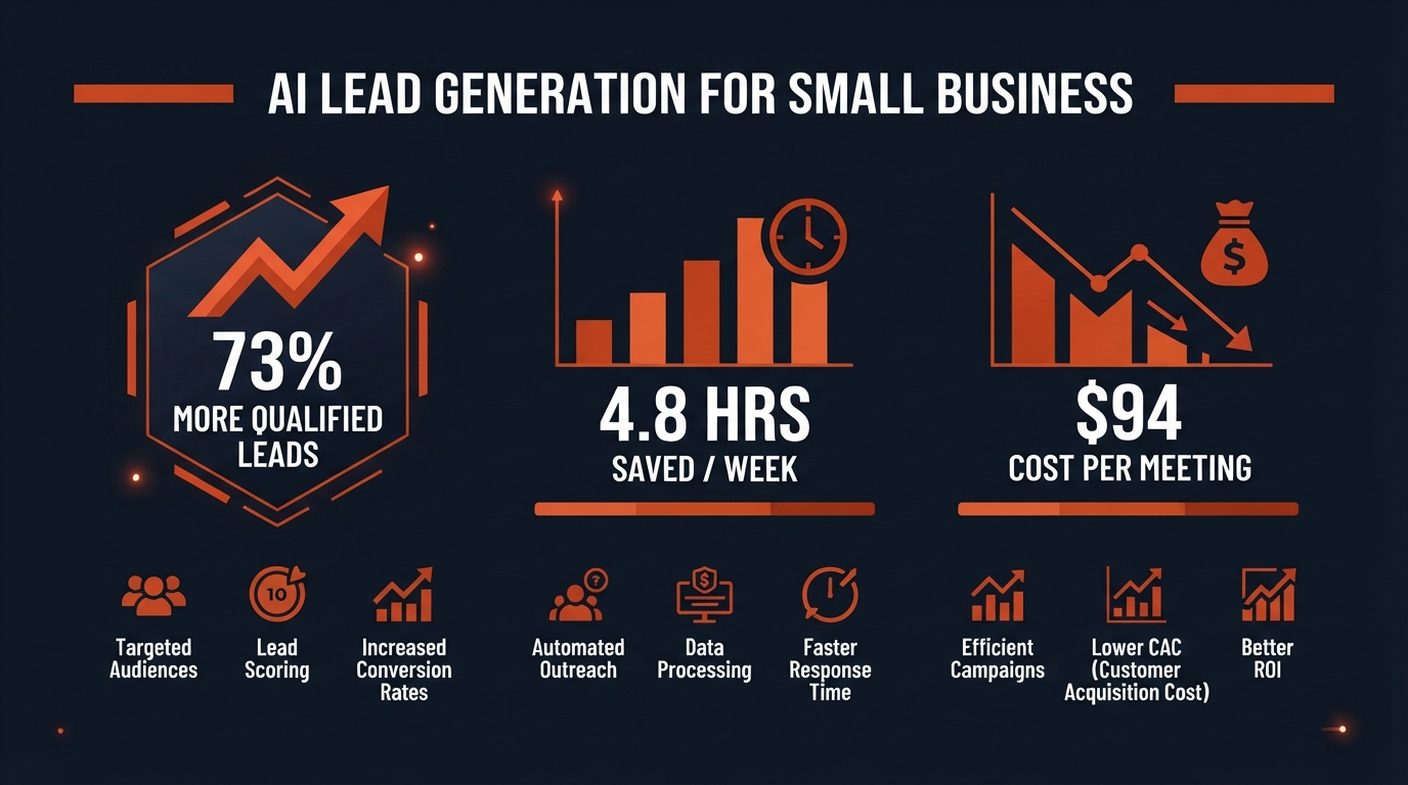
And the math on returns is getting hard to argue with. Teams running AI-human hybrid outbound watched their cost per meeting drop from $312 in early 2025 to $94 in Q1 2026 - a 70% cut (Autobound's State of AI Sales Prospecting, 2026). AI-scored leads convert about 75% better than ones picked by gut or simple rules (Landbase, Harvard Business Review, Forrester). The catch: scoring only pays off past roughly 50-100 leads a month. Below that, a three-factor rule on paper - budget, fit, urgency - beats a model trained on nothing.
The honest part: AI won't invent demand
I won't sugarcoat this. AI is a leverage layer, not a strategy. If you have no clear offer, no defined ideal customer, and no channel that's ever worked, AI just helps you fail faster and cheaper. The small businesses winning with AI in 2026 share three things: a sharp ICP, a clear offer, and the discipline to run one channel well before stacking the next.
Also - and this is the part the demos hide - cold email only works with restraint. The average reply rate is about 3.43% (Instantly's 2026 benchmark). Top teams hit 5.5%, and campaigns with real personalization (not just "Hi {first_name}") reach up to 18%. Blast a thousand untargeted messages and you'll watch your domain land in spam within weeks. Modest volume with actual relevance beats spray-and-pray every single time.
A starter stack you can turn on this week
You don't need a project plan. You need an afternoon:
- Write one sentence about your ideal buyer. Not "SMBs." "Auto-repair shops with 3-10 bays in cities over 100k people." Specific beats broad.
- Pull 200 matches in Apollo or Clay. Trim the ones that don't fit. Verified emails only.
- Let the AI draft, you edit. One message per segment, written like a human, referencing something real about them. Approve before anything sends.
- Set the follow-ups on autopilot in your sender, capped at a sane daily volume (under ~50 new contacts per inbox).
- Turn on CRM scoring so the replies that come back get ranked, and you call the hot ones first.
Do that for two or three weeks and you'll have a pipeline that builds whether or not you had time to prospect. That's the entire point.
The one mistake that gets your domain blacklisted
If you take nothing else: don't buy a scraped list and fire 5,000 emails on day one. Deliverability is the whole game. Warm your sending domains for 2-4 weeks, keep volume low, use two or three secondary domains, and always include a real opt-out. The tools make blasting tempting because it feels like progress. It's the fastest way to lose the ability to reach anyone by email at all. Slow and relevant wins; loud and lazy gets you filtered.
Frequently asked questions
Do I need a sales team to use AI for lead generation?
No. That's the whole appeal for small businesses. The AI handles the hunting and the first touch; you handle the conversation. Owners with no sales hire at all run consistent outbound through an AI SDR agent or a lightweight stack. The work doesn't stop when you're busy, which is exactly when it normally does.
Is cold email even legal?
It depends where you operate. In the US, B2B cold email is generally permitted with a clear opt-out and a business-relevant message. In the EU under GDPR, B2B cold email to business addresses is allowed in many member states when you have a legitimate interest, a real opt-out, and you're not blasting consumers. Don't take this as legal advice - if you're in a regulated market, check the rules for your region before you send.
How long until I see real leads?
Outbound is faster than content. Cold email and LinkedIn outreach can produce first replies within two to three weeks once domains are warmed, with qualified meetings following. Paid search with AI-assisted copy can surface a lead within 48 hours if your offer and targeting are sharp. AI scoring needs a few dozen closed deals to learn your pattern, so budget a month or two before it really sharpens. Real pipeline movement usually shows by the 60- to 90-day mark if you put in a few focused hours a week.
Won't AI-written outreach sound like spam?
Only if you let it. The generic "I came across your company and wanted to connect" garbage is what gets ignored. The good tools reference something specific - a hiring post, a new location, a tech they just adopted - and write like a person who actually looked. Personalization beyond the first name is what separates the 3% reply rate from the 18% one. Read every message before it goes out until you trust the pattern.
What's the smallest business that should bother?
If you have fewer than ~10 leads a month, you don't need AI - a spreadsheet and your own head are faster. The threshold where this pays off is roughly 50-100 leads a month, the same point where a CRM stops being optional. Below that, focus on nailing your offer. Above it, not using AI means leaving money on the table by chasing the wrong leads first.
Want a pipeline that builds itself?
We set up AI lead-generation workflows on top of the tools you already use - your CRM, your inbox, your sending domain - so finding, scoring, and reaching buyers happens before you sit down. No six-month rollout, no jargon: a pilot that puts real meetings on your calendar this month. Tell us who you sell to and we'll show you the build.
Talk to BigLobster →