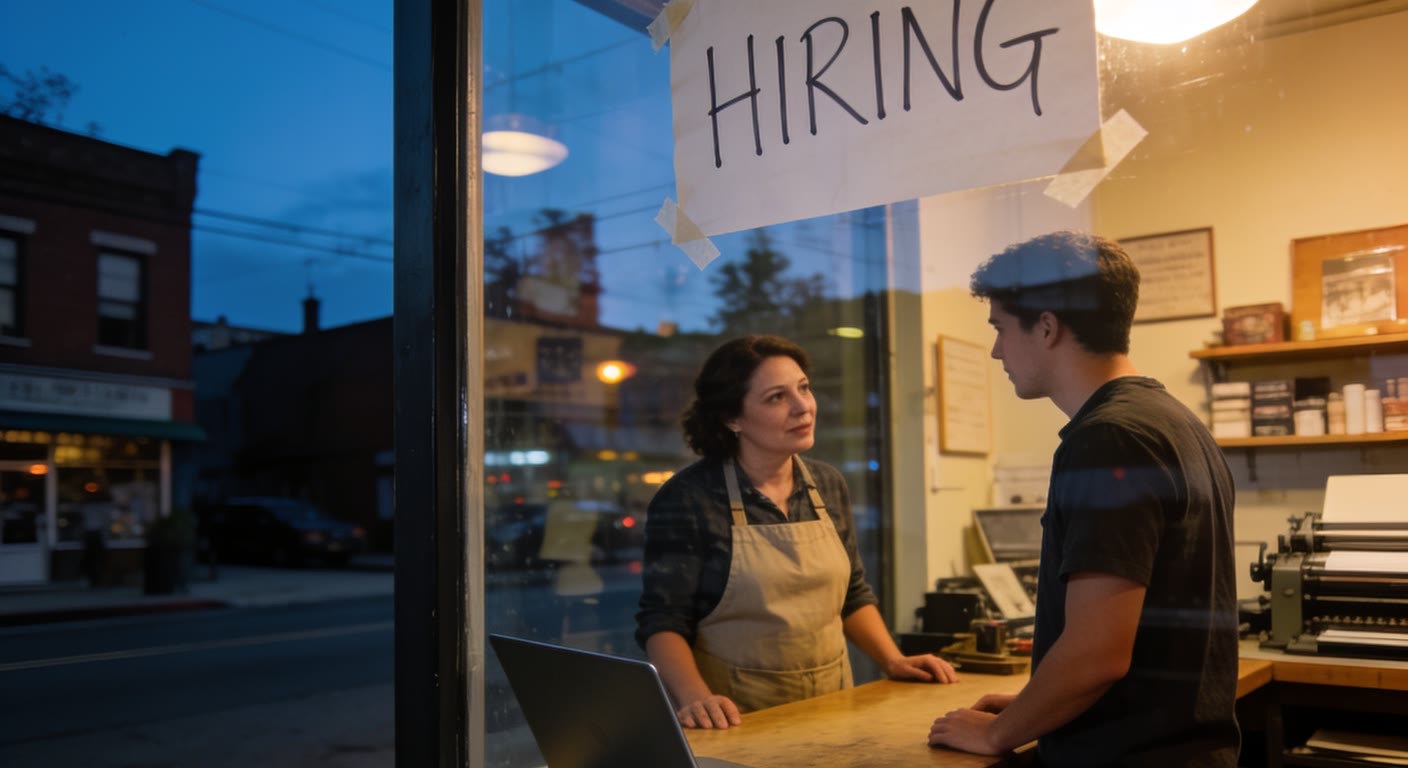
A hand-written HIRING sign taped inside the window of a small print shop looks like the opposite of an automation story. It is not. In the best small-business AI data we have right now, the sign is the expected outcome — and it shows up more often at the businesses that were struggling before they touched a single tool.
On 8 October the Federal Reserve Bank of New York published a short analysis by Will Aarons and Asani Sarkar built on the 2025 Small Business Credit Survey, run by all twelve Reserve Banks. The survey reached more than 6,500 small employer firms, and 5,248 of them answered a dedicated block of questions about AI.
What it found runs against the simplest version of the story you hear at conferences. Firms using AI are not the ones quietly planning to shrink their payroll. They are the ones most likely to say they expect to add people and revenue over the next year. And the effect is largest for the firms that report the weakest finances and the most trouble with technology.
What the New York Fed measured
The analysis published on 8 October uses the AI module of the 2025 survey, fielded between September and November 2025, with 5,248 employer firms answering those questions and the results weighted to match the national population of employer firms.
In the survey's own findings, 46% of firms with at least one employee said the business or its employees were using AI tools, and another 15% said they planned to adopt within twelve months. Among the users, 63% called AI somewhat or very important to producing their core goods and services, and 51% said it was integrated partially or fully into their processes.
So this is not a fringe group. It is your competitor, your supplier and the shop next door. The question the researchers then asked is the useful one: once you split those firms from the ones not using AI, does anything separate them?
AI users expect to hire more, not fewer
It separates them on hiring. Asked how they expect their number of employees to change over the next twelve months, firms using AI produced a net expectation of 33 percentage points — the share expecting an increase minus the share expecting a decrease. Firms not using AI came in at 15 points.
The obvious objection is that AI users are different businesses: younger, better funded, run by younger owners. The researchers controlled for exactly that. After adjusting for firm and owner characteristics and location, the gap stayed open at 13 percentage points. Then they controlled for what had already happened to headcount in the previous twelve months, on the theory that owners who just grew simply expect to grow again. It held, at 10 percentage points.
Revenue expectations follow the same shape. AI users showed a 48-point net expectation of higher revenue against 21 points for non-users, narrowing to 14 points after controls and past revenue were included. And 77% of respondents reported no change in their firm's labor costs from using AI at all.
Read those two facts together and the article you are reading becomes less surprising. If AI mostly absorbed routine work without cutting payroll, the natural next move for an owner with more capacity is to take on more orders and hire for the parts a machine cannot do.
The firms that gain most are the ones doing worst
This is the part worth taping to the wall. When the researchers split AI users by how they describe their current financial condition, the gap between users and non-users was wider for the firms reporting fair or poor finances — 24 percentage points of net revenue expectation against 15 points for the firms in good shape. The same pattern appears on technology: among AI users, those who said they were struggling with things like their website, social media, ecommerce or cybersecurity had a 16-point higher net revenue expectation than those who said they were not.
The authors read it plainly. AI may be helping these businesses clear a constraint that was holding them back, rather than simply amplifying businesses that were already winning. A hairdresser who never got the booking system right, a small workshop whose quotes go out three days late, a clinic still taking appointments by phone: these are exactly the firms where a tool that drafts, sorts and answers starts paying immediately.
That also explains why the effect is not what people assume about job cuts. If the bottleneck was never the payroll, automating around it does not remove a person. It removes the reason the person was stuck doing admin.
What the study does not say
It does not say AI creates jobs. It says AI users expect more hiring and more revenue, and that the expectation survives controls. Expectations are cheap. The same survey found only 31% of respondents reporting that AI had increased their sales, and 77% seeing no change in labor costs. The authors are explicit that whether adopters get the outcomes they expect is a question for future research.
Two more limits are worth carrying with you. It is a single survey wave of US employer firms, fielded in late 2025, and AI use is self-reported — nobody checked what was installed. And the sizing matters: the AI module covers employer firms, so the very smallest operators appear only where they have at least one employee.
None of that makes the finding useless. It makes it a signal to test, not a promise to buy.
What to do with this on Monday
Pick the one part of the business you know is behind — the area the survey calls a technology challenge. Not the part you enjoy. Write down a single task inside it and a single number that task should move: hours spent per week, quotes sent per day, minutes to first reply to an enquiry. Put one tool on that task for thirty days and leave the rest of the business alone.
Then resist the two mistakes owners make at this stage. The first is automating a whole job instead of the repetitive half of it — the estimating, the reminders, the data entry that surrounds the skilled work. The second is measuring enthusiasm instead of output. Since 77% of firms reported no change in labor costs, the honest question in week five is not "does this feel faster?" but "did the number I picked move?"
And do not let AI make your hiring decision for you. If the work piling up is repeatable, it is a candidate for a tool. If it needs judgement, context or a relationship with a customer, a tool will produce plausible rubbish and cost you a client — that is a hire.
Above all, do not wait until the business feels strong enough to experiment. The group reporting the biggest lift in this data is not the comfortable one. It is the one that was already finding technology hard.
Frequently asked questions
Is this proof that AI creates jobs in small businesses?
No. It shows that firms using AI expect to hire and grow more than firms that do not, and that difference survives statistical controls. It does not track what those firms did next. Treat it as a reason to run a small, measured test — not as evidence that a tool will pay for itself.
We are four people. Does a survey of firms up to 499 employees say anything useful to us?
Yes, with a caveat. The AI module covers employer firms, so the very smallest businesses appear only where they have staff, and the sample is weighted to the national population rather than to micro-businesses. The mechanism the authors describe — clearing a technical constraint you were never big enough to solve — is the one that applies most directly to a small team, not least because you can change a process in a week without asking anyone.
Which task should I automate first?
The one where the delay embarrasses you. Quotes that go out late, enquiries that sit unanswered overnight, invoices chased by hand. Those are measurable in hours and they are the tasks where an AI assistant produces something you can check in seconds. Start where the evidence of a problem is already visible, not where a vendor's demo looked impressive.
Should I hold off hiring until I have automated more?
Only for the repeatable part of the role. The survey's own numbers argue against treating AI as a payroll substitute: most firms saw no change in labor costs, and the users expect to hire more, not less. Decide per task — automate the routine, hire for the judgement — rather than holding a whole role hostage to a tool that has not been tested yet.
Want a second pair of hands that does not add headcount?
BigLobster maps the tasks that are eating your week, puts an AI assistant on the repeatable ones and leaves the judgement calls with your team. You keep the hiring decision; we remove the reason it felt urgent.
Tell me where I am losing time