
What Energy Efficiency Certificates are (and why you should care)
Imagine you swap your warehouse lighting for LED, or install an energy-monitoring system, or upgrade that production line that guzzles electricity like a jet engine. You make the investment, cut your power bill, and good—that part works.
But here's the thing: that energy saving you've achieved has market value. Electricity and gas suppliers have a legal obligation to demonstrate they're driving energy savings across Spain (required by energy efficiency regulations). To meet that obligation, they can buy your savings in the form of Energy Efficiency Certificates (CAEs).
A CAE is an electronic document that certifies you've saved the equivalent of 1 kWh through an efficiency measure. If your project saves 500 kWh per year, you generate 500 CAEs. And you can sell them.
In Galicia, this isn't theory. The region's industrial sector has already earned €50 million selling savings through the CAE system, according to 2026 Galician Regional Government data.
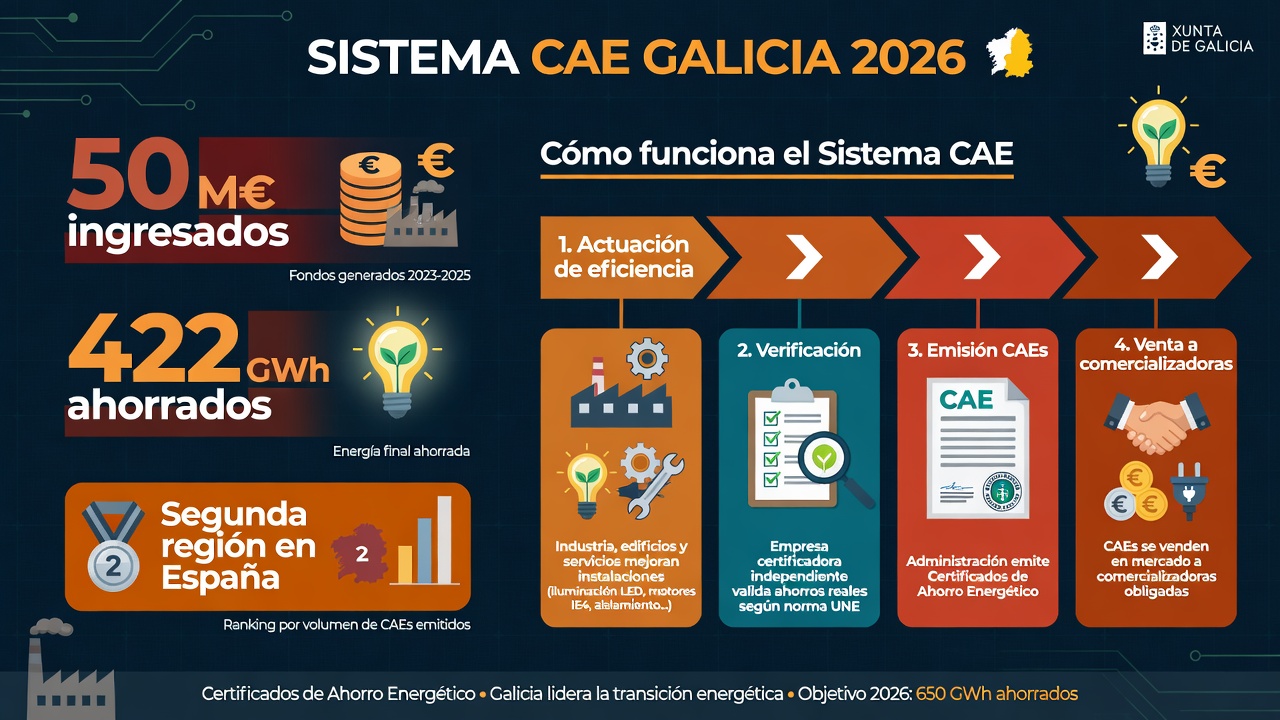
Why Galicia leads the CAE system in Spain
Galicia is now Spain's second region in terms of certified energy savings via CAEs. We've accumulated 422 GWh in savings and 67 certified projects through 2024. In the first three months of 2025 alone, we registered 93 projects with 470 GWh in savings. Growth is accelerating.
Three reasons explain Galicia's strong position:
- Inega (Galicia Energy Institute) has been very active promoting the system among Galician industry. They've organized workshops, webinars, and run a responsive support desk compared to other regions.
- Our industrial base (textiles, metals, automotive, food) runs energy-intensive processes, so efficiency projects deliver substantial savings—and therefore generate many CAEs.
- Collaboration culture between the Regional Government, the Galician Renewable Energy Cluster, and business confederations has helped the message reach SMBs.
If you run an industrial SMB in Ourense, A Coruña, Lugo, or Pontevedra, this directly affects you.
How the CAE system works (without the headache)
The process has several steps, but it's not as complicated as it sounds. Here's how:
1. You identify an efficiency measure
It could be LED lighting upgrades, insulation improvements, equipment replacement, monitoring systems, process electrification, heat recovery, or any measure that measurably reduces energy consumption.
2. You carry out the measure (or plan to)
Here's the good news: measures implemented after January 26, 2023 are already eligible. So if you did something a year ago and didn't certify it, you still have time.
3. An accredited verifier certifies your savings
You need an entity accredited by the Spanish Accreditation Body to review that the measure was completed, the documentation is correct, and the claimed savings are real. They'll give you a favorable verification report.
4. You request CAE issuance
Through the CAE System's electronic platform (managed by Inega in Galicia), you request certificate issuance. Inega reviews your file and issues the corresponding CAEs.
5. You sell the CAEs on the market
This is where you monetize. Electricity and gas suppliers ("obligated parties") buy CAEs because they're legally required to demonstrate annual energy savings. Prices fluctuate, but Galician deals have closed for tens of thousands of euros on mid-size industrial projects.
Which industrial projects generate the most revenue
Not all energy efficiency projects generate the same number of CAEs. Here are the ones that work best for industry:
The key is that the savings must be measurable. Without proof of savings, there are no CAEs. That's why pre- and post-installation monitoring is critical.
What's coming next: EU ETS 2 and your competitive edge
Here's a reason to start exploring CAEs now. Between 2027 and 2028, Europe launches EU ETS Phase 2, an emissions trading system that covers sectors not previously included: basically transport, buildings, and any industry using fossil fuels (gas, diesel, coal).
What does this mean? Starting in 2027, emitting CO₂ will get much more expensive. Companies that have already invested in energy efficiency and electrification will have a massive competitive advantage.
CAEs don't just put money in your pocket today for today's investments—they position you for a regulatory environment where energy efficiency will shift from "good practice" to "economic survival".
At the 2026 Industrial Energy Efficiency conference in Vigo last May, the message was clear: companies betting on consumption optimization and accelerating their technology transformation will be better positioned to gain competitiveness and resilience in the years ahead.
Practical steps for your industrial SMB to start earning CAEs
Sold. Where do you start? Here's a realistic roadmap:
Step 1: Get an energy audit (if you don't have one)
You need to know where energy is being wasted. If you already have an energy audit (required for many companies), review it. If not, hire a consultant to do one. Galicia has good options, some with subsidies.
Step 2: Identify the highest-return projects
Not all efficiency projects are equal. Prioritize those with:
- Short payback periods (less than 3–4 years)
- Easy-to-measure savings (lighting, HVAC)
- Eligibility for additional grants (like 2026 Industrial Innovation programs)
Step 3: Execute the project with a reputable provider
Get measurable data. Have them install metering before and after. Ensure technical documentation is impeccable—the verifier will scrutinize it.
Step 4: Contact a "delegated party" or prepare to sell yourself
CAEs can be requested by the "obligated party" (supplier) or a "delegated party" (a company acting on behalf of whoever made the savings). There are companies in Galicia that handle all the paperwork for a percentage of the sale. If you don't want the hassle, this is the easiest option.
Step 5: Monetize and reinvest
When you sell your CAEs, put that money straight into the next phase of efficiency work. It's a virtuous cycle: save, certify, sell, reinvest.
Mistakes that cost real money
I've seen companies leave thousands in CAE revenue on the table because of preventable mistakes. Don't be one of them:
- Not measuring consumption before and after: Without data, the verifier can't certify. Install meters.
- Doing the work but not keeping records: You need invoices, installation certificates, technical specs, and tons of paperwork. Keep it all.
- Not knowing this exists: Sounds obvious, but many SMBs don't know about CAEs. If you're reading this, you're already ahead.
- Waiting for the system to "get clearer": It's been operating for years and €50M is already in play in Galicia. Don't wait.
How BigLobster can help (no nonsense)
At BigLobster we work with industrial SMBs in Galicia on process automation. Energy efficiency is fundamentally a data problem: you need to measure, monitor, and act on that data.
We can help you with:
- Energy monitoring dashboards: We integrate IoT sensors with visualization systems so you have each production line's consumption in real time.
- Automated verifier reports: Instead of manually collecting data, we automate the gathering and presentation of information verifiers need.
- Energy management system integration: If you already have a system, we connect it to your other infrastructure (ERP, maintenance, etc.) so data flows seamlessly.
We're not energy consultants or accredited verifiers. We're industrial automation specialists who ensure the digital and data side of your efficiency project is airtight.
Have an energy efficiency project in mind?
If your industrial SMB in Galicia is investing (or planning to invest) in energy efficiency, let's talk. We help you set up the data and monitoring system you need to certify and monetize your savings via CAEs.
Talk to BigLobsterFrequently asked questions about CAEs in Galicia
Can a small SMB (under 50 employees) generate CAEs?
Yes. There's no minimum size. What matters is the energy savings achieved. Even a small warehouse with properly sized LED lighting can generate enough CAEs to make the process worthwhile.
How long does the whole process take?
From completing the measure to selling the CAEs, expect 6 to 12 months. The longest part is usually verification and certificate issuance by Inega.
What if I switch electricity suppliers after generating CAEs?
No problem. The CAEs are yours and you can sell them to any obligated party (any supplier). You can even run an auction and sell to the highest bidder.
Do CAEs count as taxable income?
Yes, they're considered revenue. But you can also deduct costs associated with the investment. Talk to your tax advisor—there are nuances.