
Why this affects you even if you've never heard of it
Let me be direct: industry consumes around 25% of final energy in this country, according to IDAE. With energy prices the way they are, that's not just an environmental problem—it's a hole in your bottom line every month. Brussels gets it and has stopped asking nicely.
The Directive (EU) 2023/1791, the revision of the Energy Efficiency Directive, put something in Article 11 that used to be a recommendation and is now mandatory for certain companies. And note, it doesn't just target big utilities—it targets industrial SMBs that consume enough. The problem is almost nobody in Spanish industrial zones has noticed yet.
I'm not going to sell you sustainability marketing. This is money: a proper audit pays for the electricity bill you shouldn't be paying. And if it's subsidized, not doing it is leaving cash on the table.
The thresholds that determine if this applies to you
Here's the key, and where most people get it wrong. The obligation is based not on revenue or headcount, but on total annual energy consumption. There are two tiers:
| Annual consumption | What the law requires | Deadline |
|---|---|---|
| Over 10 TJ (≈ 2.78 GWh) |
Qualified energy audit + action plan in annual report. Repeat at least every 4 years. | First audit before Oct 11, 2026 |
| Over 85 TJ (≈ 23.6 GWh) |
Certified energy management system (e.g., ISO 50001) by independent body. | Certification before Oct 11, 2027 |
Does 2.78 GWh sound like a lot? It's not. A facility with 300 kW average power running near capacity all year uses around 2.6 GWh. A workshop with furnaces, a dryer, large compressors, or multiple refrigeration lines surpasses it without effort. If you're unsure, grab your electricity and gas bills from the last 12 months and add up the kWh: if you're over roughly 2.78 million kWh, this article is for you.
There is an exit: if you already have a certified environmental management system (ISO 14001 or EMAS) that includes an energy audit meeting the Directive's criteria, you may be exempt. But watch out—it has to meet what the standard demands, not just any old paper.
The fast track: the qualified audit
If you're in the >10 TJ bracket, you don't need certification yet. What the law demands is a qualified energy audit conducted under UNE-EN 16247-1, backed by an action plan.
In practice, a technician enters your facility, measures where energy really goes (compressors, climate control, process, lighting), and tells you which changes make sense. The cheap stuff that pays for itself: wrong schedules, badly set set-points, compressed air leaks, old motors. That alone typically cuts consumption by 3–8% in year one with almost no investment, according to data from ISO 50001-type energy management systems.
The action plan must appear in your annual report and be updated. That means: don't do it, file it, and forget it. The Directive wants to see progress.
The serious path: an energy management system (ISO 50001)
If you exceed 85 TJ, or if you simply want to stop playing roulette with your energy bill, the real answer is ISO 50001. It's the international standard for building an energy management system: you measure, establish a baseline, set targets, act, and review. Classic PDCA cycle, but applied to your lights and heating.
The current version is ISO 50001:2018, confirmed in 2024, and since Amendment 1:2024 includes climate change considerations. Don't let the paperwork intimidate you: what really matters is the habit of treating consumption as a process you can improve, not a fixed cost to endure.
An industrial SMB using 1–5 GWh annually might see total cost (meters and monitoring software + consulting + certification) between €25,000 and €70,000, per the Energy Savings Certificate (CAE IND100) catalog. That sounds like a lot. But read on, because a significant chunk doesn't come out of your pocket. How to turn those savings into revenue: energy efficiency certificates in Galicia.
"Energy is one of the few things you pay religiously every month and rarely question whether you're spending it well. An audit is just stopping payment for the part you don't need."
Industrial team, BigLobsterWhat it costs and how not to pay all of it yourself
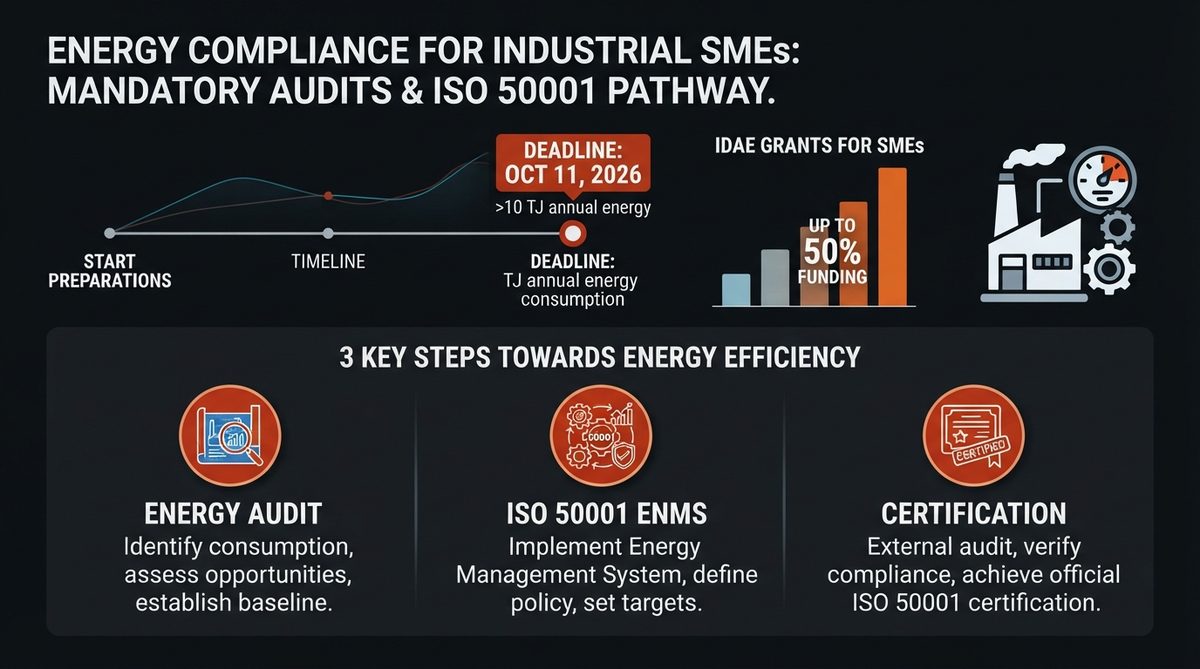
This is the part you should care about most. IDAE has opened for 2026 a program with €300 million from the National Energy Efficiency Fund for energy efficiency measures in industrial SMBs and large enterprises. For implementing ISO 50001-type energy management systems, grants reach 50% for SMBs (40% for large enterprises).
Also, in Spain Royal Decree 56/2016 already mandated energy audits for large companies and those exceeding certain consumption thresholds. The Directive's transposition updates and brings forward the deadline. Don't wait to be told: authorities don't call at the door to warn you before they fine you.
What you actually save
I'm not talking about lab-bench savings. An SMB implementing an energy management system and tackling the cheap stuff (schedules, set-points, leaks, variable frequency drives) typically sees 3–8% less consumption in year one. On a €100,000 annual bill, that's €3,000–8,000 staying in your account. With the subsidy, implementation pays back quickly.
The timeline you can't ignore
Here it is in case you want to print it for your office fridge:
- Before October 11, 2026: first qualified energy audit if you consume over 10 TJ. Then repeat at least every 4 years.
- Before October 11, 2027: certified energy management system (ISO 50001) if you consume over 85 TJ.
- Every year: the efficiency action plan must appear in your annual report and show progress.
Don't rely on "I'll look into it in September." Technicians who do good qualified audits will be swamped in autumn 2026 and prices will jump. If you move now, you choose and negotiate calmly.
How to start without losing your mind
You don't need to create internal chaos. Four real steps:
Get your consumption numbers
Electricity and gas bills for the last 12 months. Add up the kWh. If you're over 2.78 million, keep reading. If not, relax, but an audit would still save you money.
Talk to a technician who knows UNE-EN 16247-1
Your cousin-in-law with a light meter doesn't cut it. Look for engineering or consulting firms that do qualified energy audits and ask if they know about IDAE grants. If they look confused, wrong place.
Ask about the subsidy before you sign
The 2026 IDAE program covers up to 50% for SMBs. Many consulting firms help you apply. Don't let the grant become an afterthought.
Get everything in writing with an action plan
An audit does little good if you don't act on it. Prioritize what pays for itself and document. In four years you repeat, and if it's measured, the next one is a breeze.
And if you want to go all in, ISO 50001 gives you a structure so this isn't a one-quarter effect but a habit. For a mid-sized industrial SMB, with grants on top, the math usually favors you.
Frequently asked questions
How do I know if I consume over 10 TJ annually?
Add up your facilities' electricity and gas consumption (and other fuels) for the last 12 months in kWh. 10 TJ equals roughly 2.78 million kWh. A typical facility with compressors, refrigeration, or thermal processes easily exceeds it. If you spend over €300,000–400,000 annually on energy, you almost certainly do.
Can I do the audit myself with my data?
Not if it needs to count as "qualified" under the law. The Directive requires compliance with UNE-EN 16247-1 and qualified personnel. You can prepare all the information yourself (bills, plans, processes) to reduce the technician's work, but the diagnosis and action plan must come from someone meeting the standard.
Do I get an exemption if I already have ISO 14001?
Maybe, but only if your certified environmental management system includes an energy audit meeting the Directive's criteria. Not all ISO 14001s include that. Get confirmation from your auditor; don't assume.
What happens if I do nothing?
The obligation comes from the European Directive and its Spanish transposition (RD 56/2016 and its development). Missing the audit deadline puts you out of compliance and exposed to consequences set by the national authority. Plus, you keep leaving on the table the savings the audit would identify. Bad business both ways.
How do I apply for the IDAE grant?
The €300M program for 2026 is managed by regional governments and partner bodies. Grants for ISO 50001 implementation reach 50% for SMBs. Typically you submit the project before executing and justify afterward. Check with your regional government or the consulting firm you choose; they usually handle the paperwork.
Not sure if this applies to you?
Tell us your consumption and sector. We'll say whether the October 2026 deadline applies, which path makes sense, and how to leverage the IDAE grant. No jargon, plain language.
Talk to BigLobster →