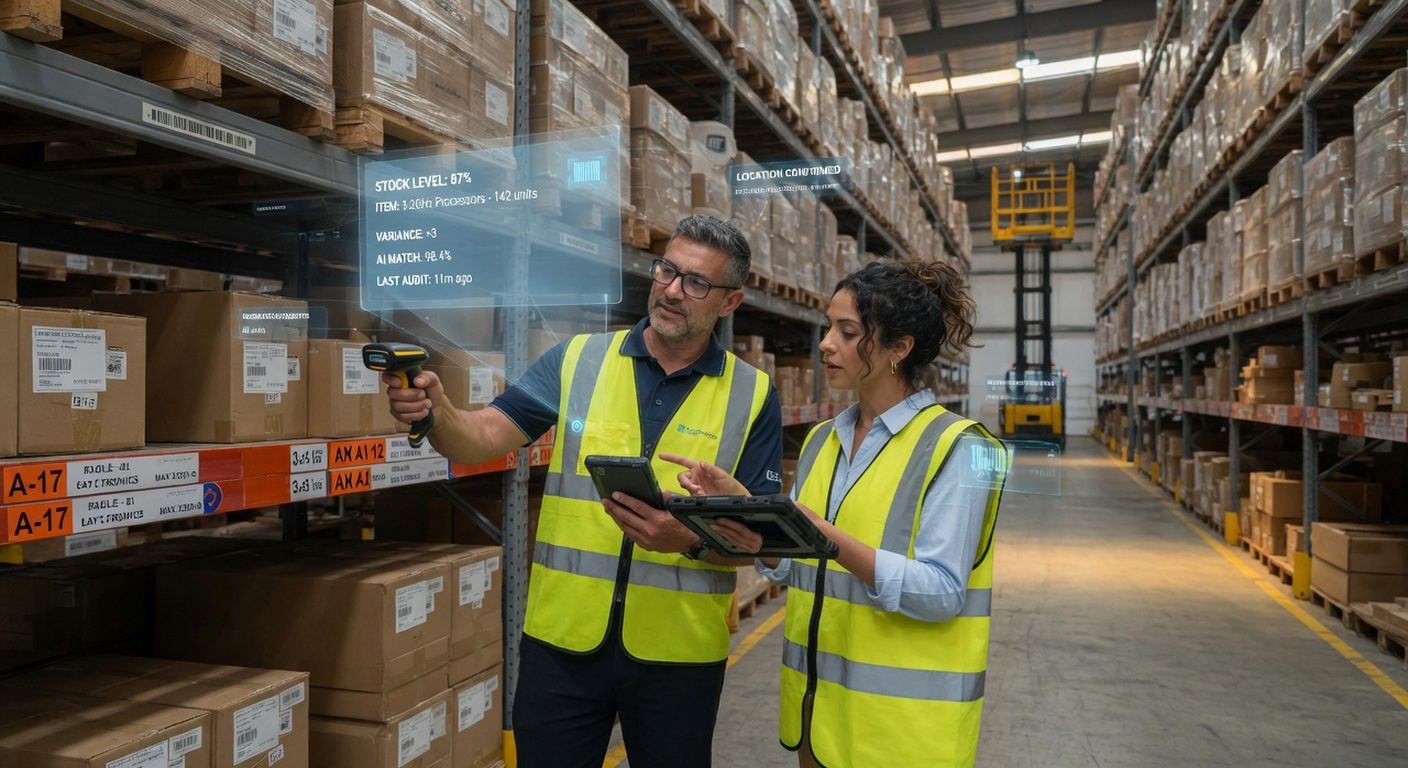
The warehouse is the last undigitized corner of the industrial SMB
Think about it for a second. You invoice digitally because VeriFactu gives you no choice. You log hours digitally because the law demands it. You might even have a decent ERP. But your warehouse? Paper, radios, the manager's memory, and an Excel file only one person understands.
You're not alone. Warehouse management remains the area where most Spanish industrial firms still run manual processes. And it shows: orders shipped incomplete, annual inventory counts that shut the plant for two days, material that "surfaces" six months later on the wrong shelf, and production lines idle because nobody knew there were two more boxes of that component.
Each mistake costs. A botched shipment to an industrial customer isn't just the return cost: it's a supplier qualification penalty, sometimes losing the account entirely. If you work in automotive, food, or pharma, you know what I mean.
What a WMS actually does (and what your ERP doesn't)
This is where the confusion usually starts. "I already track stock in my ERP — why do I need another system?" Because they're different things.
Your ERP knows you have 340 units of SKU X. That's the accounting stock. What it doesn't know is that 200 are in bin B-12, 100 are in receiving waiting to be placed since Tuesday, and 40 are in quarantine because the batch arrived with an incomplete cert. That's the physical stock, and that's what a WMS controls.
In practice, a WMS for an industrial SMB covers:
- Receiving with QC: You scan goods on arrival, spot problems at the dock, not three weeks later.
- Smart placement: The system decides where each pallet goes based on turnover, weight, and expiry. No more "ask Manolo".
- Real-time inventory: Cycle counts without stopping operations. Your two-day annual count disappears.
- Guided picking: The terminal tells the operator what to grab, where, and in what order. Fewer steps, fewer errors.
- Batch traceability: Which raw material batch ended up in which customer shipment. If you're in food or supply IFS/BRC auditors, this isn't optional — they ask for traceability going backward in under 4 hours.
- Shipping and carrier integration: Carrier labels generated in seconds, integration with logistics partners.
If your warehouse has 200 SKUs, slow turnover, and two people, the ERP module probably works. If you move batches, expiries, multiple docks, or picking became the bottleneck, you need a WMS. There's no middle ground that stays sustainable.
What a WMS costs in Spain in 2026: real numbers
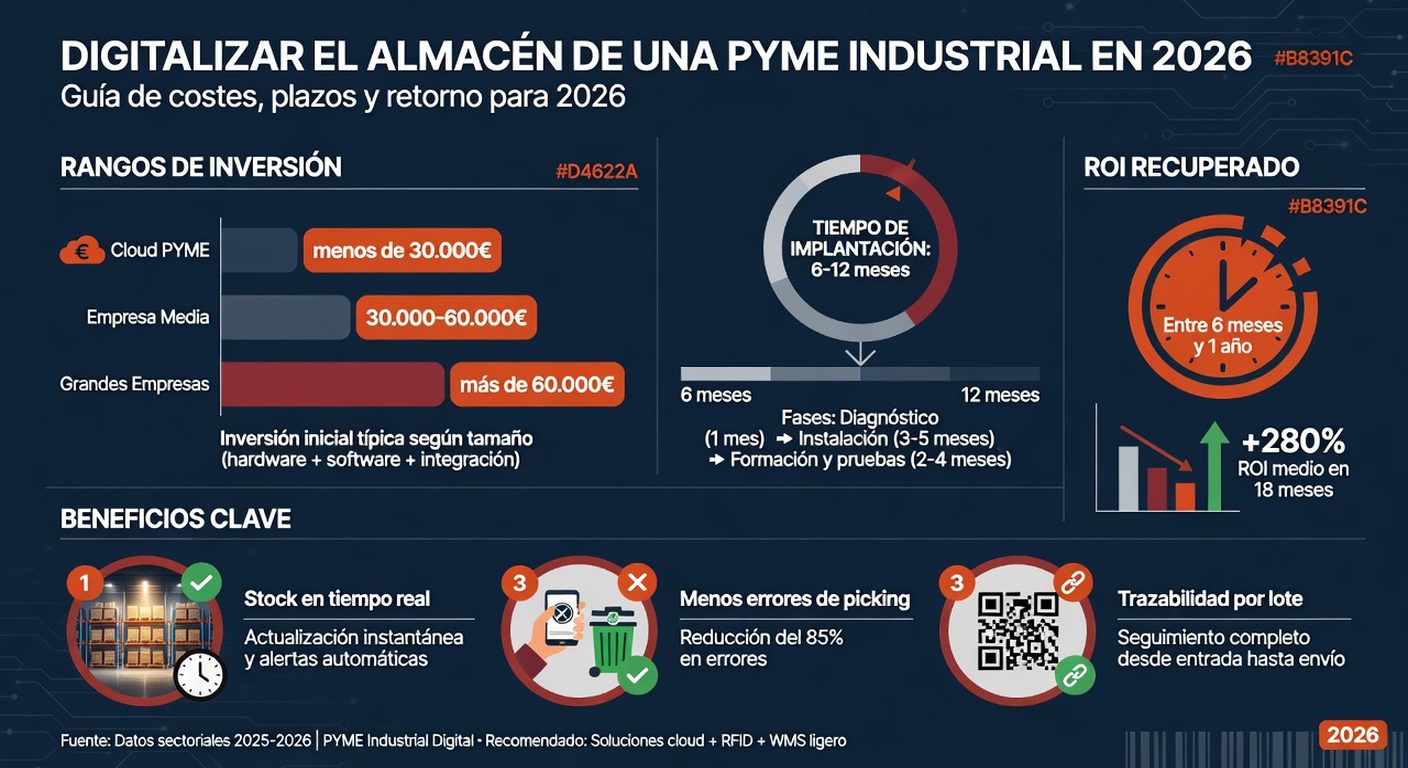
Let's get to the point — this is what you came for. Per Cronomía's survey of Spanish companies who've already gone through it, implementation investment breaks down like this: 27% managed it for under €30,000 (almost always cloud), 38% spent between €30,001 and €60,000, and 31% spent €60,001 to €100,000. Projects pushing six figures are large or automated warehouses — probably not you.
| Scenario | Typical investment | Right for |
|---|---|---|
| Cloud WMS (SaaS) | €50–200/user/month + project from ~€10,000 | SMBs with standard warehouse, no automation |
| Mid-size implementation | €30,000 – €60,000 | Growing companies, ERP integration, RF terminals |
| Large project | €60,000 – €100,000+ | Automated warehouses, multi-site, high pallet volume |
One red flag from that survey: 96% of companies couldn't say what their WMS costs them to maintain annually. They signed without asking. Don't make that mistake: demand a breakdown of support fees, updates, and cost per additional user before you sign anything.
And the return? Here's the good part: 100% of surveyed companies recovered their investment within 6 months to 1 year. It's not magic. It's that picking errors, hours wasted hunting material, and inventory cycles that halt the plant cost more than people realize when nobody measures them.
Real timelines (the demos won't tell you this)
I won't sugarcoat it: this doesn't go live in a weekend. 73% of projects in Spain take 6 months to a year to be fully operational. Lightweight SaaS solutions brag about 4–6 week deployments, and that's true for simple operations, but most of the time doesn't go into software installation.
It goes into three things: integration with your ERP (having the WMS and ERP talk properly is 80% of project success), data cleanup (duplicate SKUs, bin locations that don't exist, phantom stock), and team training. If your operators have done paper for 15 years, switching to RF terminals needs real support, not a PDF manual.
Instead of trying to flip everything at once, go in phases: receiving and placement first, then picking, then shipping. Each phase shows wins and your team buys in instead of sabotaging the system by reverting to paper "because it's faster".
5 signs your warehouse can't survive on Excel any longer
How do you know if this is your year or if you can wait? These are the signals we see over and over:
- Accounting stock and physical stock never match. If variance runs consistently above 2–3%, you're buying material you already have and stopping production for material you think you have.
- Only one person knows where everything is. When the manager goes on vacation, warehouse productivity tanks. That's not a team — that's a risk.
- Picking errors reach customers. A B2B industrial pick error rate above 1% is dynamite for your supplier qualifications.
- A customer or auditor asked for traceability and you sweated. If reconstructing a batch's journey takes days instead of minutes, a serious request (IFS, BRC, a food safety alert) leaves you exposed.
- You're growing. 45% of companies deploying a WMS did so because expansion broke the manual system. Better to digitalize before it collapses than after.
If you nodded yes to two or more, you're already behind. And we're not just pushing — every month you delay costs picking errors, hours hunting material, and locked-up stock you're paying for even though it doesn't show on an invoice.
How to make it cheaper: digital vouchers and Galician grants
Good news if you're an SMB: you don't have to pay for it all yourself. Warehouse and inventory digitalization fits several active funding lines in 2026, from the Digital Kit program (process management category) to regional industry digitalization grants from Igape in Galicia.
We've written in detail about digital transformation grants in Galicia and about the Digital Kit consulting program. The smart move is sizing your WMS project with the grant calls in front of you, not applying for aid after you've signed.
One more note: if your sector is food and beverage, a WMS isn't just efficiency — it's compliance. EU traceability rules (Regulation 178/2002 and the IFS/BRC protocols large retailers demand) increasingly require digital records recoverable in hours. Paper doesn't cut it in a serious audit anymore.
Frequently asked questions
How much does a WMS cost to implement in an industrial SMB in 2026?
Per Cronomía, 27% of Spanish companies implemented one for under €30,000 (usually cloud), 38% spent €30,001–€60,000, and 31% spent €60,001–€100,000. In SaaS, licensing starts around €50–200 per user per month, plus implementation and ERP integration.
What's the difference between a WMS and my ERP's warehouse module?
Your ERP tracks accounting stock: how many units you have on paper. A WMS manages physical movement in real time: which bin holds each batch, what route the picker takes, what ships from each dock. For simple operations the ERP works; with batches, expiries, or high volume, you need a WMS.
How long to recoup the investment?
100% of companies in Cronomía's survey recouped their investment within 6 months to 1 year. Savings come from fewer picking errors, inventory counts without halting operations, and fewer hours of workers hunting for material.
Can I start smaller than a full WMS?
Yes. For small warehouses, digitizing just receiving and inventory with barcode readers connected to your ERP cuts errors significantly. That's a reasonable first phase, as long as you pick tools that can grow toward a full WMS later without redoing the work.
Does a WMS help me meet traceability demands from customers?
It's the natural tool for it. IFS and BRC protocols require proving batch traceability backward in under 4 hours during audit. Paper records are nearly impossible; a WMS does it in seconds.
Is your warehouse still running on paper and memory?
BigLobster helps Galician industrial SMBs digitalize operations without pharaonic projects: honest diagnosis, short phases, measurable results. Tell us how your warehouse works and we'll say whether a WMS makes sense or something lighter would do.
Talk to us →