
Why this decision defines the next 5 years of your company
If your industrial SMB still runs on Excel for stock, separate accounting software for invoices, and WhatsApp for customer orders, I have bad news: that doesn't scale. According to 2026 Eurostat data, 60.38% of Spanish companies with more than 10 employees already use an ERP system. Spain ranks third in the EU for adoption, behind only Denmark and Belgium.
But the statistic hides a trap. Spain's national statistics institute reveals that only 23% of SMBs with fewer than 10 employees have adopted an integrated digital management system. And according to the Gigas-Ipsos Digitalization Barometer, barely 9% of Spanish SMBs reach solid digitalization. In other words: most small companies know they need an ERP, but don't know which to choose and keep postponing. Another year on Excel.
Picking the wrong ERP is expensive. Picking the right one is one of the best investments you can make. Let's go through each option.
Odoo — the modular ERP that grows with you
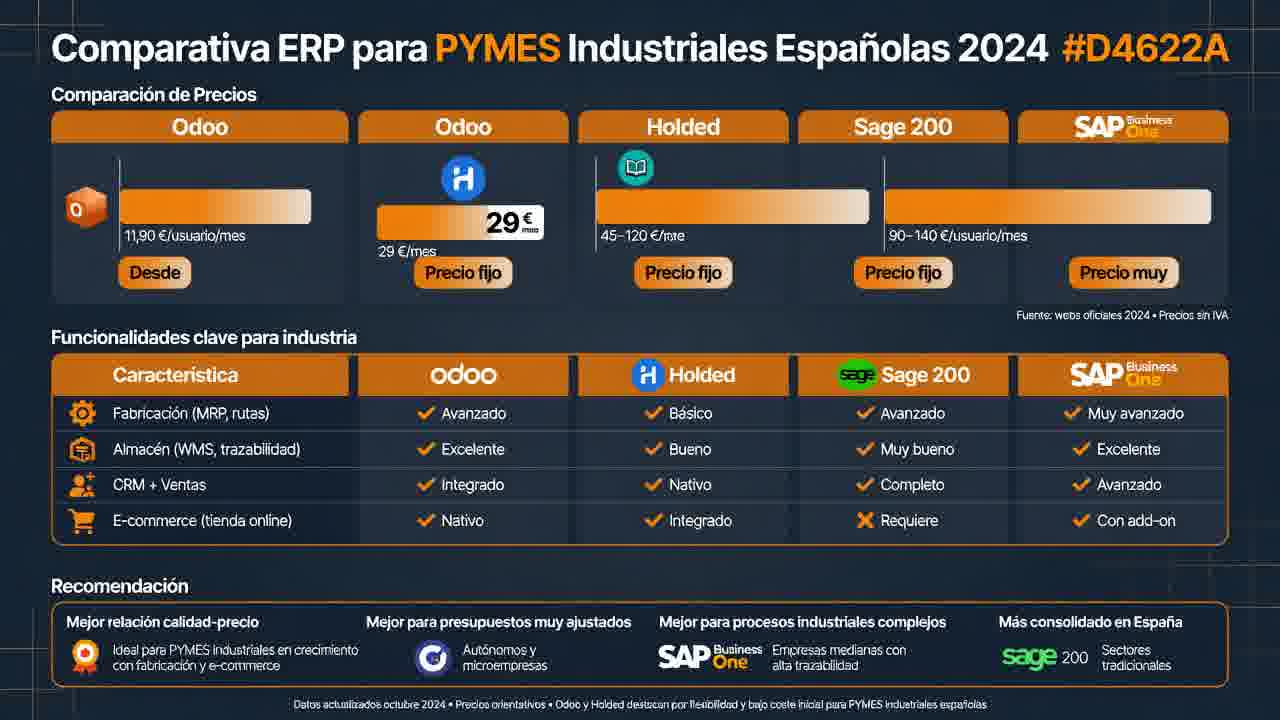
Price: Standard from €11.90/user/month (first year), then €14.90. Custom from €17.90/user/month (first year), then €22.40. SaaS from €24.90/user/month with hosting included.
Odoo is Spain's fastest-growing ERP, and for a simple reason: you get 82 native modules (CRM, sales, purchasing, inventory, manufacturing, accounting, HR, e-commerce, projects, marketing …) at a per-user price that includes everything. You don't pay extra to enable manufacturing or inventory — it's included from day one in the Standard plan.
For an industrial SMB with manufacturing, Odoo is probably the most balanced option on the market. It has a complete MRP module (bill of materials, manufacturing orders, production routes, quality control), warehouse management with locations, batches, and serial numbers, and mandatory traceability for sectors like food or industrial components.
The catch: implementation is complex. Odoo isn't plug-and-play like Holded. You need a certified partner. For a 20–30 person SMB, implementation costs €5,000–30,000 and takes 6–12 weeks. If you underestimate this, the project can derail.
"Most Odoo failures aren't the software's fault — they're from companies that tried to implement without a partner, without planning data migration, and without training their team."
Certified Odoo Partner, quoted in ERP InspectorBest for: Industrial SMBs with 10–200 employees with manufacturing, complex warehousing, or personalization needs. Companies that are growing and don't want to change systems in 3 years.
Not for you if: You're a small services company without complex processes. Odoo will be overkill and implementation will cost more than you need.
Holded — the simple option for service companies
Price: From €29/month (Basic plan, up to 2 users) to €199/month (Advanced, unlimited users). No significant implementation cost. Manufacturing add-on: +€25/month.
Holded is the Spanish ERP that's won over thousands of service SMBs for one reason: you're invoicing on day one. The interface is clean, modern, and onboarding takes days, not months. Plus it's built for Spanish regulations from the ground up: Verifactu, form 347, electronic invoicing all included without weird configurations.
Where's the limit? Holded covers invoicing, accounting, basic CRM, projects, and simple inventory well. But it has no real manufacturing module (the add-on is very basic), doesn't manage warehouses with locations, doesn't handle batch traceability, and doesn't scale well once you exceed 50 employees or need complex processes.
The flat-rate pricing model (you pay per company, not per user) is especially appealing for teams of 5–30 people. For 20 users, Holded Advanced at €199/month costs much less than Odoo (€238/month for 20 users). But if you need features Holded doesn't have, you'll patch with external integrations that rack up costs.
Best for: Service SMBs (consultancies, agencies, law firms), simple retail, and companies of 5–30 employees without manufacturing or complex warehousing.
Not for you if: You have manufacturing, advanced inventory management, multiple warehouses, or plan to grow above 50 employees in the next few years.
Sage 200 — the longtime classic
Price: From €45/user/month (Sage 50) to €80–120/user/month (Sage 200). Implementation: €10,000–25,000.
Sage is the ERP that's been on the Spanish market for decades, especially in traditional companies and accounting firms. Its strength is accounting and tax solidity: if your accounting firm works with Sage, integration is immediate. Compliance with Verifactu, electronic invoicing, and Spanish tax models is excellent.
Where does it limp? Sage 200 covers finance, sales, purchasing, and inventory, but lacks Odoo's breadth (no native e-commerce, no marketing, no depth in manufacturing). Plus the interface feels dated: not as modern or intuitive as Holded or Odoo. Another downside: in Sage 200 you pay per module, not all-inclusive like Odoo.
Best for: Traditional companies already working with an accounting firm that uses Sage. Businesses that prioritize tax stability over functional innovation.
Not for you if: You want integrated e-commerce, need advanced manufacturing, or want a modern interface your employees will adopt without resistance.
SAP Business One — for when you need industrial power
Price: From €90/user/month. Implementation: €30,000–150,000. Timelines: 6–18 months.
SAP Business One is the ERP for companies that already know their operations are complex and don't mind paying for a system that handles anything. Its strength is solid manufacturing, logistics, traceability, and multi-company setup: if you have multiple plants, multiple divisions, or need to meet major customer quality standards (automotive, pharma, food), SAP B1 offers guarantees others don't.
But be honest: SAP is expensive, slow to implement, and requires technical expertise (ABAP or SDK) to customize. If your company invoices less than €5 million a year, Odoo or Sage will likely give you what you need for much less money. The unwritten rule: SAP for >100 employees or >€10M revenue.
Best for: Midsize industrial companies with very complex processes, multiple locations, or needing to meet major-customer standards. Companies already in the corporate SAP ecosystem.
Not for you if: Your revenue is below €5M and you don't have forced integrations with SAP-using clients. The cost-to-benefit ratio doesn't work.
Quick comparison: summary table
| Feature | Odoo | Holded | Sage 200 | SAP B1 |
|---|---|---|---|---|
| License price | €11.90–37.40/user/month | €29–199/month (company plan) | €45–120/user/month | €90–140/user/month |
| Implementation | €5,000–30,000 | €0 (DIY) | €10,000–25,000 | €30,000–150,000 |
| Time to launch | 6–12 weeks | 2–7 days | 4–12 weeks | 6–18 months |
| Manufacturing/MRP | Yes (complete) | Basic (add-on) | Partial | Yes (complete) |
| Multi-location warehouse | Yes (advanced) | Basic | Medium | Yes (advanced) |
| Traceability (batches/serials) | Yes | No | Yes | Yes |
| Native CRM | Yes (powerful) | Yes (basic) | Basic | Yes (integrated) |
| Built-in e-commerce | Yes | External integrations | No | Limited |
| Verifactu/SII | Via localization module | Native | Native | Via partner |
| Scalability | High | Medium (up to ~50 employees) | Medium-high | Very high |
| Open source | Yes (Community free) | No (closed SaaS) | No | No |
Total cost over 3 years: what you actually pay
The table above shows license prices, but the real ERP cost is licenses plus implementation plus maintenance plus training plus, and this hurts the most, the cost of switching if you chose wrong. Let's look at a concrete example:
Industrial SMB of 20 employees needing invoicing, purchasing, inventory, and basic manufacturing:
| Item | Holded Advanced | Odoo Standard | Sage 200 |
|---|---|---|---|
| Licenses (3 years) | €7,164 | €10,728 | €32,400 |
| Implementation | €0 | €15,000 | €18,000 |
| Maintenance/support (3 years) | Included | €3,600 | €5,400 |
| Total 3-year cost | €7,164 | €29,328 | €55,800 |
| Average annual cost | €2,388 | €9,776 | €18,600 |
Does this mean Holded is always better? No. Holded has no real manufacturing or traceability. If your industrial SMB needs MRP or batch management, that Holded cost is imaginary because it doesn't deliver what you need. That's where Odoo becomes the most balanced option. And if your processes are very complex or you work for clients that require SAP, neither Holded nor Odoo works.
Quick guide: which ERP for your profile
You're a service SMB (consultancy, agency, law firm)
No inventory, no manufacturing, no warehouse. You want to launch fast and keep it simple. Holded is your pick. You're up and running in days, you pay a flat rate, and you're done.
You're an industrial SMB with manufacturing and warehousing
You need MRP, bill of materials, quality control, traceability, and multi-location management. Odoo gives you all that at a price no competitor matches. But budget the implementation with a serious partner. Don't try to do it yourself.
Your accounting firm uses Sage and your processes aren't very complex
If your accountant works with Sage and your operations are standard (invoicing, purchasing, accounting), Sage 200 is a solid, hassle-free choice. Integration with your accountant will be immediate.
You have over 100 employees, multiple plants, or clients demanding SAP
There's no way around it: SAP Business One (or SAP S/4HANA if you're even larger) is what you need. The cost is high but the risk of getting a less robust solution wrong is higher.
You're on a tight budget but need something that works
Odoo Community is free (open source). You can install it on your own server with no license cost. You'll need technical knowledge or someone to hire for setup, but it's the most economical way to start. Another option is ERPNext, also open source, though less popular in Spain.
The 5 most expensive ERP implementation mistakes
I've talked to enough people who've been through this to know where things usually go wrong. Here are the recurring errors:
Mistake 1: Choose by license price without counting implementation
The classic move. You see Odoo at €11.90/user and think you've found a bargain. You sign up directly from the website without a partner. Six months later the system is half-configured, accounting doesn't balance, and your team is frustrated. License price is 20–30% of total cost. Implementation, data migration, and training are the rest.
Mistake 2: Don't define processes before choosing the ERP
If you don't know exactly how your purchasing, sales, or manufacturing process works, any ERP will fit badly. The ERP should adapt to your processes, not the other way around. Before requesting quotes, document how each part of your company works.
Mistake 3: Underestimate data migration
Moving from Excel, old accounting software, or an old ERP to the new system is the most delicate moment. If historical data doesn't migrate correctly, accounting won't balance, customer balances won't match, and inventory appears with wrong quantities. Budget time and money for this.
Mistake 4: Don't involve the team that will use it
You won't be the only one using the ERP. The sales rep, the buyer, the warehouse manager, and the accountant will. If you don't ask them what they need before choosing, adoption will be poor or won't happen. An ERP nobody uses is money down the drain.
Mistake 5: Choose a solution that doesn't scale
You start with Holded because it's cheap and easy. Two years later, once your company has grown and you need manufacturing or multi-warehouse, you realize it doesn't scale. Migration to Odoo or SAP is painful and expensive. Think 5 years ahead, not 5 months ahead.
"40% of companies that switch ERPs do so because they chose wrong the first time. The cost of that forced migration usually exceeds what you would have paid by choosing correctly initially."
ERP SMBs 2026 Report, CódigoNextAlternatives you might not know about
Besides the big four, there are options worth mentioning:
ERPNext (open source, from $10/user/month in the cloud): complete ERP with 20+ modules covering manufacturing, inventory, accounting, and HR. The interface is functional but less polished than Odoo. Spain doesn't have as strong a partner network, but if you have technical staff it's a solid, cheap alternative.
Microsoft Dynamics 365 Business Central (from €59/user/month): Microsoft's ERP play. Its integration with Office 365, Teams, and Power BI is unbeatable. Perfect if you already live in the Microsoft ecosystem. But watch out: implementation is expensive (€12,000–28,000) and per-user cost escalates compared to Odoo.
A3ERP (Wolters Kluwer): very popular in Spanish accounting firms for tax and labor compliance. If regulatory compliance is priority one, it's worth considering. But it falls short in sales management, manufacturing, and e-commerce.
Factusol: the low-cost option for micro-businesses that only need invoicing and basic accounting. Free in its most basic version. When you need more, you know: time to migrate.
Custom software: if your processes are very specific and don't fit any standard ERP, custom development might make sense. You pay once and own the software. The problem is maintenance and updates fall to you. For most SMBs, a well-implemented commercial ERP wins out.
Frequently asked questions
How much does an ERP cost for an industrial SMB in 2026?
Depends on the ERP and number of users: Odoo ranges €11.90–37.40 per user per month; Holded has a flat rate of €29–199/month; Sage 200 costs €45–120 per user per month; SAP Business One costs €90–140. Add implementation: €0 for Holded, €5,000–30,000 for Odoo, €10,000–25,000 for Sage, and €30,000–150,000 for SAP.
What ERP is best for an industrial SMB with manufacturing?
Odoo offers the best value for an industrial SMB with manufacturing. It includes MRP modules (bill of materials, manufacturing orders, quality control), multi-location warehousing, batch and serial number traceability. Holded has no real manufacturing; SAP B1 covers industry but at much higher cost.
How much does ERP implementation cost?
Holded implements in days with no additional cost. Odoo needs a certified partner: €5,000–30,000 for a typical SMB, taking 6–12 weeks. SAP Business One can cost €30,000–150,000 and take 6–18 months. Sage 200 falls in the middle: €10,000–25,000.
What ERP is best for a service SMB without inventory?
For service SMBs (consultancies, agencies, professionals) without inventory or manufacturing, Holded is the most practical: immediate launch, flat pricing, and no implementation cost. Odoo also works but requires more initial setup. Why pay €15,000 to implement when you can have everything ready for €199/month and a couple of days?
Odoo or Holded for a 10-person SMB?
Depends on your business. If it's a service company without stock or manufacturing, Holded (€29–199/month with unlimited users) is cheaper and faster. If you need inventory management, manufacturing, or plan growth, Odoo (€11.90/user/month ≈ €119/month for 10 users on Standard) scales better long-term. The choice is: pay less now or pay less in 3 years.
Can I use Odoo Community for free?
Yes. Odoo Community is open source and free. You can download and install it on your own server with zero license cost. But it doesn't include Enterprise features (like Studio, advanced automation, or some integrations) and the Spanish localization module (Verifactu, tax forms) needs manual maintenance or a partner.
Is it easy to migrate from Holded to Odoo if I outgrow it?
Technically yes: Holded lets you export data as CSV and Odoo imports it. Migration usually costs €1,500–4,000 plus a 4–6 week parallel period. The bigger challenge isn't the technical migration but training your team on a new system. That's why I insist on thinking 5 years ahead when you choose.
Not sure which to pick?
We help you analyze your situation without the sales pitch. We tell you which option fits your company, industry, and budget best. No strings attached, no pressure.
Free consultation →