
Where are your deals disappearing right now?
If you manufacture or sell technical products, this scenario will feel familiar. A salesperson visits a prospect in February. The prospect asks for a quote. Someone builds it in Excel, emails it, and then the fog rolls in: Did they see it? Did they ask for changes? Who else has to sign off? When should we follow up? By the time the order lands—if it lands—it's September, and nobody knows how many similar deals went cold in an email inbox along the way.
The pattern is always the same: sales and operations don't share information, quotes don't connect to orders, and all the knowledge about each account lives in one person's head (and phone). If that person leaves, the customer book walks out the door. It's not an exaggeration—it's the number-one risk for industrial SMBs doing €2–20 million in annual revenue.
Industry data says a well-used CRM lifts sales by roughly 29% and sales productivity by 34%, according to Salesforce. But note the caveat: well-used. And that's exactly where industrial businesses trip up.
Why off-the-shelf CRM ends up neglected
HubSpot, Salesforce, Pipedrive—all excellent tools. For the business they were designed for: short sales cycles, one decision-maker, standardized product. Industrial selling doesn't work that way, which is why so many SMBs end up paying for licenses that their team barely uses.
What breaks a generic CRM in an industrial company:
- Long cycles. Six to 18 months elapse between the first technical visit and the order. Without automated reminders and long-term nurturing, opportunities die of neglect.
- Multiple decision-makers. The engineer who specifies, the buyer who negotiates, the manager who signs. If your CRM only tracks one contact per company, you're flying blind.
- Technical quotes. Budgets with revisions, client-specific terms, volume discounts. That doesn't fit in a text field.
- Distributor networks. If you sell through distributors, you need two layers: the distributor account and the deals that distributor is moving with end customers.
- ERP integration. If your salesperson has to call accounting to check order status or inventory, the CRM becomes an island and gets abandoned.
This doesn't mean you should rule out the big platforms. It means the decision isn't "which CRM should I buy" but "who will adapt it to how I actually sell". A properly configured HubSpot for industrial sales—with multi-stage pipelines and ERP integration—works. An out-of-the-box HubSpot doesn't.
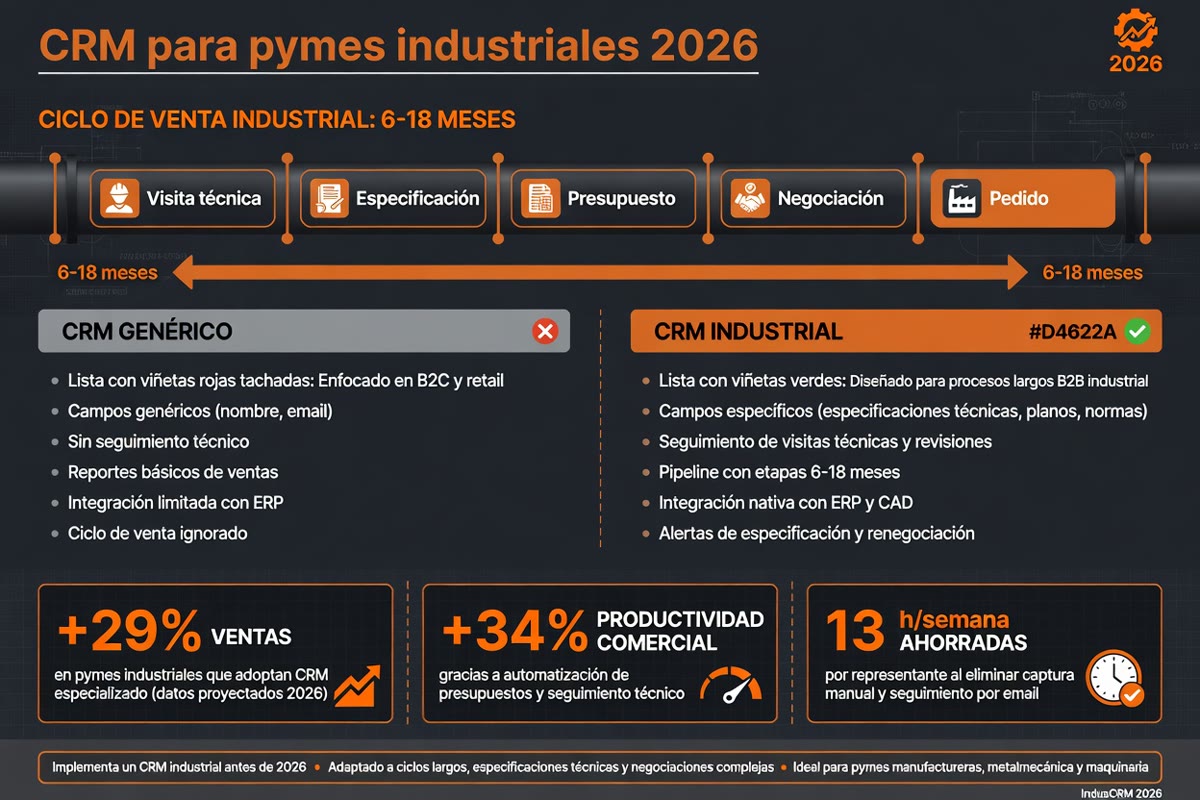
What an industrial CRM must have
Regardless of brand. Before looking at logos, verify the solution covers these five things—they're what separate a CRM that gets used from one that gets abandoned:
Multi-stage pipeline tailored to your process. Technical visit → specification → quote → negotiation → order. With alerts when a deal stalls. If the CRM's pipeline doesn't match your actual sales process, your team will do the work outside the system and the data will rot.
Account card with all decision-makers. Who specifies, who buys, who signs, and the complete history of visits, calls, and quotes. Anyone on your team should be able to open an account and know where it stands in 2 minutes.
ERP integration. This is the most valuable piece. Syncing customers, prices, orders, and inventory eliminates double data entry and gives salespeople real visibility without calling accounting. The big platforms have connectors for SAP, Dynamics 365, Odoo, or Sage; for custom ERPs, it's handled via API. If you're already considering an ERP change, our guide to ERP systems for industrial SMBs will help you navigate it.
Real mobile app. The industrial salesperson lives in a van and on customer floors. If they can't log a visit from their phone in 30 seconds, it doesn't get logged. This also means being able to register WhatsApp Business conversations directly in the CRM, because half the industrial sales in Spain happen on WhatsApp, even if nobody admits it in their annual report.
Automated long-term nurturing. Workflows that keep the relationship alive during months when the prospect "is thinking about it": tech specs, use cases, call reminders. Industrial sales are won through persistence, and persistence is exactly what automation does best.
"Industrial companies manage 6–18 month sales cycles, coordinate sales-engineering teams, and run distributor networks—often without a CRM that pulls all the data into one place."
GrupoCRM, analysis of Digital Kit grants for industrial businesses, 2026What it really costs (and what Digital Kit covers)
Let me be straight: the license fee is the small part. Basic Pipedrive runs €15–30 per user per month; HubSpot Sales Pro is around €90; and there are custom flat-fee options with no per-seat cost. The real money is implementation: setting up your pipeline, migrating data from Excel, integrating your ERP, and training your team usually runs €2,000–15,000 depending on complexity.
The good news is that's exactly what the Digital Kit covers in its Customer Management category: €2,000 for businesses under 10 employees, up to €14,000 for those with 100–250. In 2026 they also added an AI-CRM category that funds opportunity scoring and churn risk detection. If you still have grant money available, this is one of the best ways to use it. We cover how the program works in our guide to Digital Kit and Consulting Kit.
And the payback? Run the math with your numbers: if your average deal is €30,000 and you lose just three deals this year to poor follow-up, that's €90,000 in lost revenue against an investment that costs one-tenth of that. The real question isn't whether you can afford a CRM. It's how many more cold deals you'll lose before you implement one.
How to implement it so it doesn't die in three months
CRM failure isn't usually technical—it's adoption. You buy the tool, run a two-hour training, and three months later only the director is using it. To avoid that, three rules that we've seen work:
First: start with the pipeline, not marketing. No landing pages or mass email in month one. Just deals: get the team seeing all open quotes on a dashboard and receiving follow-up alerts. That's the quick win that creates momentum.
Second: migrate lean and clean. Don't dump ten years of Excel with dead contacts. Load active accounts from the last two years and live opportunities only. A CRM that launches full of garbage launches dead.
Third: one non-negotiable rule: if it's not in the CRM, it doesn't exist. Weekly sales reviews happen on the dashboard, not a parallel Excel file. The moment leadership asks for data from another channel, the CRM is dead even if you're still paying the bill.
And one note for industrial companies: the CRM is one piece of something bigger. If you're digitizing the plant—OEE measurement, predictive maintenance, warehouse management—the principle is the same: systems that talk to each other, data that flows without being entered twice.
Frequently asked questions
What's the difference between an industrial CRM and a generic one?
Generic CRMs handle short sales cycles and single decision-makers. Industrial CRMs manage 6–18 month cycles, multiple contacts per account, versioned quotes, distributors, and ERP integration. That's why many industrial SMBs end up using just 20% of a generalist platform: the other 80% doesn't fit how they actually sell.
How much does CRM implementation cost for an industrial SMB?
Licenses range from free to €90 per user per month depending on the platform. The real cost is implementation: pipeline design, data migration, and ERP integration typically run €2,000–15,000. The Digital Kit covers this category with €2,000–14,000 depending on company size.
Can we integrate the CRM with the ERP we already have?
Yes, and that's the piece that delivers the most value: syncing customers, prices, orders, and inventory eliminates double entry. There are connectors for SAP, Dynamics, Odoo, and Sage; custom ERPs integrate via API. If the CRM doesn't talk to your ERP, your team will stop using it in three months.
How many open quotes do you have right now? If you hesitated, let's talk
We help you choose and implement a CRM that fits how you actually sell: custom pipelines, ERP integration, and automated follow-up. Starting with what moves the needle in month one, not the full feature list.
Organize my sales →