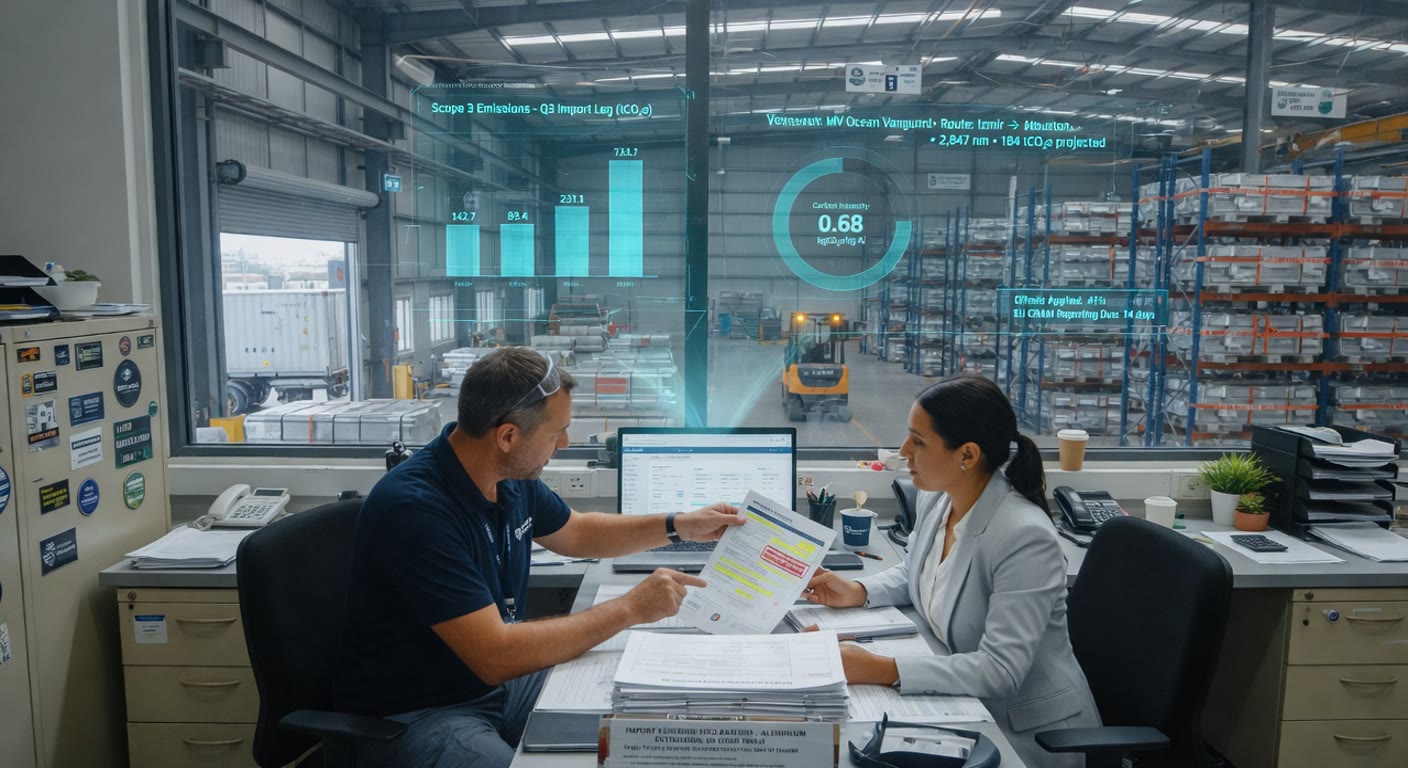
If you buy materials or intermediate products outside the European Union, this matters to you. And I'll be direct: there's a lot of Galician industrial SMBs importing steel profiles, aluminum coils, or sacks of fertilizer who've never heard of CBAM. It's not absent-mindedness — the rule is new, dense, and the administration communicated it poorly at first.
I'll break it down in plain language. No assumption that you're a lawyer or customs officer.
What the heck is CBAM?
CBAM stands for Carbon Border Adjustment Mechanism. In simpler terms: the EU put a tax on carbon emissions in certain products entering from outside. The idea is simple and, honestly, makes sense. Inside the EU, factories pay for CO₂ through the emissions trading system (ETS). If a product made in a country without that cost enters and pays nothing, it competes unfairly with European industry. CBAM levels the playing field: the importer pays for the carbon the foreign manufacturer "saved."
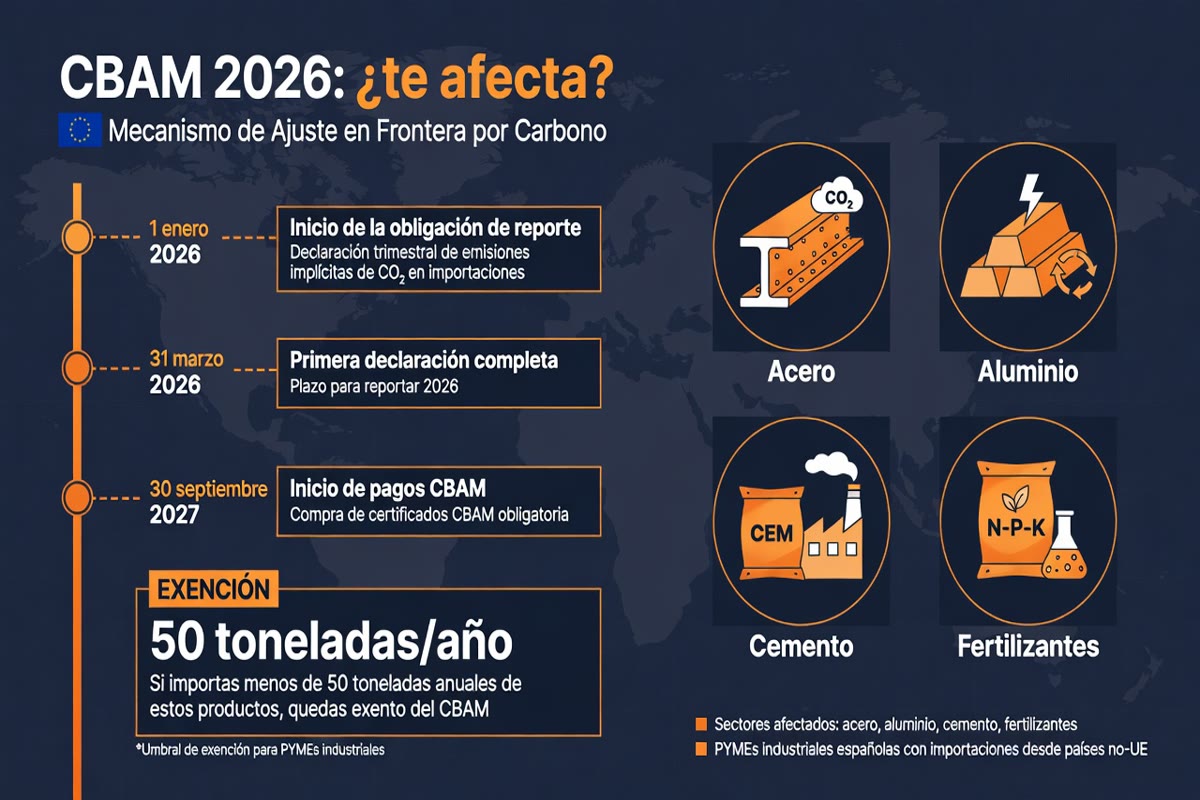
EU Regulation 2023/956 came into force May 16, 2023. There was a transition period for reporting data without paying (October 2023 to December 2025). The permanent period, the one that actually costs money, started January 1, 2026.
I won't sugarcoat it: the good news is the tax is usually lower than people fear. The bad news is the paperwork and the obligation to be "someone authorized" can leave you stranded at customs if you don't move.
Does it affect you? Check these four sectors
CBAM currently only touches certain goods in Annex I of the regulation. The ones that really matter for Galician industrial SMBs are four:
- Iron and steel: profiles, sheets, tubes, wire, fasteners. If you buy metal from Asia or Turkey, pay attention.
- Aluminum: profiles, coils, ingots. Galicia has lots of metal carpentry and component manufacturing that buys imported aluminum.
- Cement: sacks or bulk for construction or prefabs.
- Fertilizers: urea, ammonia, nitrates. Relevant if you're in agro or distribute supplies.
Hydrogen and electricity are also covered, but those rarely apply to a direct-importing Galician SMB, so I won't dwell on them.
How do you check safely? The Spanish Tax Authority already flags affected goods in customs paperwork since October 2023. If you import and see that reference, CBAM touches you. The European Commission also has a self-assessment tool (CBAM Self Assessment Tool) that tells you in minutes if your tariff codes fall in.
The catch with the 50-ton threshold
Here's good news few people know. EU Regulation 2025/2083, which came into effect January 1, 2026, set a single exclusion threshold: if you import a total of less than 50 tons per year of CBAM goods (adding all iron, steel, aluminum, cement, and fertilizer codes together), you're exempt from everything. No authorization, no declaration, no certificates.
Watch for two things. One: the count is per importer per calendar year, summing all those goods together. If you buy 30 tons of steel and 25 of aluminum, you add to 55 and you're in. Two: electricity and hydrogen don't count toward that exemption, so if you import those, the threshold won't save you.
"90% of an SMB's questions boil down to one: did I exceed 50 tons last year? If not, breathe. If yes, get moving."
BigLobster team, after reviewing cases with Galician industrial clientsThe dates you cannot miss
The calendar has three milestones that matter to an SMB:
What happens if you didn't apply for authorization in time? The rule is that from January 1, 2026 only an authorized declarant (or an authorized indirect customs representative) can bring CBAM goods into the EU. Those who filed by March 31, 2026 can keep importing provisionally until the authority approves, with an extension foreseen through September 27, 2026 in certain cases. Those who did nothing are out, and customs will halt your clearance.
The competent authority in Spain is the Ministry for Ecological Transition. The process goes through the EU CBAM Register, not your usual regional office.
What you need to do now (no panic)
If you're inside the mechanism, the real work isn't paying tomorrow — it's collecting data now. The 2027 declaration is based on what you imported in 2026, so the clock is ticking.
1. Get emissions data from your suppliers
For each shipment imported you need implicit emissions: CO₂ tons per product ton. You can use the Commission's default values (simpler, more conservative) or real values verified by an accredited verifier (more work, but usually lower cost if your supplier is efficient). Start now asking foreign suppliers for emissions data per product. If you don't have it by 2027, you'll pay with default values, which aren't usually favorable.
2. Keep clean records of quantities
Note real tons by tariff code and year. Expensive software isn't needed: a well-maintained spreadsheet works to start. The problem comes when October 2027 arrives and nobody knows how much came in January.
3. Decide whether to delegate
As an authorized declarant you can delegate the declaration submission to a third party (customs broker, consultant). You stay responsible, but someone with the machinery lifts the burden. For an Ourense or Vigo SMB that doesn't want to memorize EU regulations, it's the sensible option.
4. Budget for 2027
CBAM certificates are bought and submitted in the annual declaration. Their price tracks the EU ETS market price, which fluctuates. What's certain is the cost depends on implicit emissions in your imports, and using verified real values from an efficient supplier usually beats the default value.
If your company already manages waste and environmental data digitally, you've already covered part of the work: having traceability in order saves the biggest CBAM headache.
Three mistakes that will cost you
I've seen these repeat. Here they are so you don't fall in:
Mistake 1: thinking "it's for the big guys"
The 50-ton threshold protects micro-businesses, but an SMB buying profiles or bulk aluminum easily crosses it without noticing. Don't look at your headcount — look at your tons.
Mistake 2: not asking suppliers for data in time
The Commission's default value is a sledgehammer, not a scalpel: it penalizes those without real values. If you wait until 2027 to ask, your suppliers won't have 2026 records. Ask this month.
Mistake 3: confusing authorization with declaration
They're separate steps. Authorization (becoming a declarant) is the prerequisite to import. The annual declaration is the 2027 payment. Having one doesn't excuse you from the other. I've seen authorized SMBs forget the declaration and get hit with surcharges.
And if your supply chain includes suppliers you yourself approve, keep it in mind: CBAM is another reason to keep suppliers well qualified and documented. A supplier who hands you emissions data without you asking is gold.
Why this matters especially in Galicia
It's not coincidence I mention Galicia and not "generic Spain." Real industrial fabric lives here: metallurgy in A Coruña, aluminum and transformed products, concrete prefabs, agrifood industries buying fertilizer, Ourense industrial parks with dozens of workshops importing steel and aluminum for machining and assembly. Those are exactly Annex I sectors.
Plus Galicia is moving fast on sustainability and ESG criteria. CBAM isn't just a tax: it's a signal where the market heads. Large industrial customers (and Government in tenders) increasingly demand carbon traceability. The SMB with that sorted today will sell easier tomorrow.
I'm not telling you to panic. I'm telling you the company next door, the one that doesn't find out until customs halts a container, will lose production days. Yours doesn't have to.
Frequently asked questions
Does CBAM affect importing SMBs?
Yes, but there's an exemption threshold: if you import a total of less than 50 tons per year of CBAM goods (iron, steel, aluminum, cement, fertilizers), you're exempt from obligations. Above that you need to be an authorized declarant and submit the annual declaration.
Until when can I apply to be an authorized CBAM declarant?
The general deadline to submit applications was March 31, 2026. Those who applied on time can keep importing provisionally until the authority approves, with an extension foreseen through September 27, 2026 in certain cases. Failing to apply in time blocks CBAM goods imports.
When is the first CBAM declaration submitted?
The first annual declaration, covering 2026 imports, must be submitted no later than September 30, 2027 in the EU CBAM Register. It calculates implicit emissions and delivers the corresponding certificates.
What does a CBAM certificate really cost?
There's no fixed price: the certificate tracks EU ETS market prices, which fluctuate. What's sure is cost depends on implicit emissions in your imports, and using verified real values from an efficient supplier usually beats the default value.
Can I delegate the declaration to my customs broker?
Yes. The authorized declarant can delegate submission to a third party acting on their behalf, but you stay responsible for compliance. For many Galician SMBs it's the most practical route.
Want to know if CBAM affects you and get it ready?
At BigLobster we help Galician industrial SMBs digitalize their traceability and prepare the data customs and CBAM will ask for. Without €10k consultant bills: we speak straight and start with what you really need.
Talk to us →