
Where things stand right now, straight talk
Directive (EU) 2023/970 came into force in June 2023 and gave Member States three years to implement it. The deadline closed June 7, 2026. Spain missed it.
In July 2026, the Ministry of Labor circulated a draft decree to business groups and unions that, instead of creating new law, amends the 2020 Royal Decree on Pay Equality. According to sources cited by Spanish business media, the target was September approval via decree—bypassing Parliament.
Why tell you now, before it's in the official gazette? Because the Spanish Supreme Court is already using the directive as an interpretive standard even though it's not formally transposed. And when this regulation lands, most SMBs will discover they've already been in breach for years on the parts that were already in effect.
What already applies to you today (and you probably don't have)
The salary register isn't new. It's been mandatory since 2019 under Article 28.2 of the Workers' Statute. And here's what surprises almost every business owner we talk to:
- It applies starting with the first employee. A self-employed person with a single hire must maintain it.
- It applies even if your entire staff is one gender. Yes, even if it's six men in the shop.
- It includes management and senior staff, not just union-covered positions.
- It covers base salary, supplements (seniority, night shifts, shift premiums), and non-salary benefits like meal allowances or transport bonuses, shown as both mean and median.
Luis Tobajas, spokesperson for the Spanish Labor Inspectors' Union, has repeatedly stated in the press: absence of this register is a sanctionable violation. It's not decorative paperwork—it's the first thing inspectors ask for when they show up.
If you were inspected tomorrow and the salary register didn't exist, the conversation wouldn't start with pay equity. It would start with a citation.
What the transposition draft adds
The proposal modifies Articles 3, 4, 5, and 8 of the 2020 decree. Three changes actually matter for an industrial SMB:
Salary criteria disclosed to all staff. Every company must now make available to employees the objective, neutral criteria used to set pay and salary levels. For companies with 50+ employees, also the criteria for wage progression: how someone moves up a level, what earns them a raise. If at your company that gets decided "depending on how the year goes," you have work to do.
Elimination of wage confidentiality clauses. The draft declares void any contract or union clause that prohibits an employee from discussing what they earn. Many boilerplate contracts in circulation include these. Time to review yours.
Two months to respond, two months to correct. When someone requests in writing their wage level or the average for their role broken down by gender, you have two months to respond in writing. And if an audit finds unjustified pay differences, the correction plan goes into effect within two months. There's no room for delays.
On the 5% threshold: the directive sets it, and according to analysis by the University of Seville's pay equity research group, the Spanish draft seems to absorb comparative pay assessment within the pay audit. In practical terms: any Spanish company with an equal pay plan will end up meeting these requirements, whether there's a 5% gap or not.
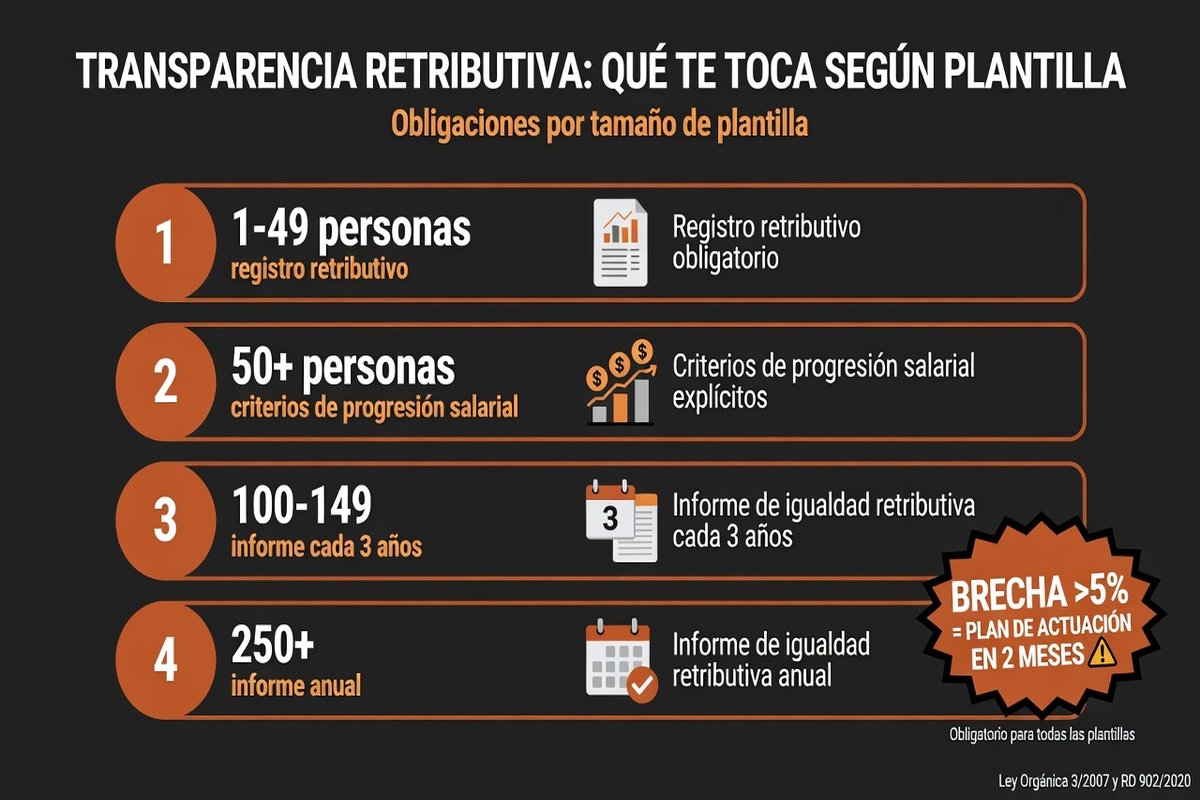
What applies based on your team size
| Headcount | Primary obligation | Key deadline |
|---|---|---|
| 1–49 | Salary register + objective wage-setting criteria | Already in effect (register) / when decree publishes (criteria) |
| 50–99 | Above + wage progression criteria + pay equity plan and audit | When decree publishes |
| 100–149 | Periodic pay gap report every three years | June 2031 (first report) |
| 150–249 | Report every three years | June 2027 |
Companies over 250 employees move to annual reporting with first submission by January 31, 2027, but that's already outside SMB territory.
Watch the 50–99 band. Spanish regulation usually treats 50+ as "mid-market," so it's reasonable to expect EU requirements meant for 100+ might end up lowered to that threshold. If you're at 60 people, don't assume you're exempt.
The real problem isn't legal, it's data
Here's where this stops being an HR compliance issue and becomes a systems issue. Think it through: to comply, you need to cross-reference by person and period the role, job category, gender, base salary, each supplement, and each non-salary benefit. Then calculate means and medians by category.
In most industrial SMBs we see, that data lives in three different places: payroll goes through an accounting firm, hours and shifts are in a shop floor manager's Excel, and travel premiums show up in paper work tickets. Nobody has one unified table.
That's the real work. When information is scattered, each employee request becomes two weeks of someone manually entering data, and each audit becomes a project. When information lives in one system, the register generates in minutes.
No company violates this intentionally. They violate it because extracting the data costs three days of manual work.
What to do now, in order
Don't wait for the official gazette. When it publishes, the adaptation window will be tight—just like with mandatory digital time tracking, where companies had 20 days from publication.
Start with the quick wins and build from there:
- Verify you have a current salary register, including management. If not, this is priority one—you can do it in an afternoon with your accounting firm.
- Review your contracts and remove any clause prohibiting discussion of salary.
- Write down how your company determines wages: what sets a level, what makes someone move up a pay grade. Even if you've never written it down, it exists. Document it now.
- Calculate your pay gap using the 5% standard, not 25%. If a difference appears, document the objective reason now: seniority, qualifications, shift type, responsibility. Written justification is worth far more before an inspection than after.
- Consolidate your data source. Payroll, hours, and bonuses in one system with export capability by role and gender. This is where an SMB saves 90% of recurring effort.
That last point connects to two other regulations rolling out in parallel: mandatory digital time tracking and digital work orders. All three demand the same thing underneath: traceable, exportable data about your workforce. Solving them separately with three different tools is the expensive way.
Frequently asked questions
Do I have to maintain a salary register if I have just one employee?
Yes. Article 28.2 of the Workers' Statute sets no minimum headcount. It applies even to a self-employed person with a single hire, and also when your entire staff is one gender. It must include management and senior staff.
What's the fine for not having one?
Spanish labor law penalties for missing the register can reach €7,500, depending on whether the inspection classifies it as minor, serious, or very serious. The transposition draft currently doesn't toughen penalties—that would require Parliamentary approval.
Do I have to publish individual salaries?
No. Averages and medians are published by role and job category, broken down by gender. When sharing a figure would identify a specific employee's salary—someone other than the person requesting it—the information is only provided to employee representatives.
What if my company has no employee representatives?
That's true for most small SMBs, and it's one question the draft leaves poorly resolved. Until clarified, the prudent approach is to have wage criteria documented and accessible to all staff, and respond in writing to individual requests within the two-month window.
When does it take effect exactly?
No firm date. The text was under negotiation with stakeholders in July 2026, targeting September approval. What's already in effect today, no waiting required: the salary register and the 2020 Royal Decree in its current form.
Does your staffing data live across four different spreadsheets?
We build the system that unifies payroll, time tracking, and bonuses so that salary registers, timesheets, and work orders generate automatically. No six-month projects.
Tell us your situation →