
The number that should worry you: 76% use AI, 8% control it
Picture this: your top sales rep has spent the last three months writing prospecting emails with ChatGPT. They've mastered the prompts, closed more deals because of it. Sounds good, right?
Now imagine what you're not seeing. In one email they accidentally pasted your VIP discount structure—the one only your premium clients see. Another day they copied a full customer conversation so the AI could summarize key points before a meeting. Real names, real numbers, real deal terms, all pasted into a public chat.
That's shadow AI. According to Wolters Kluwer and BBVA Research (2026), it's not an edge case—it's the reality of 76% of Spanish SMBs whose teams use AI weekly, versus the mere 8% running AI through a proper corporate system.
That 68-point gap isn't a statistical footnote. It's the distance between having productive employees who play with prompts on their own time and running a business that deploys AI safely, with audit trails, and legally.
What shadow AI actually is (and what it isn't)
The term borrows from shadow IT: employees adopting software without IT approval. AI amplifies the problem because tools like ChatGPT, Gemini, and Claude are one click away, free, and need no installation.
Shadow AI includes:
- The sales rep pasting customer deal terms into ChatGPT to draft an email
- HR uploading a CV to an external tool for a quick summary before passing it to the team
- Marketing connecting your web form to a Make or Zapier workflow without telling IT
- Someone running a WhatsApp bot on a free tool using a personal phone or account to reply to customers
Shadow AI is not: deliberate malware use, employees acting in bad faith, or industrial espionage. In most cases we're talking about people who want to be more productive and found a tool that works. The problem isn't intent—it's that nobody told them what's safe, what isn't, and which tools are approved.
"The risk isn't that your team uses AI. The risk is they're using it without knowing what data leaves your organization, who can access it, and what happens if the tool fails or the employee leaves."
, TIC System, Shadow AI Report 2026Three concrete risks that are happening right now
This isn't speculative. Right now, cybersecurity firms and data protection consultants are auditing this in 5–50 person SMBs across Spain.
Data leaked to public platforms
When someone pastes customer data into free ChatGPT or the public version of Gemini, that data travels to external servers. Many of these services' terms reserve the right to use submitted content to improve their models. Your pricing strategy, customer list, and competitive positioning could end up, without your knowledge, making the model better—potentially for competitors who use that same service. Deleting the chat doesn't undo what's already trained into the model.
In Sharp Europa's survey of over 2,500 IT leaders, 46% believe their employees sign up for AI platforms without management knowing. And 42% admit they use them without telling the company.
Phantom processes that depend on one person
Common pattern: someone builds an automation that works beautifully. Problem: they built it on a personal account, never documented it, and connected it to a free tool that can change its terms tomorrow. If they take vacation, leave the company, or the API shifts, the whole system breaks. And nobody knows how to fix it.
We're not talking about IT infrastructure—we're talking about who receives leads, how issues get assigned, where management reports come from. When that invisible cable snaps, the crisis is real. If your SMB operates in industrial sectors, this risk compounds with the IoT sensor systems that many factories are now connecting without security protocols.
GDPR and AI Act violations
This one hits hardest: the legal liability for what your employees do with data is yours. Spain's data protection authority (AEPD) is clear on this point: if an employee sends personal data to an external tool without controls, the company is liable. GDPR penalties go up to 4% of annual revenue or €20 million—whichever is larger.
Starting August 2, 2026, the European AI Act becomes mandatory. Any company using AI must be able to prove which models it uses, where data gets processed, and how it's audited. If your team runs ChatGPT on their own, you can't prove any of that.
Shadow AI by the numbers in Spain
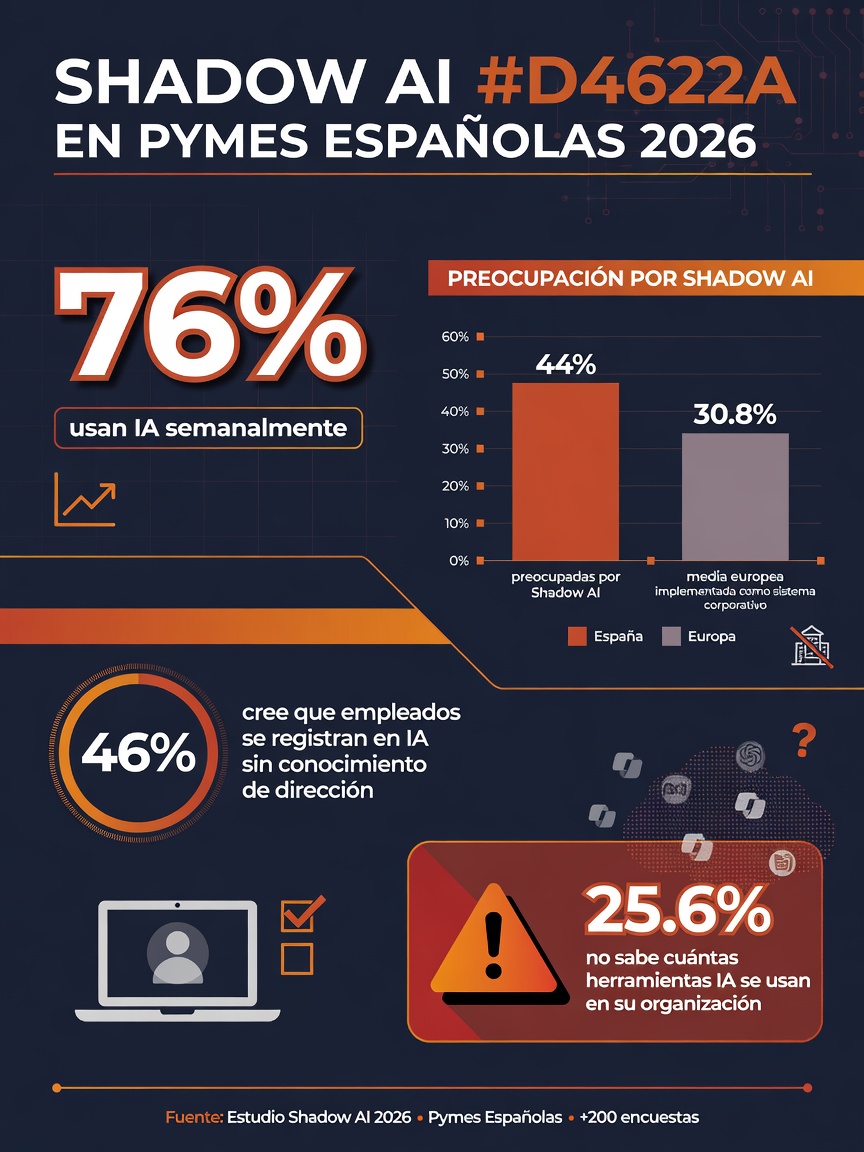
Notice this number: 25.6% of Spanish IT leaders admit they don't know how many AI platforms are being used in their organization. If you can't see it, you can't protect it. If you can't protect it, you're exposed.
Why banning AI is the worst move you can make
Some companies' first move is to block ChatGPT on the network, ban AI use, and threaten discipline. Big mistake.
A total ban backfires two ways. First, employees who used AI for harmless tasks (summarizing notes, translating, prepping meetings) lose a productivity tool. Second, anyone who relies on it for speed—your top sales rep, designer, marketing lead—just uses it more secretly.
We saw this with shadow IT in SMBs: companies that banned Gmail ended up with employees using personal email on corporate phones, just as exposed but with zero visibility or control.
The fix isn't to ban—it's to offer something better. A corporate AI tool where data never leaves your control, with the same power as free ChatGPT but with legal guarantees, audit trails, and centralized management. Then your employee has no reason to go rogue because the official channel is just as easy and actually safe.
90-day plan to close the gap (without a full IT team)
If you run a 10–50 person SMB and think shadow AI might be an issue: spoiler alert—it almost certainly is. Here's what specialists recommend. No enterprise budget needed, no dedicated IT department required.
Weeks 1–3: map without blame
Before you change anything, understand what's happening. Talk to teams: what AI tools do you use, what automations are you building on your own, have you wired anything to forms, CRMs, or databases? It's not an interrogation—it's an inventory. The goal: know what exists so you can decide what to protect, what to regularize, and what to leave alone.
More than 25% of companies don't even know how many AI tools are active inside. If that's you, step one is opening your eyes.
Weeks 4–6: minimal governance framework
You don't need a 40-page handbook. Three things suffice to start:
- Approved tool list: which tools are okay for what, and what data types they can handle (public, internal, confidential)
- Golden rule on data: what information never goes into an external tool (customer personal data, pricing strategy, confidential terms)
- Proposal channel: somewhere any employee can request a new tool or propose an automation, with a response within a week
That proposal channel is critical. If the only option is asking permission and waiting months, people improvise. If there's a controlled space to experiment, you spot real improvements and prevent shadow growth.
Weeks 7–9: the corporate alternative
Once you know what the team needs, give them the tool to do it safely. Three typical options:
| Option | Cost estimate | Best for | Technical level |
|---|---|---|---|
| ChatGPT Team | $25–30/user/month | Quick start, team under 15 people, non-critical data | Low |
| Private managed platform | €8,000–25,000 setup + €600–1,500/month | 20–50 person SMB, sensitive data, own branding | Medium (with partner) |
| Self-hosted open source | Free software + infrastructure cost | In-house technical team, strict compliance, data in-house | High |
For most SMBs reading this, the middle option—a private platform with your brand, data on European infrastructure, and a partner to set it up—balances cost, safety, and speed best. It deploys in 4–6 weeks and covers both daily generative AI and internal process automation.
Weeks 10–12: train and measure
Deploying the tool is half the battle. The other half is getting the team to use it and knowing when. Run 4–6 hours of internal training per role: basics for everyone, advanced for departmental champions. One metric matters at the end of quarter three: 70% of the team uses it weekly. Without that, you've just paid for an unused license.
Spain leads Europe in concern (and exposure)
Back to the Sharp data: 44% of Spanish IT leaders think shadow AI is a risk. The European average is 30.8%. We're the most worried country in the study—ahead of Germany, France, even Italy.
It's not random. Spain has high adoption of digital tools among workers—we're early adopters of apps and online services—but an economic structure where 99% of firms are SMBs, with lean internal IT and far fewer formal policies than enterprise corporations.
The 48% who say they need clearer guidance on adopting and using AI safely—five points above the European average—shows this isn't fundamentally a technical problem. It's a support problem. SMBs want to do this right. They need someone to show them how.
Frequently asked questions
What is shadow AI?
Shadow AI is employee use of AI tools without approval, oversight, or a clear policy from the company.
Should an SMB ban AI tools?
No. A ban often drives use underground. An approved tool list, data rules, and a simple request process provide better control.
How can a small business reduce shadow AI risk?
Inventory current tools, classify sensitive data, approve safer alternatives, document automations, and train staff on escalation rules.
How much AI is running inside your company without your knowledge?
BigLobster helps SMBs move from chaos—scattered tools, loose practices—to a proper corporate AI system with secure data, traceable processes, and a trained team. No vendor lock-in, no long contracts, your own branding if you want it.
Audit your shadow AI free →