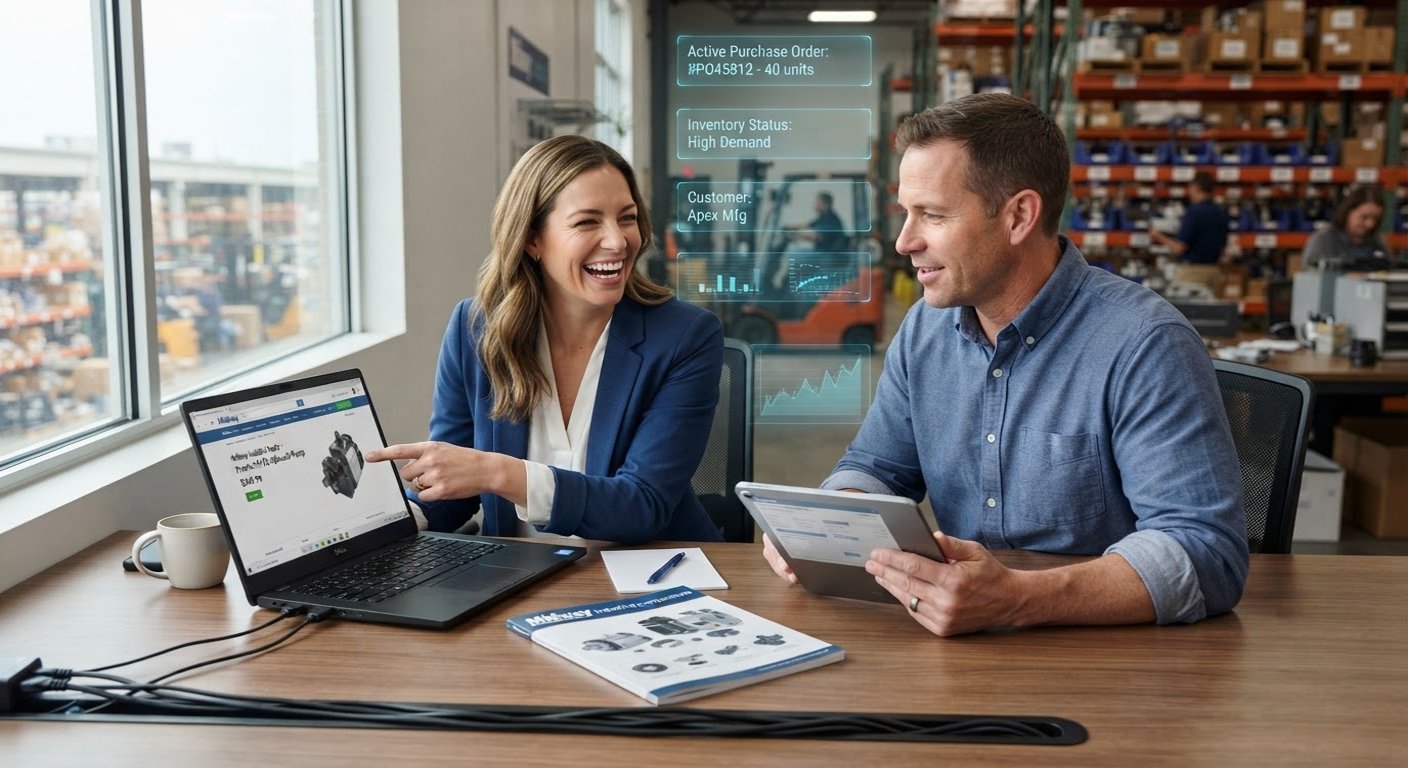
The market isn't that they don't buy online. It's that almost no one lets them
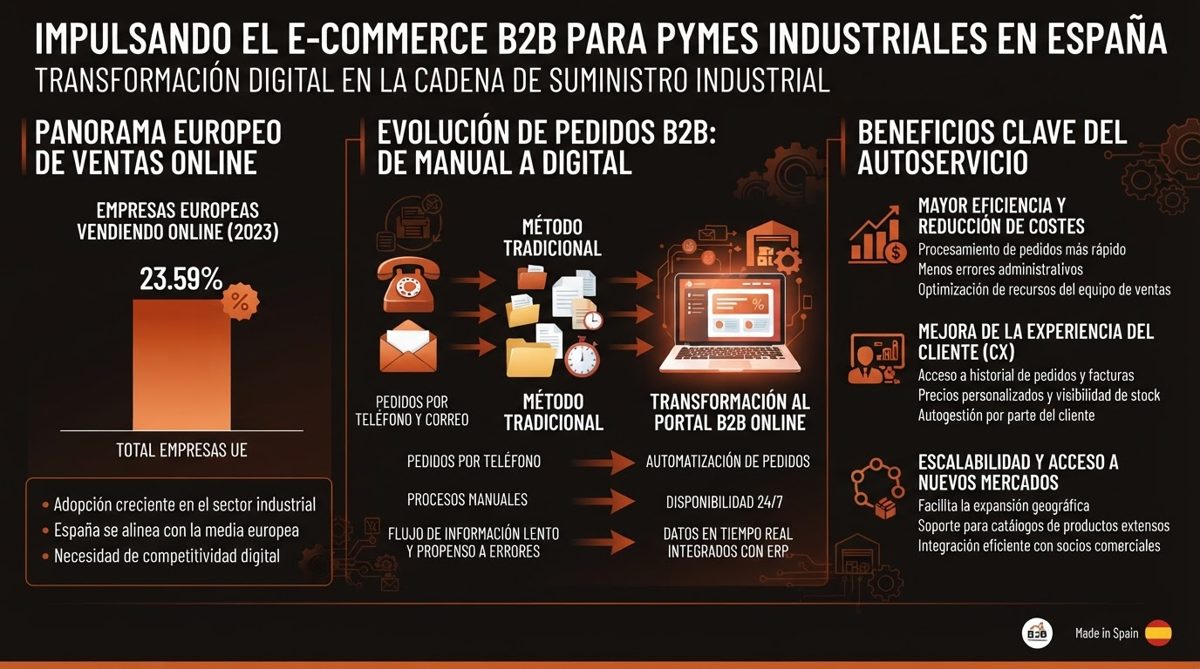
Let's start with the fact that breaks the "my sector is pure B2B, this doesn't apply" myth. According to Eurostat, only 23.59% of EU companies had online sales in 2024. And in manufacturing, dependence on traditional channels is even higher.
That means two things. First: there's huge white space—your competitors aren't there either. Second, more importantly: it's not that customers don't want to buy online. It's that because nobody in your sector gives them a decent portal to do it, they keep calling and emailing like it's 1998.
Don't take this as opinion. McKinsey measured it: B2B buyers are comfortable buying online even for orders over $500,000 (about €430,000). The barrier isn't order size or the buyer's tech skills. It's that the seller hasn't opened the channel.
There's a clear local example: Würth Spain closed 2025 with 30% growth in online business and €52 million in digital channel revenue. They're not a tech startup. They're a classic distributor of fasteners and installation solutions who opened an online store for professional customers. And they kept growing in 2026.
What a real B2B industrial ecommerce is (and isn't)
Here's the mistake that sinks most projects. A B2B ecommerce is not a consumer store with more products. If you set up basic WooCommerce with public prices and hope your longtime customers will use it, you'll be the only visitor.
This is what makes a B2B portal that actually gets used:
Pricing and terms per customer
Customer A pays one price, customer B pays another, and wholesaler C has net-60 payment terms. This should work automatically, without someone calling a salesperson asking for a discount that isn't published. It's the first thing they ask for and the hardest to get right.
Technical search, not clothing-store search
Industrial buyers search by technical reference, certification, standard, or compatibility with their equipment. If your search doesn't understand "gasket 25x32 DIN" or filter by applicable manufacturer, the professional buyer leaves in 20 seconds and calls sales again.
Recurring orders you repeat with one click
B2B buyers are creatures of habit: they order nearly the same thing, in similar quantities. If they can save their list and reorder with two taps, they're never leaving.
Integration with your ERP—non-negotiable
Your catalog, inventory, and pricing live in your ERP or management system. If the ecommerce doesn't integrate, you'll have someone manually updating prices twice a week and inventory will get out of sync. This stops being viable faster than you think.
In short: the B2B portal handles the mechanical part of the sales process (orders, stock, pricing) and reserves your salesperson for real value: technical expertise, urgent requests, and trust-building.
Platforms and real costs in 2026
Let's get to what matters: cost and platform choice. I've put it in a table for easy comparison. One heads-up: these 2026 prices include ERP integration, which is where costs vary most.
| Option | Setup cost | Monthly cost | Best for |
|---|---|---|---|
| WooCommerce + B2B plugins | €1,500-4,000 | €50-150 | Small catalogs, cheap start, teams already using WordPress |
| Shopify B2B | €1,000-3,000 | €60-400 | SMBs seeking speed and no technical overhead |
| PrestaShop with B2B modules | €2,000-5,000 | €80-200 | Distributors with medium catalogs who want shop control |
| Specialized B2B platform | €8,000-25,000 | €300-800 | Manufacturers with complex technical catalogs and deep ERP integration |
Here's my straight advice: don't choose a platform. Choose integration. 90% of a B2B ecommerce's success comes from good ERP sync and your team actually using it. The tool itself—WooCommerce, Shopify, PrestaShop, custom code—matters far less than who configures it and what process they're serving.
If you work with a complex technical catalog and many SKUs, don't jump at a consumer store with a plugin. Get a realistic budget for integrating it with your management system before choosing anything. That's where time and money disappear.
ROI isn't the challenge. Adoption is
Every B2B project fails for the same reason, and it's usually not cost. It's adoption: you build the store, your sales team ignores it because they prefer "real selling on the phone," and customers never find out they can order online. The portal dies in six months.
This is the piece nobody talks about, and it matters most: the customer isn't who needs converting—your own team is. If your salespeople don't trust the system, they won't pitch it to customers, and without that push the online orders won't come.
"The platform doesn't fail. The team fails when they stop selling over the phone and don't encourage customers to order online. Change the culture first, and the portal gets a real shot."
BigLobster Product TeamThat's why your launch plan should include, alongside the technology: a pilot with your best customers, commission incentives for salespeople on online orders, and a clear fast-track for urgent requests. The portal doesn't kill phone support. Urgent requests stay on the phone, and everything else goes digital.
The 5 mistakes that sink a B2B ecommerce
I've seen enough failed projects to know where they break. These are the recurring failures and how to avoid them.
Mistake 1: Build a consumer store with public pricing
Publishing prices for everyone destroys B2B. Your customers don't want competitors seeing their rates. Fix: the portal needs customer-specific pricing from day one, even if it's basic at first.
Mistake 2: Ignore ERP integration
When inventory, pricing, and orders don't flow with your ERP, the store becomes a second set of books you update manually. Fix: budget integration before you pick a platform. Don't start without it.
Mistake 3: Don't think about how customers will search
A search that doesn't understand technical specs or certifications scares off professional buyers. Fix: invest time in clean product specs and useful filters before you launch.
Mistake 4: Launch without your team on board
Without training and convincing your salespeople, the channel is dead on arrival. Fix: involve them in design and pay commissions on online orders from day one.
Mistake 5: Want your entire catalog perfect before launch
Waiting to load 10,000 perfect product listings delays launch by months. Fix: launch with 20% of your catalog—the most-ordered items—and keep adding the rest.
How it fits with your warehouse and CRM
B2B ecommerce doesn't stand alone. If you're already digitalizing, you probably have a warehouse management system and a CRM to track your customers. The B2B portal connects to both: the WMS feeds live inventory online and the CRM stores order history and each customer's terms.
Good news: if you already have an ERP that centralizes orders and stock, B2B ecommerce is the missing piece that makes that investment pay back more than it cost. It's literally putting your existing data to work.
And if you plan to go international, a B2B portal with per-customer pricing and multi-currency support is your launch pad. Digital channels don't see borders, and your technical catalog works as well in Ourense as in Lyon. How to take that step with an online store: cross-border ecommerce for Spanish SMBs.
Frequently asked questions
Isn't it risky to go online when I've sold by phone for years?
You don't lose anything: phone and salespeople stay for urgent requests and technical questions. You're giving routine orders a self-service channel. Your customer saves time and your team stops manually typing up orders. It's adding, not replacing.
How much does B2B ecommerce cost for an industrial SMB in 2026?
With a platform like Shopify B2B or WooCommerce with plugins, a solid project with ERP integration runs €3,000-8,000 setup and €100-400/month. If your catalog is highly technical and needs custom development with a specialized platform, initial investment can reach €8,000-25,000. ERP integration is the line item that varies most—don't cut corners there.
Will my longtime customers use it or keep calling?
At first they'll keep calling—that's normal. Start with your most-repeat customers, load their pricing and terms, and show them how fast a routine order takes. Habits form when they realize it saves time. Don't expect it to happen overnight in month one.
What if I don't have an ERP? Can I still build the ecommerce?
You can, but I don't recommend it. Without a central system managing stock and orders, the ecommerce relies on manual updates and errors—you'll end up hating it. Getting a simple ERP in place first before launching the digital channel is the smarter move for a manufacturer or distributor.
Ready to sell online to your industrial customers?
We build a B2B ecommerce that your team and customers actually use: platform, ERP integration, and adoption strategy. Fixed pricing, real timelines, no technical smoke.
Talk to BigLobster →