What is a digital twin (and why it should matter to you)
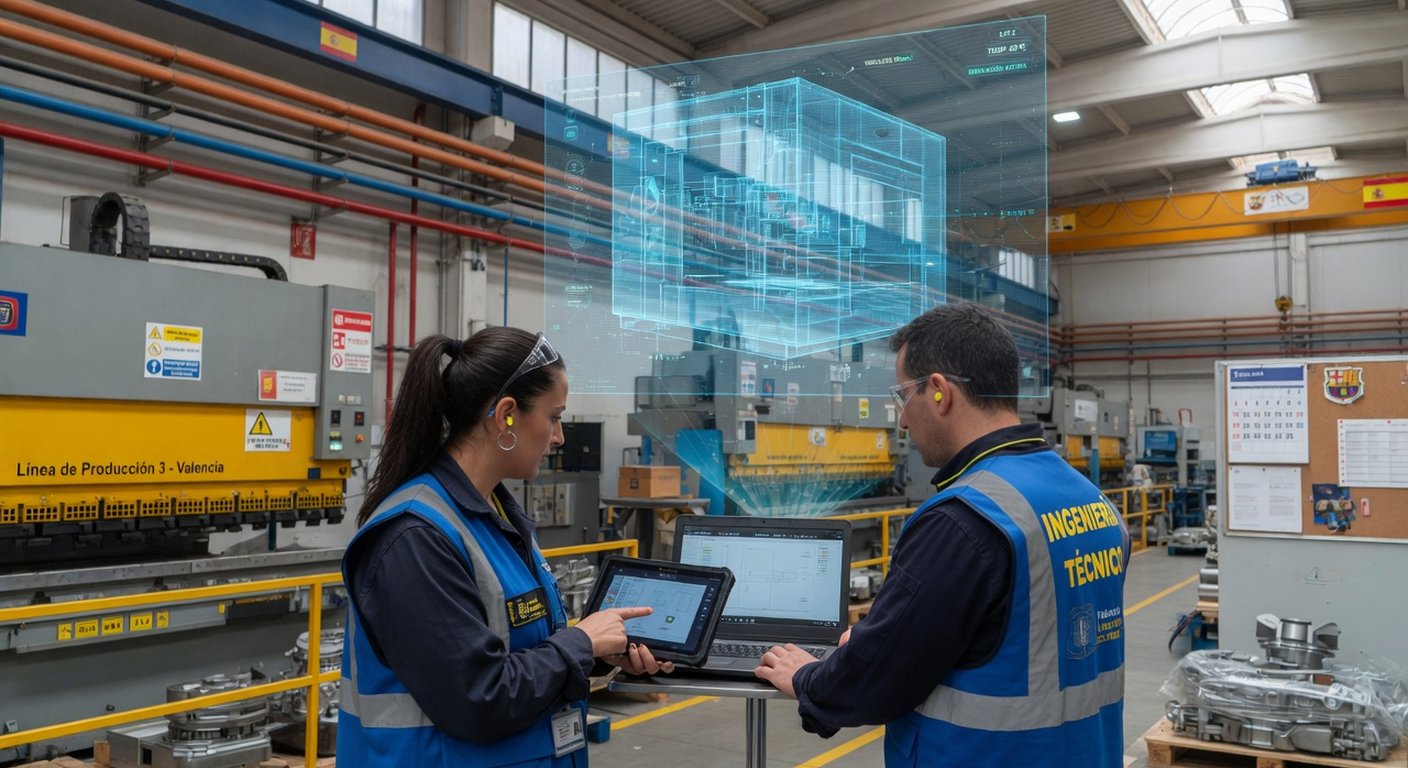
Let me start simple, because it sounds like science fiction and it's not. A digital twin is a virtual copy of something physical: a machine, a production line, or an entire process. The difference from a drawing or a static simulation is that it updates with real data. What happens on your floor shows up in the model, and what you test in the model tells you what will happen in reality.
Picture a real example any workshop in industrial Galicia gets instantly. You have an oven, a press, or a packaging line. The twin receives temperature, power draw, cycles, and vibration live. When something's about to go wrong, you see it on the screen before the machine stops. That's not magic — it's having the data where before you only had gut feeling.
What changed recently is the entry price. Five years ago, this meant sensors everywhere, your own server, and an engineering team to make it work. Today you have cheap sensors, cloud infrastructure, and platforms you don't need a PhD to use. That's why a 30- or 80-person industrial firm can actually consider it now.
Why 2026 and not five years from now
I'm not going to sell you on "the future is here." The real reason is sharper: the cost to get started dropped hard, and the risk of doing nothing climbed.
Three things converge in 2026. First, the Internet of Things (IoT): putting sensors on a machine costs a fraction of what it did. Second, the cloud: you don't need a server in the basement to process data anymore. Third, no-code tools: you can wire up sensors, visualize them, and set alerts without writing a line of code. That kills the "we have no IT department" excuse.
And this touches the Galician industrial sector directly: with NIS2 regulations and pressure for traceability, having your process data properly collected stops being a luxury and starts being a business requirement. Digital twins ride on the same wave.
The three use cases that actually deliver ROI
Not every use case is worth the investment for an SMB. I've seen beautiful proposals that don't save a single euro. These three make measurable sense:
Predictive maintenance
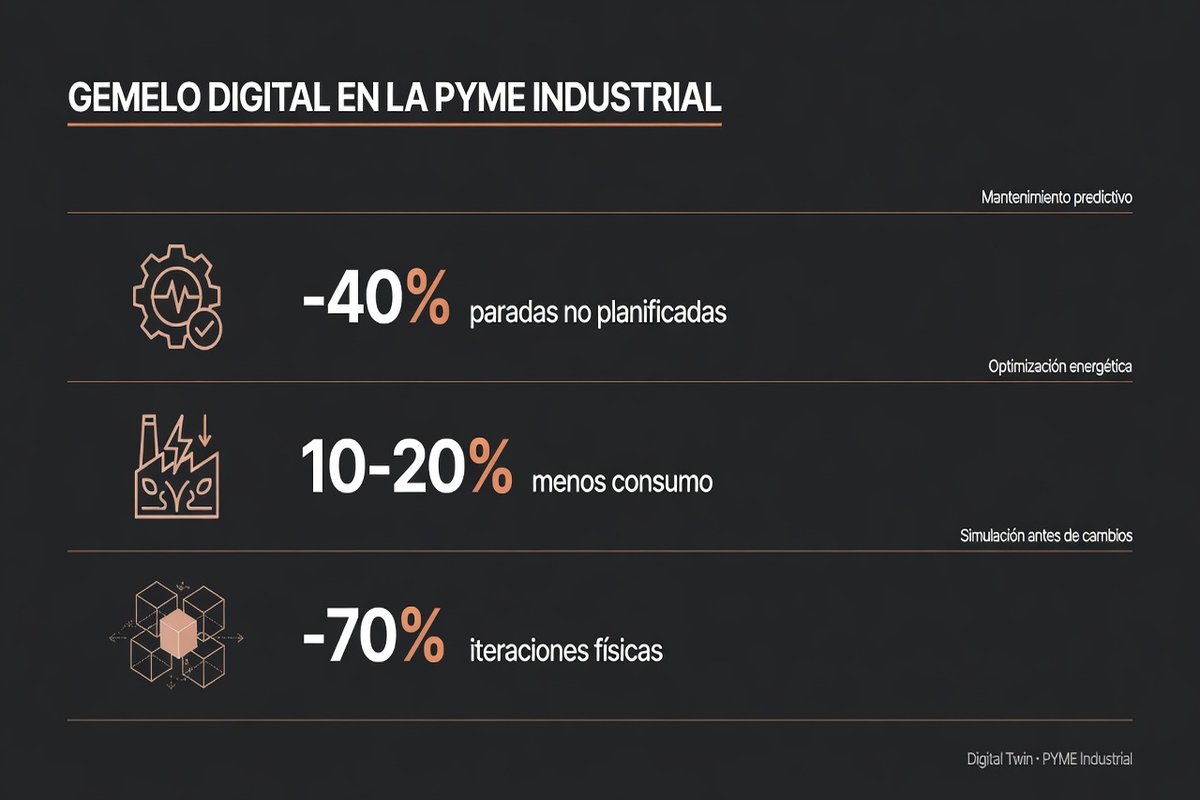
The clearest win. Instead of replacing a component "just in case" every X months, the model alerts you when the part approaches failure. You shift from fixing breakdowns to preventing them. Bureau Veritas puts unplanned downtime reduction at around 40%. If an hour of downtime costs you €200, you know where the savings come from. We cover this in depth in our predictive maintenance article.
Energy efficiency
The twin monitors power draw in real time and catches weird spikes that go unnoticed for months in a conventional plant. Bureau Veritas data points to 10–20% lower consumption just from seeing where energy leaks out. For an SMB with a fat power bill, that pays for the project.
Simulate before you touch the machine
You want to change a process parameter, a tool, or the line layout. Normally you test it in live production and hope. Now you test it in the model: you spot the bottleneck before it exists. Every physical iteration you avoid is time and material saved. In thermal processes (ovens, brazing), validation savings are significant.
What you need first: the data
Here's the part nobody mentions in the sales demo. A digital twin doesn't float in thin air — it runs on data. Without reliable data, you don't get a useful model.
The first step isn't buying a digital twin. It's having your process data. That means instrumenting the basics (your critical machine, not your entire plant), storing history, and making that information accessible. It's prep work, yes, but it already improves your process: you stop making decisions based on feel.
If your ERP or production system lives in the cloud, you're ready to go faster. That's why migrating your industrial SMB to the cloud is often the logical step first, not a buzzword.
What it costs and what ROI to expect
It depends on scope, like everything. But drop the fear — we're not talking millions.
A modular project starting with one critical machine (sensors + cloud platform + visualization) can launch for just a few thousand euros. The beauty is it scales gradually: you plug in the next line once the first one has proven it saves money. It's not all-or-nothing.
The practical rule: If the cost of your mistakes or downtime exceeds the cost of instrumenting the process, a digital twin makes sense. On critical or high-value processes, ROI comes fast.
McKinsey puts average ROI between 10% and 20% in less than two years for companies using it in real production. Bureau Veritas sets the payback window at 2–3 years, with savings that compound year after year. This isn't an expense you write off — it's an improvement that stacks.
"A digital twin is a means, not an end. If you build it because 'we have to go digital' and you don't have a real problem to solve, you'll flush the budget down the drain."
BigLobster industrial teamMistakes that blow your budget
I've seen these repeat. Avoid them:
- Starting with everything. You want the twin for the entire plant on day one. Wrong: one well-done critical machine beats 20 sensors nobody looks at.
- Not having good data. You buy the platform and the machine doesn't produce useful signals. The model goes blind. Get the data first, then the model.
- Thinking it replaces maintenance. It doesn't. It improves maintenance. If your preventive program works, the twin makes it sharper — it doesn't erase it.
- Forgetting cybersecurity. You plug sensors into the network and leave the door unlocked. A connected twin is an asset that needs protection (more on this below).
- Not measuring. If you don't compare before and after, you won't know if it works. Put metrics in place from day one.
How to start without bringing production to a halt
This sounds like a joke, but it's not: the real fear is pausing production to install it. The good news is you can do it with barely a touch to the machine.
Step 1. Pick a critical process with a clear pain point (a machine that breaks, an unexpected power spike).
Step 2. Add minimal sensors: temperature, power, cycles, vibration depending on your case.
Step 3. Feed the data to a visual platform (cloud, no-code) your team sees every day.
Step 4. Set one useful alert: "notify when X goes above Y." One well-placed alert delivers value immediately.
Step 5. Check results at three months. If it saves money, connect the next machine. If not, refine before scaling.
Machine vision for quality control fits perfectly here: the camera is just another sensor feeding your model.
Your twin and cybersecurity (don't skip this)
A digital twin connects sensors, cloud, and production networks. That makes it a cybersecurity concern. If your plant falls under NIS2, the data your twin collects is exactly what regulators want to see protected and documented.
Don't put it off. Multifactor authentication on access, a separate network for OT, and verified backups from day one. The twin helps you — it's not a back door.
Frequently asked questions
Can a small industrial firm actually have a digital twin?
Yes. Five years ago this was a big-company project; today there are modular solutions that let you start with one machine or line. The real prerequisite isn't company size — it's having process data (sensors, production history) to build the model on.
How much does a digital twin cost for an industrial SMB?
It depends on scope. Instrumenting a critical machine with sensors and a cloud platform can start at just a few thousand euros, and grow step by step. Typical payback, per Bureau Veritas and McKinsey, is 2–3 years with ongoing operational savings.
Does a digital twin replace preventive maintenance?
It improves it, not replaces it. You move from calendar-based maintenance to state-based maintenance. It detects when a component nears failure before production stops, and that's exactly what cuts unplanned downtime.
Do I need an IT department for this?
Not for a modular project. Today's platforms use visual interfaces and vendors usually provide setup support. What you do need is someone on the floor who knows which data matters and watches the alerts.
Where do I start if my company is in Galicia?
Same as anywhere: pick a critical machine, add minimal sensors, and connect to a cloud platform. If you already work with us on your plant's digitalization, the twin fits as one more piece of the same puzzle.
Want to know if a digital twin fits your plant?
Tell us which machine gives you the most trouble or what power consumption surprises you. We'll tell you if it makes sense and where to start — no hard sell on big-company-sized projects. We speak straight and in your language.
Let's talk no strings attached →