
The stat that changes everything: 79% of industrial companies plan the move
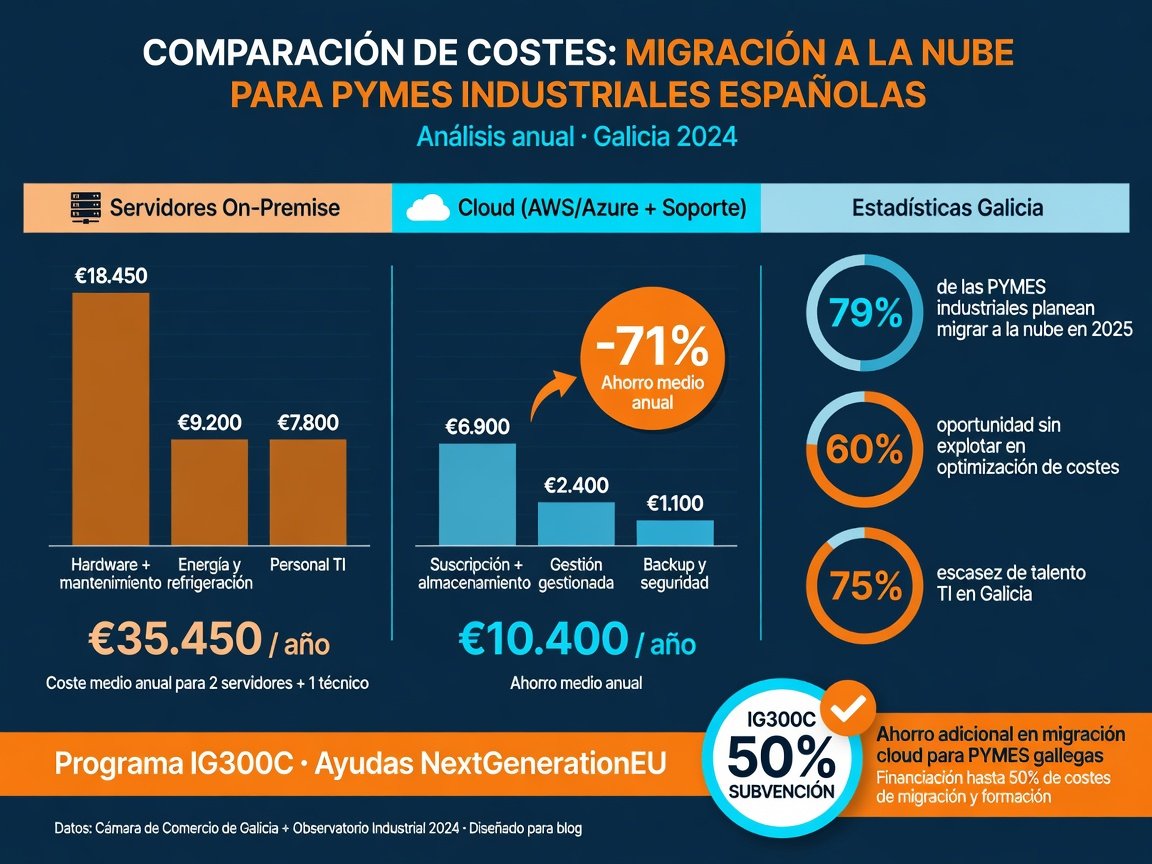
I'll start with data you probably haven't seen in your accountant's reports or industry news. The "Digital Future of European Medium-Sized Industrial Enterprises" study by Forterro, conducted with 1,250 business leaders across five countries, reveals something massive: 79% of Spanish industrial companies plan to adopt cloud or hybrid models in coming years.
This isn't a random survey stat. It's 79% of companies already thinking about how to leave local servers and paper behind. This happens in a country where, per the 2026 Cloud Nation Observatory by Aire, general cloud adoption in SMBs is 44% — below the European average of 53%.
So there's a huge gap between what companies want to do (79%) and what they've actually done (44%). That gap is exactly where you, as an industrial SMB, have a chance to get ahead of the competition.
What cloud is and why your factory should care
OK, let's cover the basics in case anyone still thinks "the cloud" is some abstract concept IT salespeople made up. The cloud simply means having your data, programs, and operating systems on servers you access via the internet, instead of having a computer in a back office acting as a server.
For an industrial SMB, this means your ERP, production management system, invoices, delivery notes, and even machine data can be in the cloud and accessible from anywhere: the office, the factory floor, your home, or your phone while visiting a customer.
Today, 35% of Spanish industrial companies already use cloud-based ERP and 40% operate hybrid models. But 60% admit cloud remains an opportunity not yet seized. And 57% say not fully extracting cloud value prevents them from leveraging AI. This last point is key: if you want to use AI in your factory (predictive maintenance, quality control, production optimization), you need your data in the cloud. There's no other way.
Why industrial SMBs hold back (and it's not just money)
The Forterro study is clear on the barriers. And no, cost isn't the only thing. Here's what slows companies down:
| Barrier | % mentioning it | What it really means |
|---|---|---|
| Budget constraints | 44% | It's not that it's expensive; they don't know the real cost or how to finance it |
| Weak management buy-in | 43% | The owner or CEO doesn't see it as priority until something breaks |
| Internal resistance | 41% | Production, finance, and logistics teams resist the change |
| IT talent shortage | 75% | In Galicia, 3 of 4 companies struggle to hire skilled technical staff (Osimga 2026) |
Look at the last stat. 75% of Galician companies report difficulty hiring qualified tech profiles, per Osimga research. And it's not a new problem — it's structural. Galicia has tech talent, but not enough for demand.
This means waiting for an in-house IT person to migrate is like waiting for rain to buy an umbrella. It won't happen. The answer is managed services: external providers who do the migration, configure it, and maintain it for you.
"The real challenge as a country is making sure SMBs and industrial sectors don't fall behind. We need to democratize cloud access with intuitive solutions and secure data in European territory."
Santi Magazù, Director General of Cloud and Cyber, Aire (Cloud Nation 2026)What cloud migration really costs
I won't give you numbers from a consultant's brochure. I'll give you real market numbers based on data we work with at BigLobster and what cloud vendors actually charge in Spain.
First thing: cloud isn't more expensive than local servers. It's different. A local server has high upfront cost (hardware) and recurring maintenance, electricity, cooling, and most importantly, the time you or your staff lose when something fails. Cloud has a predictable monthly cost with no surprises.
| Item | Local server (annual cost) | Cloud (annual cost) |
|---|---|---|
| Hardware | €2,000–5,000 (every 4–5 years) | €0 |
| Maintenance/support | €1,200–3,600 | €2,400–7,200 (included in subscription) |
| Electricity + cooling | €600–1,200 | €0 |
| Backups | €300–600 | Included |
| Time spent by management on incidents | Hard to calculate, but it's the highest cost | €0 (vendor handles it) |
| Total estimate | €4,000–10,000/year | €2,400–7,200/year |
And the migration itself? A basic migration for a 10–20 person industrial SMB (local server → cloud, with ERP, shared files, email) costs €3,000–8,000 including consulting, data migration, and initial training. If you have more complex systems (ERP with integrations, connected machinery, etc.), it can go up to €10,000–15,000.
But here's what people don't tell you: IGAPE grants cover up to 50% of these projects under the IG300C digital transformation program. So your €6,000 migration drops to €3,000. And when you factor in the annual savings from not maintaining local servers, you're already ahead in year one.
Steps to migrate your industrial SMB to cloud without stress
This isn't a weekend project. But it's also not a six-month process that paralyzes your factory. A well-planned migration follows these steps:
1. Diagnose what you have
Before moving anything, understand what you have: what programs you use, what data is critical, who accesses what, how your machinery connects (if at all). This step usually takes 1–2 weeks and an external consultant should do it. Don't try it yourself unless you're technical — you'll miss things.
2. Choose the right cloud model
Not everything has to go to public cloud. There are three options:
- Public cloud (AWS, Azure, Google Cloud): everything on third-party servers. Most common for SMBs.
- Private cloud: servers dedicated only to your company. Pricier, but useful if you have specific security or compliance needs.
- Hybrid model: mix of both. Most sensible for many industrial SMBs: keep on-premises what needs low latency (machine control) and move administrative stuff to the cloud (ERP, invoicing, email).
40% of Spanish industrial companies already run hybrid models. It's the option with least risk and most flexibility.
3. Plan migration in phases
Don't shut everything down Friday and hope it works Monday. Migrate in phases:
- Phase 1: email and calendars (if not already in cloud).
- Phase 2: shared files and documentation.
- Phase 3: ERP and management systems (the trickiest part).
- Phase 4: production systems if applicable (machine connections, sensors, etc.).
Each phase takes 1–4 weeks. Total time: 2–4 months for a complete migration without stress.
4. Train your team (most overlooked, highest ROI)
A cloud infrastructure is only as good as your people using it. If your production team still saves delivery notes in Excel on the desktop, good infrastructure won't help. Training is the most undervalued and highest-return step. Invest at least a couple of sessions with your team so they understand how the new system works and why it's better.
5. Security and backups from day one
When migrating, security isn't optional. Ensure your provider includes: two-factor authentication, data encryption, daily automatic backups, and a disaster recovery plan. And watch out for NIS2, the EU cybersecurity directive now in force in 2026: if you work with large companies or government agencies, they may demand a certain cybersecurity level to keep doing business with you.
Cloud and AI: the pair your factory needs
This is what turns cloud migration from "IT spending" into a competitive advantage. Without data in the cloud, you can't use AI in your factory. Period.
57% of Spanish industrial companies acknowledge that limited cloud adoption prevents them from using AI and generative AI. And 48% put AI as their top technology priority (the highest in Europe, per Forterro).
With data in the cloud, you can apply AI for:
- Predictive maintenance: analyze sensor data from your machines to know when they'll fail before they do. We covered this in our article on predictive maintenance.
- Visual quality control: use machine vision to catch defects during production. We covered this in machine vision for quality control.
- Production optimization: adjust parameters in real-time based on historical data.
- Process automation: connect your ERP, invoicing system, and warehouse so everything flows without manual intervention.
If your factory isn't in the cloud, you can't do any of this. Your competitors that are, can.
"Cloud is the key to unlocking innovation and the potential of advanced technology. For the mid-sized industrial company, cloud is shifting from secondary to fundamental."
Thomas Knorr, Vice President, ForterroGalician grants: IGAPE pays up to 50%
If your industrial SMB has a work location in Galicia, you're in luck. IGAPE has opened the IG300C grant program for digital transformation of SMBs, co-funded by the Galicia Feder 2021-2027 program. And yes, cloud migration qualifies as a fundable project.
The grants cover:
- Process digitalization and automation (like deploying ERP in the cloud).
- Integrated management systems.
- Digital interfaces and channels with customers and suppliers.
- Improved logistics function with digital solutions.
- Cybersecurity for digital operations.
- ESG initiatives (environmental, social, governance) backed by data.
We wrote a complete guide on digital transformation grants in Galicia 2026 explaining how to apply step-by-step. What matters now: the 2026 call opened June 11, 2026, with application deadline July 10, 2026. If you're reading after that, don't worry — there are usually annual calls.
What if you don't migrate to cloud?
I'll be straight: nothing catastrophic happens tomorrow. You can keep running on a local server for years. But the question isn't whether it will stop working — it's how much not migrating will cost you when your competitors have.
Think about this:
- If your local server fails, how many production days do you lose until it's repaired or replaced?
- If a large customer asks you to invoice through an online platform and you can't, who gets that order?
- If your competition uses AI to optimize production routes and you don't, who can cut prices?
- If you don't meet NIS2 requirements and lose a major enterprise contract, what's that customer worth?
Not migrating isn't free. It's a decision with an opportunity cost. What we're seeing in 2026 is that the gap between companies that have migrated and those that haven't is widening every quarter.
Frequently asked questions about cloud migration for industrial SMBs
How much does cloud migration cost for an industrial SMB?
A basic migration (local server → cloud, with ERP, files, email) for a 10–20 person SMB costs €3,000–8,000 including consulting, migration, and training. Monthly operational cost is typically €200–600, vs €300–1,000 to maintain a local server with everything included.
Do I need an in-house IT person to migrate to cloud?
No. Managed service providers (MSPs) and digitalization agencies handle everything: diagnosis, migration, configuration, and ongoing support. In Galicia, 75% of companies struggle to find IT profiles, so the market is already geared to outsourced services for SMBs.
What security risk does cloud pose to my factory?
Cloud is more secure than a local server if you pick the right provider. Major providers (AWS, Azure, Google Cloud) meet ISO 27001, ENS, and GDPR. The real risk is misconfiguring access — something a managed provider handles by default.
Are there grants for cloud migration in Galicia?
Yes. IGAPE's IG300C call covers up to 50% of digitalization projects including cloud migration, process automation, cybersecurity, and management systems. Learn more in our guide to digital transformation grants in Galicia.
How long does migration take?
A complete phased migration typically takes 2–4 months. It's not a weekend project, but it also doesn't paralyze production because you migrate in phases: email first, then files, then ERP, then production systems if applicable.
Can I stick with a hybrid model?
Yes, and it's actually recommended for many industrial SMBs. 40% of Spanish industrial companies already run hybrid: keep on-premises what needs low latency (machine control) and move administrative stuff to the cloud (ERP, invoicing, email, files).
Want to migrate your industrial SMB to cloud hassle-free?
We help you through the whole process: diagnosis, planning, migration, and support. And we help you apply for IGAPE grants to make it up to 50% cheaper.
Request free diagnosis →