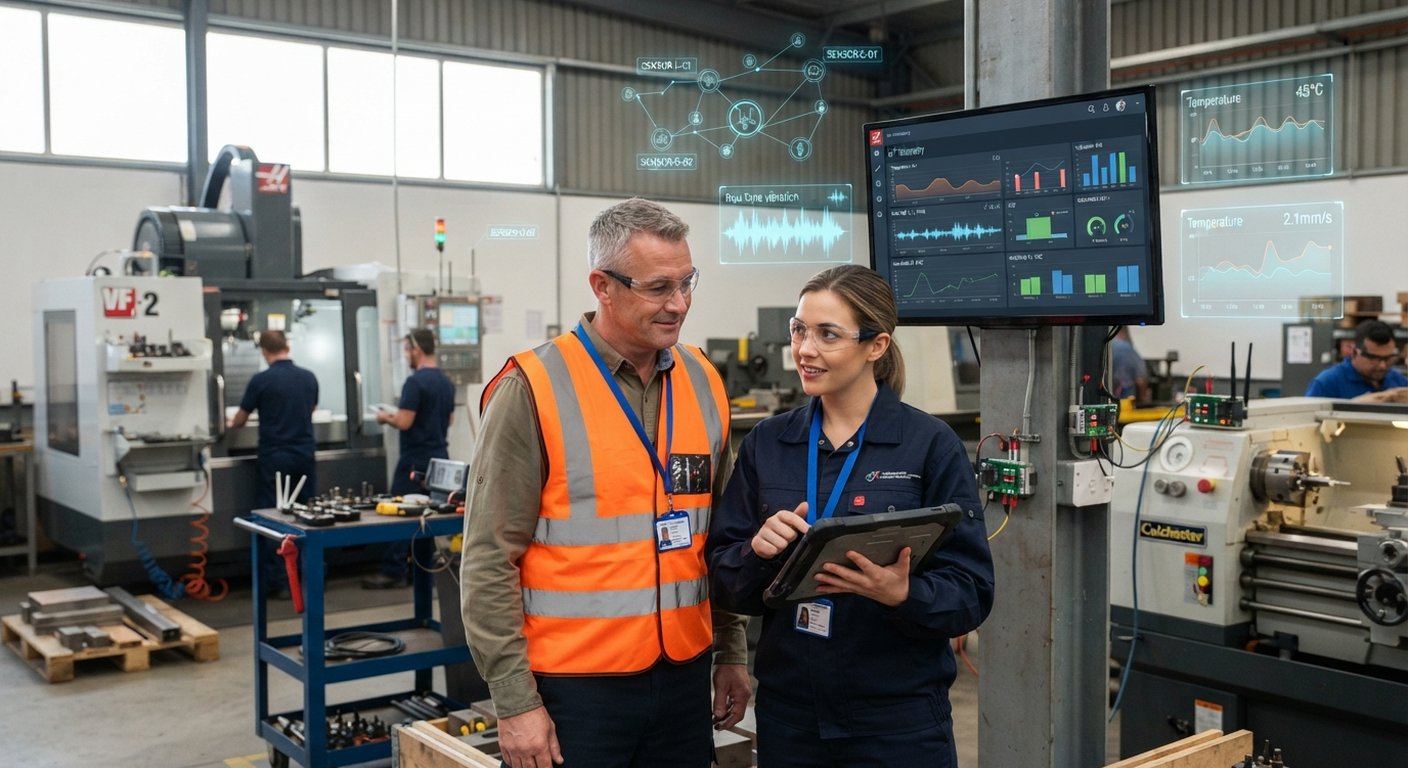
Why it makes sense now (and didn't before)
If you've spent years in manufacturing, you've seen "digitalization" initiatives that died in a tool nobody used. So have I. The difference in 2026 is cost and effort.
In 2020, a quality accelerometer cost about €200 per chip. That same component today costs less than €8. A complete vibration sensor—with wireless radio, battery, and housing—sells for under €50 on the open market. Hardware isn't the bottleneck anymore. In the age of full automation, the expensive part is wiring and integration, and that's exactly what low-power wireless networks have eliminated.
In Spain, over 65% of manufacturing companies already use some form of IoT to better understand what happens on their plant floor, according to Nexdigm's market analysis of Spanish industry. The Spanish industrial sensor market sits at €1.8–2.1 billion in 2026 and grows 5.5%–6.5% annually. You're not arriving late—you're arriving exactly when the price has dropped enough to justify the investment in an SMB.
What you can realistically measure
You don't need to measure everything. Most industrial SMBs start by monitoring four things that actually move the needle:
- Vibration. The highest-ROI signal. Bearing wear, shaft misalignment, and imbalance show up in vibration weeks before the machine fails. A wireless vibration sensor costs €47–€89.
- Temperature. A motor that starts running hot is a motor that's failing. Wireless temperature probes cost under €30.
- Power draw. Current clamps measure how much current each machine pulls. A clamp with wireless connectivity runs about €65.
- Downtime. Even with simple presence or power-on sensors, knowing when and for how long each line stops is the first step to calculating real OEE.
Those four cover 90% of the value. Everything else (pressure, gases, water leaks, quality) is a later improvement, not a requirement to start.
How it all connects
This is the part that confuses everyone. We think "IoT" and imagine impossible protocols. Reality is simpler:
- Modbus is the industry standard; most machines already speak it. Cheap and reliable.
- MQTT is the modern protocol for sending data to the cloud—lightweight and designed for many sensors.
- LoRaWAN is the gem for almost-free wiring: one gateway covers a 4,500 m² warehouse and sensors run for years on a battery.
- LTE-M / NB-IoT use cellular networks, so you don't even need a gateway at plants without existing network infrastructure.
General rule that works: inside the plant, use Modbus or LoRaWAN; if you have dispersed machines or no network, go cellular. You don't need to implement this yourself. Just know what's being measured and what the budget proposal promises.
What it actually costs to set up
Hardware prices have plummeted, but don't stop at the sensor price and forget the complete system.
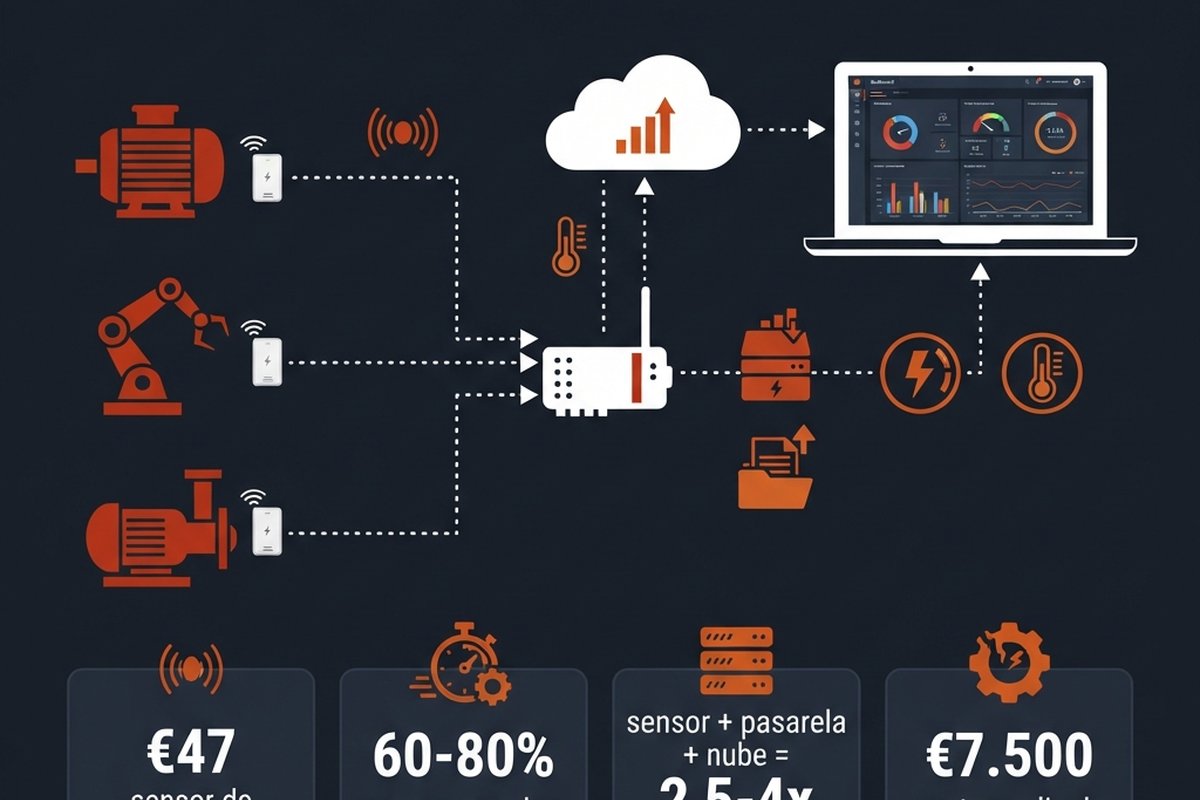
The trap most people fall into: asking for sensor price alone and then being shocked by the system bill. Think in four layers: the sensor (30–50% of cost), the gateway or radio (€400–3,500 depending on brand), connectivity (€5–15/year per sensor with LoRaWAN to €20–60 with cellular), and the cloud platform where you see the data (usually €3–50/month per device, though open-source options exist if you run your own server).
A real example: 20 sensors at €60 each (€1,200) plus gateway, connectivity, and cloud can run €3,200–4,800 in year one. The result is 2.5–4 times the hardware price alone. That's not someone ripping you off—it's that the system costs more than the box. Always ask for an itemized breakdown.
Does it actually prevent failures or is it hype?
Let me be straight: a vibration sensor isn't magic. But there's a stubborn fact. The average cost of an unexpected motor failure is around €7,500 when you add the part, line downtime, and shop hours. A 20-sensor network costs about €3,280 in hardware and installation. Translation: one breakdown you catch before the machine stops pays for the entire investment.
I'm not making this up. Data from real deployments in mid-sized plants shows the first prevented failure usually appears within the first 90 days, and vibration monitoring covers much of what a real maintenance team needs. You won't get lab-grade spectral analysis from a €47 sensor, but it's plenty to spot a degrading bearing.
One more thing: start with your 10–20 worst machines—the ones that fail most often or cost the most to stop. Don't try to instrument the entire fleet at once. The teams that do everything at once give up halfway through.
Steps to start this week
If you're convinced, here's how I'd approach it without getting stuck:
- Pick your pain points. The machines that fail most or cost the most to fix. 10 to 20 at most.
- Decide what to measure on them. Vibration almost always. Temperature and power as reinforcement.
- Choose connectivity based on your layout. LoRaWAN if machines are in one building, cellular if they're spread out.
- Review the dashboard before buying hardware. Have someone show you where the data appears and what alarms look like. No clear screen means no project.
- Get an itemized quote. Sensor, gateway, connectivity, and cloud separately. Compare the whole system, not just the sensor.
Starting small and doing it right always beats launching a massive rollout and abandoning it. Your first month's goal isn't to instrument the whole factory—it's to get one alert about a machine that was about to fail and have proof that this works.
Frequently asked questions
Isn't Industrial IoT only for big companies with huge budgets?
It was five years ago. Today hardware has fallen far enough that an industrial SMB can start with €3,000–5,000 in hardware and installation, versus €15,000–40,000 for a traditional proprietary system. The difference is choosing standard sensors and a simple dashboard, not the latest platform.
Do I need an IT person or an R&D team to set this up?
Not to start. With a LoRaWAN gateway and a pre-configured cloud dashboard, installation is physical: mount sensors on the machines and pair them. Advanced configuration (ERP integration, complex alarms) is where a consultant who's done it before can help. It's worth reading how to migrate systems to the cloud without failing before you start.
What if a machine is old and has no display?
Doesn't matter. The sensor mounts externally (magnetic or bracketed), measures vibration and temperature with no digital interface needed. That's exactly the point of Industrial IoT: you don't have to replace your machinery.
Is my machine data a security risk?
Possible if you connect sensors straight to the internet without controls. With a local LoRaWAN network and a segmented dashboard, risk is manageable. Like any connected system, review who has access and don't leave it open to the network. Any serious vendor has this solved.
Does predictive maintenance come built-in?
Sensors give you raw data: vibration, temperature, trends. Predictive maintenance is the layer that interprets those trends to alert you when something is degrading. With a good dashboard and configured alarms, you get much of the value without needing a sophisticated algorithm. To understand the jump, see what building real predictive maintenance for your SMB looks like.
How long until it's running?
A pilot with 10–20 sensors in one building sets up in days if connectivity is planned. The real pace comes down to pairing sensors and setting alarms, not the hardware. With dashboard tweaks, you should have reliable data and your first alerts in a couple of weeks.
Ready to see what's really happening in your plant?
We install sensor networks on your critical machines with a clear dashboard, alarms that warn before failure, and transparent pricing with no surprises. We start with 10–20 machines and grow as ROI proves itself.
Talk to BigLobster →